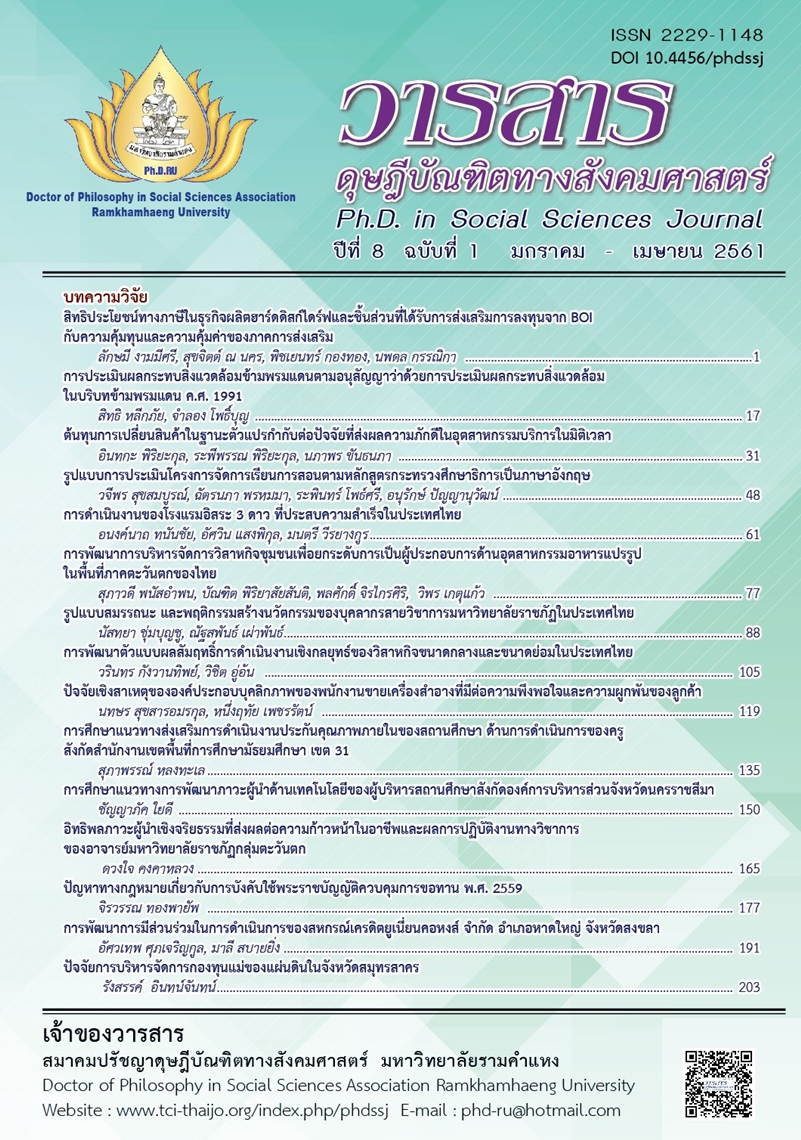
รูปแบบสมรรถนะ และพฤติกรรมสร้างนวัตกรรมของบุคลากรสายวิชาการมหาวิทยาลัยราชภัฏในประเทศไทย
Article Sidebar
Main Article Content
บทคัดย่อ
การวิจัยครั้งนี้เป็นการวิจัยเชิงปริมาณ มีจุดประสงค์เพื่อ (1) เพื่อศึกษาปัจจัยที่ส่งผลต่อสมรรถนะของบุคลากรสายวิชาการของมหาวิทยาลัยราชภัฏ และ (2) เพื่อศึกษาปัจจัยที่ส่งผลต่อพฤติกรรมการสร้างนวัตกรรมของบุคลากรสายวิชาการของมหาวิทยาลัยราชภัฏ ผู้วิจัยได้ทำการทบทวนแนวคิดและทฤษฎีที่เกี่ยวข้องพร้อมทั้งงานวิจัยที่เกี่ยวข้องเพื่อกำหนดตัวแปร องค์ประกอบ และยืนยันเส้นอิทธิพลก่อนที่จะตั้งสมมติฐาน และได้ทำการรวบรวมข้อมูลจากกลุ่มตัวอย่างจาก บุคลากรสายวิชาการ ของมหาวิทยาลัย ราชภัฏทั่วประเทศไทย 38 แห่ง จำนวน 420 คน ก่อนที่จะนำมาวิเคราะห์ด้วยวิธีการสมการโครงสร้าง (Structural Equation Model--SEM)
ผลการวิจัยพบว่า สมรรถนะของบุคลากรสายวิชาการด้านคุณลักษณะภาพรวมอยู่ในระดับมาก ( = 4.18, SD = 0.55) ในด้านปัจจัยการเปลี่ยนแปลงด้านการคำนึงถึงความเป็นปัจเจกบุคคลภาพรวม อยู่ในระดับมาก (
= 3.97, SD = 0.76) ส่วนปัจจัยวัฒนธรรมองค์กรด้านความสอดคล้องอยู่ในระดับมาก (
= 4.02, SD = 0.54) ด้านปัจจัยแรงจูงใจด้านสภาพแวดล้อมของสถานที่ทำงาน และปัจจัยพฤติกรรมการ สร้างนวัตกรรมด้านพฤติกรรมนำไปประยุกต์ในภาพรวมอยู่ในระดับมาก (
= 3.88, SD = 0.70;
=3.96, SD = 0.63) ตามลำดับ
Article Details
บทความวิชาการ บทความวิจัย และบทวิจารณ์หนังสือในวารสารดุษฎีบัณฑิตทางสังคมศาสตร์ เป็นความคิดเห็นของผู้เขียน มิใช่ของคณะผู้จัดทำ และมิใช่ความรับผิดชอบของสมาคมปรัชญาดุษฎีบัณฑิตทางสังคมศาสตร์ มหาวิทยาลัยรามคำแหง (กรณีการทำวิจัยในมนุษย์ ผู้วิจัยต้องผ่านการอบรมจริยธรรมการวิจัยในมนุษย์ และนำหลักฐานมาแสดง)
เอกสารอ้างอิง
Avolio, B. J., Bass, B. M., & Jung, D. I. (1999). Re-examining the components of transformational and Transactional leadership using the Multifactor Leadership. Journal of Occupational & Organizational Psychology, 72(4), 441-462.
De Jong, J. P., & Den Hartog, D.. (2008). Innovative work behavior: Measurement and validation. Zoetermeer, November 2008.
Denison, D. R., & Mishra, A. K. (1995). Toward a theory of organizational culture and effectiveness. Organization Science, 6(2), 204-223.
Dorner, W. (2012). Lifecycle of pressure gas cylinder Purchase, maintenance, refurbishment and disposal. Frankfurt: N. A.
Duangta, P. (2015). The teachers’ professional competence in the area of educational service area. Phitsanulok District 1. Veridian E-Journal, 8(3), 12-17. [In Thai]
Harrison. (2013). Aspects of a change in organization design. Malibu, CA: Pepperdine University, School of Business and Management .
Kanter, R. (1988). When a thousand flowers bloom: Structural, collective and social conditions for innovation in organizations. In B. M. Straw & L. L. Cummings (Eds.), Research in organizational behavior (pp.169-211). Greenwich, CT: JAI Press.
Koegel, L. K., Ashbaugh, Koegel, R. L., Detar, W. J., & Regester, A. (2013). Icreasing socialization in adults with asperger’s syndrome. Psychology in the Schools, 50(9), 899-909.
Marin-Garcia, F. (2014). Intra-rater and inter-rater consistency of pair wise comparison in evaluating the innovation competency for university students. Working Papers on Operations Management, 5(2), 24-46.
Moorhead, G., & Griffin, R. W. (1995). Organizational behaviou (4th ed.). Boston: Houghton Mifflin.
McClelland, D. C. (1973). Testing for competence rather than for “intelligence.” American Psychologist, 28(1), 1-14.
Parry K. W., & Proctor-Thomson, S. B. (2002). Perceived integrity of transformational leaders in organizational settings. Journal of Business Ethics, 35(2), 75-96.
Pedraza, R. O., & Diaz-Ricci, J. C. (2012). A survey of denitrifying Azospirillum brasilense in two contrasted conditions of the sugarcane cropping region of Tucuman, Argentina. Revista Agronomica del Noroeste Argentino, 32(1-2), 23-29.
Prieto, I. M., & Pe´rez-Santana, M. (2013). Building ambidexiterity: The role of human resource practices in the performance of firms from Spain. Human Resource Management, 51(2), 189-212.
Rajabhat University. (2004). Rajabhat University Act B.E. 2547. Bangkok: Author. [In Thai]
Ragland. (2013). Integrating strategic management practices and organization development with Biblical Principles in scripture to increase engagement in congregations. Ph.D. dissertation organization development, Benedictine University, Lisle, Illinois.
Schein, E. H. (2010). Organizational culture and leadership. San Francisco, CA: Jossey-Bass.
Schuh, S., & Zhang, H. (2013). The 2010 survey of consumer payment choice. Federal Reserve Bank of Boston Research Data Report, 13-2.
Spencer, L. M., & Spencer, S. M. (1993). Competence at work: Models for superior performance. New York: John Wiley & Sons.
Stacho, L. (2010). Prediction of human protein kinase substrate specificities. IEEE International Conference of Bioinformatics and Biomedicine (BIBM, 2010) IEEE Computer Society, pp.259-264.
Vanichbuncha, K. (2003). Using SPSS for Windows to analyze data (6th ed.). Bangkok: Chulalongkorn University Press.[In Thai]
Walters, C. J. (1978). Adaptive management of renewable resources. New York: Mc Graw-Hill.
Yingxin, Z., Yanqiu, L., & Xiangyang, W. (2013). Organizational unlearning and organizational relearning: A dynamic Process of knowledge management. Journal of Knowledge Management, 17(6), 902- 912.
Wiratchai, N. (1999). LISRELL Model: Statistical analysis for research (3rd ed.). Bangkok: Chulalongkorn University Press. [In Thai]
Wisawakulwanich, W., Yongsorn, C., & Skulkhu, J. (2016). A factor analysis of effective leadership for engineering students at Kasetsart University. Veridian E-Journal Humanities and Social Sciences and Art, 9(3), 65-82. [In Thai]
Zikmund, W. G. (2010). Business research methods (8 th ed.). New York: John Wiley & Sons.
