
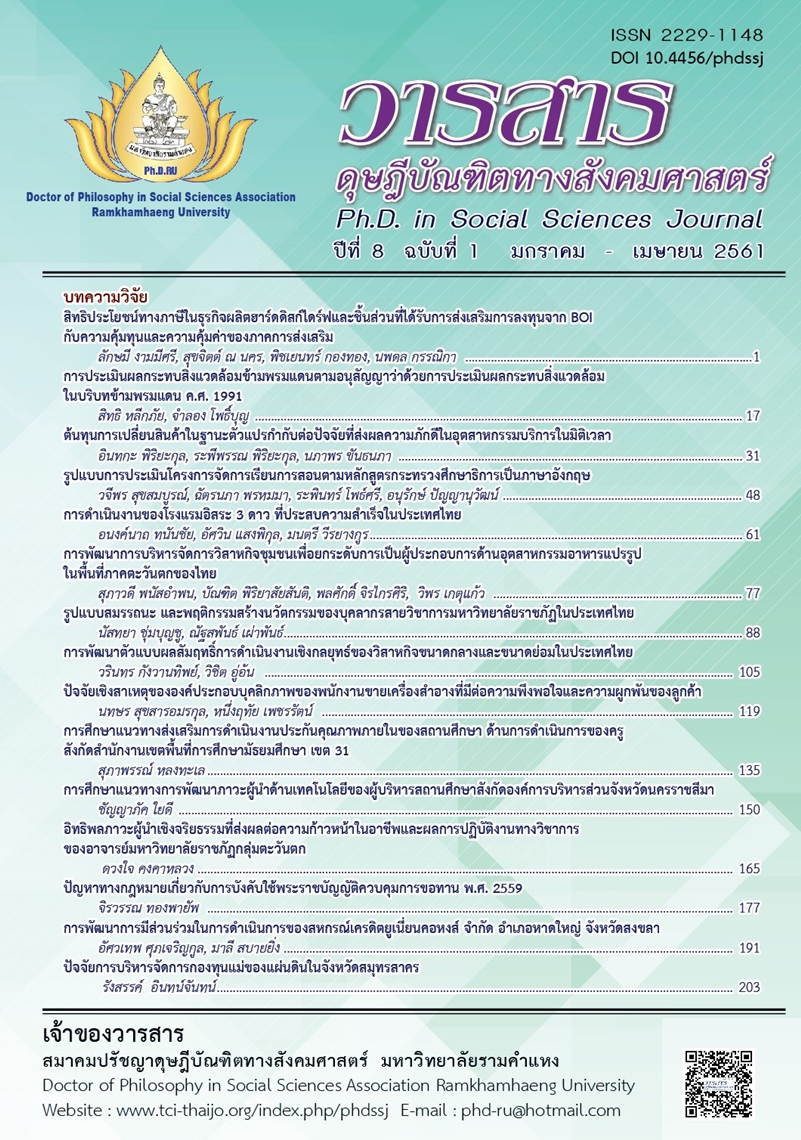
สิทธิประโยชน์ทางภาษีในธุรกิจผลิตฮาร์ดดิสก์ไดร์ฟและชิ้นส่วนที่ได้รับการส่งเสริมการลงทุนจาก BOI กับความคุ้มทุนและความคุ้มค่าของภาคการส่งเสริม
Article Sidebar
Main Article Content
บทคัดย่อ
การวิจัยนี้มีวัตถุประสงค์ (1) เพื่อศึกษาถึงความคุ้มทุนของธุรกิจที่ได้รับการส่งเสริมการลงทุนจากบีโอไอ (2) เพื่อศึกษาถึงความคุ้มค่าของรัฐบาลที่ให้การส่งเสริมการลงทุนในธุรกิจ (3) เพื่อศึกษาอิทธิพลของสิทธิประโยชน์ทางภาษีของธุรกิจที่ได้รับการส่งเสริมการลงทุนจากบีโอไอที่มีต่อความคุ้มทุนของภาคเอกชนและความคุ้มค่าของรัฐบาล (4) เพื่อศึกษาผลได้ ผลเสียของการให้สิทธิประโยชน์ทางภาษีของบีโอไอแก่ธุรกิจ เป็นการวิจัยเชิงปริมาณและเชิงคุณภาพ ประชากร คือ บริษัทผู้ผลิตฮาร์ดดิสก์ไดร์ฟและชิ้นส่วนที่ได้รับการส่งเสริมการลงทุนจากบีโอไอ จำนวน 61 บริษัท โดยใช้สถิติ ร้อยละ ค่าเฉลี่ย และการวิเคราะห์ถดถอยพหุคูณแบบขั้นตอน
ผลการวิจัยสรุปได้ดังนี้
1. ความคุ้มทุนของธุรกิจ พบว่า มูลค่าปัจจุบันสุทธิมีค่าเป็นบวก โดยลงทุน 1 บาท ได้รับผลตอบแทน 1.13 บาท อัตราผลตอบแทนภายใน ร้อยละ 7.16 สูงกว่าอัตราดอกเบี้ยเงินกู้เฉลี่ย MLR และผลการดำเนินงานด้านกระบวนการภายในมีค่าเฉลี่ยมากที่สุด รองลงมาเป็นผลการดำเนินงานด้านสิ่งแวดล้อม
2. ความคุ้มค่าของรัฐบาล พบว่า มูลค่าปัจจุบันสุทธิมีค่าเป็นลบ โดยลงทุน 1 บาท ได้รับผลตอบแทน 0.75 บาท อัตราผลตอบแทนภายใน ร้อยละ 3.87 ซึ่งตํ่ากว่าอัตราดอกเบี้ยพันธบัตรรัฐบาล โดยประเทศไทย มีมูลค่าการส่งออกผลิตภัณฑ์ฮาร์ดดิสก์ไดร์ฟในสัดส่วนที่สูงติดอันดับแรกของโลกควบคู่กับประเทศจีน
3. ผลการทดสอบสมมติฐาน พบว่า การยกเว้นภาษีเงินได้นิติบุคคลและการยกเว้นภาษีในส่วนสูญเสียจากการผลิตที่ลดลงมีอิทธิพลเชิงบวกต่อความคุ้มทุน ผลการดำเนินงานด้านสิ่งแวดล้อมมีอิทธิพลเชิงลบต่อความคุ้มทุน และการยกเว้นภาษีในส่วนสูญเสียจากการผลิตที่ลดลงมีอิทธิพลเชิงบวกต่อความคุ้มค่าของรัฐบาล
Article Details
บทความวิชาการ บทความวิจัย และบทวิจารณ์หนังสือในวารสารดุษฎีบัณฑิตทางสังคมศาสตร์ เป็นความคิดเห็นของผู้เขียน มิใช่ของคณะผู้จัดทำ และมิใช่ความรับผิดชอบของสมาคมปรัชญาดุษฎีบัณฑิตทางสังคมศาสตร์ มหาวิทยาลัยรามคำแหง (กรณีการทำวิจัยในมนุษย์ ผู้วิจัยต้องผ่านการอบรมจริยธรรมการวิจัยในมนุษย์ และนำหลักฐานมาแสดง)
เอกสารอ้างอิง
Bhimani, A. (1993). Performance measures in UK manufacturing companies: The state of play. Management Accounting, 71(11), 20-23.
Bierman, H., & Smidt, S. (2007). The capital budgeting decision: Economic analysis of investment projects (9th ed.). New York: Routledge.
Borad of Investment (BOI). (2011). Type of business recived Investment Promotion. Retrieved October 25, 2011, from www.boi.go.th [In Thai]
Boardman, A. E., Vining, A. R., Greenberg, D. H., & Weimer, D. L. (1996). Cost-benefit analysis concepts and practice. Upper Saddle River, NJ: Prentice Hall.
Burhan, A. H. N., & Rahmanti, W. (2012). The impact of sustainability reporting on company performance. Journal of Economics, Business, and Accountancy Ventura, 15(2), 257-272.
Carl, E. P. (1985). Private sector research and technology transfer in Asian agriculture: Report on phase I aid grant OTR-0091-G-ss-4195-00, Economic Development Centre, Bulletin Number 85–5.
Canada, J. R., Sullivan, W. G., & White, J. A. (1996). Capital investment analysis for engineering and management (2nd ed.). Upper Saddle River, NJ: Prentice Hall.
Charoensiriwath, C.(2007). Cluster disk drive development: A comparison between Thailand and Singapore. KKU. Research Journal, 13(3), 391-396. [In Thai]
Chung, S.-W., & Murakami-Suzuki, R., (2008). A comparative study of e-waste recycling systems in Japan, south Korea, and Taiwan from the EPR Perspective: Implications for Developing Countries. Promoting 3Rs in Developing Countries, Lessons from Japanese Experience, p.128.
Collins, C. N. (2008). Environmental responsibility and firm performance: Evidence from Nigeria. International Journal of Social, Behavioral, Educational, Economic, Business and Industrial Engineering, 2(10), 1055-1062.
Daengrongrot, N.(2013). The competitiveness of Thailand in hard disk drive export and four ASEAN competitors. Master's thesis business administration, Thai-Nichi Institute of Technology. [In Thai]
Department of International Trade Promotion.(2014). Product reports hard drive storage (HS Code 847170). Retrieved January 2, 2015, from https://ditp.go. th/ditp_pdf.php? [In Thai]
El Mola, K. G., & Parsaei, H. (2010) Dimensions and measures of manufacturing performance measurement, computers and industrial engineering, Retrieved December 30, 2011, from https://ieeexplore.ieee.org/xpl/freeabs_all.jsp?arnumber=5668236
Filbeck, G., & Gorman, R. F.(2004). The relationship between the environmental and financial performance of public utilities. Environmental and Resource Economics, 29(2), 137–157.
Gapenski, L. C. (1993). Capital investment analysis: Three methods. Retrieved October 2, 2008, from www.findarticles.com
Global Trade Atlas. (2015). Reporting countries export statistics partner country: World. Retrieved September, 5, 2015, from https://www.gtis.com/gta/secure
Holland, D., & Vann R. J. (1998), Tax law design and drafting. International Monetary Fund, (1), 1-26.
Kanaswat, Y. (2008). Overview of UNCTAD’s foreign direct investment. Investment Promotion Journal, 20(12), 60-64. [In Thai]
Kenan Institute Asia.(2006). Cluster mapping to enhance the competitiveness of the manufacturing and service sectors. Bangkok: Udomrat Publish & Design. [In Thai]
Liard-Muriente, C. F. (2003). The effectiveness of tax incentives in attracting investment: The case of Puerto Rico. Ph.D. dissertation economics, University of Massachusetts-Amherst.
Meenapan, H. (2006). Principles of project analysis: Theories and practices for feasibility studies. Bangkok: Chulalongkorn University Press. [In Thai]
Morisset, J., & Pirnia, N. (2000). How tax policy and incentives affect foreign direct investment. Washington, DC: World Bank and International Finance Corporation.
Ngowi, H. P. (2000). Tax incentives for Foreign Direct Investments (FDI): Types and who should/should not qualify in Tanzania. The Tanzanet Journal, 1(1), 19-28.
Organization for Economic Co-operation and Development. (2009). Governing regional development policy. Retrieved January 30, 2013. from https://www.oecd.org/publishing/corrigenda [In Thai]
Organization for Economic Co-operation and Development. (2011). Tax incentive for investment-background document, Retrieved October 2, 2015, From https://www.oecd.org/tax/tax-global [In Thai]
Ramanathan, K. (2013). An overview of technology transfer and technology transfer models. Retrieved January 30, 2013, from https://tto.boun.edu.tr/files/1383812118_An%20overview%20of%20TT%20and%20TT%20Models.pdf [In Thai]
Sakulitsariyaporn, C. (2005). Factors affecting the increased output of ISO 9000 certified industries involving radio, TV, and communication equipment. Ph.D. dissertation business administration, Ramkhamhaeng University. [In Thai]
Simons, A. (2014). How does technology transfer affect backward linkages?: A motivating example theoretical analysis. Economic Modelling, 42(C), 94-105.
Stewart, R. A., & Waroonkun, T. (2007). Benchmarking construction technology transfer in Thailand. Construction Innovation: Information, Process, Management, 7(3),218–239.
Tsai, W. T., & Chou, Y. H. (2003). Government policies for encouraging industrial waste reuse and pollution prevention in Taiwan. Journal of Cleaner Production, 12(7), 725-736.
Tongyingsiri, P. (2001). Project planning and analysis. Bangkok: SE-ED. [In Thai]
Tuan, M. L. (2003). Analysis of tax and trade incentives for foreign direct investment: The case of Vietnam. Ph.D. dissertation, Harvard University, Cambridge, Massachusetts.
Tung, S., & Cho, S. (2001). Determinants of regional investment decisions in China: An econometric model of tax incentive policy. Journal of Quantitative Finance and Accounting, 17(2), 167-185.
United Nations Conference on Trade and Development. (2000). Tax incentives and foreign direct investment: A global survey. New York: United Nations.
United Nations Conference on Trade and Development. (2009). Promotion investment and trade: Practices and issues. New York: United Nations.
Wells T. L., & Wint, A. G. (2000). Marketing a country: Promotion as a tool for attracting. Foreign Investment Advisory Service, Occasional Paper 13.
Wells, J. (2001) . Petroleum and ethanol fuels: Tax incentives and related GAO work.bWashington, DC: United States General Accounting.
Zanatta, M., Costa, I., & Filippov, S. (2006). Foreign direct investment: Key issues for promotion agencies. United Nations University Policy Brief, No. 10.
