
Attitude and Confidence in Technology Influencing the Acceptance of QR Code Technology among Business Organizations in Songkhla Province
Article Sidebar
Main Article Content
Abstract
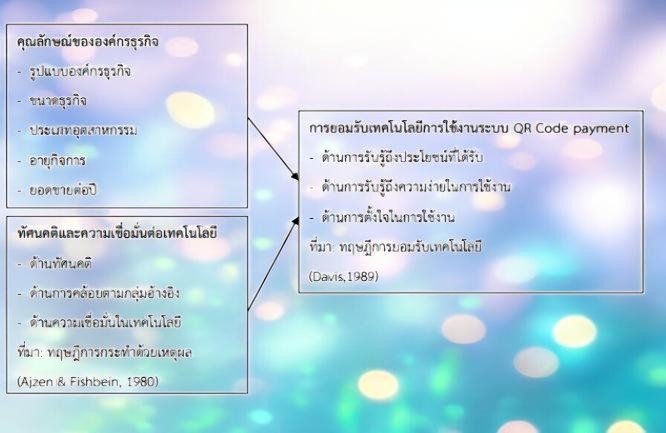
This study aimed to examine the characteristics of business organizations together with the acceptance of QR Code Payment technology use, as well as the attitude and confidence that influence the acceptance of QR Code Payment technology use. The sample consisted of 385 business organizations in Songkhla Province. A questionnaire was used for data collection. The data were analyzed using percentage, mean, standard deviation, t-test, f-test, and multiple regression analysis. The findings revealed that the majority of respondents were sole proprietors operating small retail businesses with no more than 50 employees, had been in operation for 1–5 years, and reported annual sales of 300,001–400,000 baht. The results of the hypothesis testing indicated that business organizations with different characteristics exhibited statistically significant differences in their acceptance of QR Code Payment technology at the .05 level. Attitude and confidence differed significantly in their effects on the acceptance of QR Code Payment technology use at the .05 level. The analysis of influencing variables revealed that all independent variables (attitude, subjective norm, and confidence in technology) had statistically significant positive influences on perceived usefulness. Regarding differences in business organizational characteristics, organizational form, business size, and industry type were significantly associated with technology acceptance, whereas business age was not significantly associated.
Article Details

This work is licensed under a Creative Commons Attribution-NonCommercial-NoDerivatives 4.0 International License.
References
กระทรวงการคลัง. (2568, 1 มกราคม). โครงการคนละครึ่ง พลัส. https://www.xn--42caj4e1a2ame9b2c q0dyo.com/
กัตตกมล พิศแลงาม. (2565). ปัจจัยการยอมรับเทคโนโลยีการทำธุรกรรมทางการเงินผ่านไทยคิวอาร์เพย์เมนต์. วารสารสารสนเทศ, 21(1), 1-12. https://so03.tcithaijo.org/index.php/oarit/article/down load/265848/176705/1023296
กองส่งเสริมวิสาหกิจชุมชน กรมส่งเสริมการเกษตร. (2569). รายงานสถานภาพวิสาหกิจชุมชนและเครือข่ายวิสาหกิจชุมชน ประจำปีงบประมาณ พ.ศ. 2568. กระทรวงเกษตรและสหกรณ์.
คณะกรรมการบริหารงานจังหวัดแบบบูรณาการ. (2566). เป้าหมายการพัฒนาจังหวัดสงขลา 20 ปี (พ.ศ. 2566–2585). https://www.songkhla.go.th/files/com_news_develop_plan/2023-06_8e5 a039fe5ac788.pdf
ธนาคารแห่งประเทศไทย. (2568). รายงานพฤติกรรมการชำระเงินของประชาชนและภาคธุรกิจไทย (Payment Insight). https://www.bot.or.th/th/statistics/payment-systems.html
นิตยา โพธิ์ศรีจันทร์ และศิริวรรณ เพชรไพร. (2565). ผลกระทบของการประยุกต์ใช้ข้อมูลการบัญชีบริหารเชิงรุกที่มีต่อประสิทธิภาพการดำเนินงานของธุรกิจขนาดกลางและขนาดย่อมในจังหวัดนครพนม.วารสารศิลปศาสตร์และวิทยาการจัดการ, 9(1), 19-30.
ปัญจรัตน์ ปราณโสภณ. (2567). อิทธิพลของประเภทของกลุ่มอ้างอิงและประเภทของผู้บริโภคกีฬาที่มีต่อความตั้งใจซื้อแบรนด์สินค้ากีฬา [วิทยานิพนธ์ปริญญามหาบัณฑิต, จุฬาลงกรณ์มหาวิทยาลัย]. https://cuir2.car.chula.ac.th/bitstream/123456789/62968/1/5881543926.pdf
ภรวิสาร์ กลัดแก้ว. (2561). ปัจจัยที่มีอิทธิพลต่อความตั้งใจในการชำระเงินรูปแบบรหัสคิวอาร์ผ่านระบบโมบายแบงก์กิ้งและโมบายเพย์เม้นต์: กรณีศึกษากรุงเทพมหานครและปริมณฑล [การค้นคว้าอิสระปริญญามหาบัณฑิต, มหาวิทยาลัยธรรมศาสตร์]. http://ethesisarchive.library.tu.ac.th/thesis /2018/TU_2018_6002037130_9456_9508.pdf
วัลลภา พัฒนา, บุญรัตน์ บุญรัศมี, พันธ์ยศ วรเชฐวราวัตร, พรโพยม วรเชฐวราวัตร์, วิชชุลฎา ถาวโรจน์, จินตนา เจริญเนตรกุล, อรอุมา สุพัฒนกุล และอัมรินทร์ สันตินิยมภักดี. (2565). กลยุทธ์การตลาดของผลิตภัณฑ์ชุมชนพื้นที่จังหวัดสงขลา. มหาวิทยาลัยเทคโนโลยีราชมงคลศรีวิชัย. https://riss. rmutsv.ac.th/upload/doc/202209/q5fGTEfG5dL9tisNJW1r/q5fGTEfG5dL9tisNJW1r.pdf
สานุ สังวาลเพ็ชร์. (2567). ปัจจัยการยอมรับเทคโนโลยีและการรับรู้ความเสี่ยงที่ส่งผลต่อพฤติกรรมความตั้งใจในการใช้งาน e-Wallet [สารนิพนธ์ปริญญามหาบัณฑิต, มหาวิทยาลัยรามคำแหง]. http://www. ba-abstract.ru.ac.th/AbstractPdf/2567-2-1_1743748867.pdf
สำนักงานคลังจังหวัดสงขลา. (2568). รายงานประมาณการเศรษฐกิจจังหวัดสงขลา ฉบับที่ 1/2568. https://online.fliphtml5.com/mjlcf/ytlh/#p=1
สำนักงานสถิติจังหวัดสงขลา. (2565). สำมะโนธุรกิจและอุตสาหกรรม พ.ศ. 2565 ข้อมูลพื้นฐานจังหวัดสงขลา. https://songkhla.nso.go.th/images/stitic/society/5businessindustrialcensus2022.pdf
สำนักงานส่งเสริมวิสาหกิจขนาดกลางและขนาดย่อม. (2566). รายงานสถานการณ์วิสาหกิจขนาดกลางและขนาดย่อม รายปี 2566. https://www.sme.go.th/
Ajzen, I., & Fishbein, M. (1980). Understanding attitudes and predicting social behavior. Prentice-Hall.
Amnas, M. B., Selvam, M., Raja, M., Santhoshkumar, S., & Parayitam, S. (2023). Understanding the determinants of FinTech adoption: Integrating UTAUT2 with trust theoreticmodel. Journal of Risk and Financial Management, 16(12), 505. https://doi.org/10.33 90/jrfm16120505
Arli, T., van Esch, P., Bakpayev, M., & Laurence, A. (2021). Do consumers trust AI? Exploring the role of algorithms and digital marketing in the era of artificial intelligence. Journal
of Consumer Marketing, 38(5), 579-591. https://doi.org/10.1108/JCM-04-2020-3754
Christine, S. (2025, November 26). รหัส QR สำหรับการชำระเงิน: ทางสู่สังคมไร้เงินสด. QR Tiger. https://www.qrcode-tiger.com/th/qr-code-for-payment
Cochran, W. G. (1977). Sampling techniques (3rd ed.). John Wiley & Sons.
Davis, F. D. (1989). Perceived usefulness, perceived ease of use, and user acceptance of information technology. MIS Quarterly, 13(3), 319-340. https://doi.org/10.2307/249008
Fillgoods Technology. (2021). QR code คืออะไร พร้อมวิธีใช้แบบถูกต้อง. https://www.samsung. com/th/explore/entertainment/how-to-scan-qr-code/
Harnchanpanich, K. (2026). Impact of Mobile Banking Access on Financial Well-being: A Comparative Cross-country Analysis. [Doctoral dissertation, Chulalongkorn University]. https://www.eba.econ.chula.ac.th/wp-content/uploads/2025/07/6448008929-Kulchat-Harnchanpanich.pdf
Hair, J. F., Page, M., & Brunsveld, N. (2019). Essentials of business research methods (4th ed.). Routledge. https://doi.org/10.4324/9780429203374
Jafri, J. A., Amin, S. I. M., Rahman, A. A., & Nor, S. M. (2024). A systematic literature review of the role of trust and security on Fintech adoption in banking. Heliyon, 10(1), e22980. https://doi.org/10.1016/j.heliyon.2023.e22980
Kelly, S., Kaye, S. A., & Oviedo-Trespalacios, O. (2023). What factors contribute to the acceptance of artificial intelligence? A systematic review. Telematics and Informatics, 77, 101925. https://doi.org/10.1016/j.tele.2022.101925
Kotler, P., Kartajaya, H., & Setiawan, I. (2021). Marketing 5.0: Technology for humanity. John Wiley & Sons.
Lisana, L. (2024). Understanding the key drivers in using mobile payment among Generation Z. Journal of Science and Technology Policy Manageme nt, 15(1), 122-141. https:// doi.org/10.1108/JSTPM-08-2021-0118
News-thaipbs. (2565, 8 ธันวาคม). ผลสำรวจชี้คนไทยชอบโครงการคนละครึ่งเข้าร่วมมากสุด หวังลดค่าใช้จ่าย. https://news.thaipbs.or.th/content/299009
Rogers, E. M. (2003). Diffusion of innovations (5th ed.). Free Press.
The Bangkok Insight Editorial Team. (2563, 30 ธันวาคม). มัดรวมมาให้! เปิด มาตรการกระตุ้นเศรษฐกิจแห่งปีต่อลมหายใจสู้ ‘โควิด’. https://www.thebangkokinsight.com/news/business/econo mics/516479/
We Are Social & Meltwater. (2023, January 26). Digital 2023: Global overview report. https:// wearesocial.com/digital-2023-global-overview-report/
Zhao, Y., & Bacao, F. (2021). How Does the Pandemic Facilitate Mobile Payment? An Investigation on Users’ Perspective under the COVID-19 Pandemic. International Journal of Environmental Research and Public Health, 18(3), 1016. https://doi.org/1 0.3390/ijerph18031016
