An Analysis of Slang Words Used in Song Lyrics on TikTok Billboard Chart
Article Sidebar
Main Article Content
Abstract
DOI : 10.14456/pnuhuso.2025.22
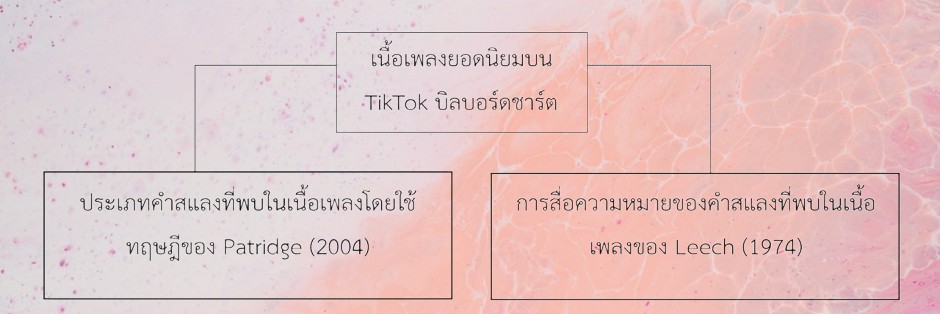
This research aims to analyze the characteristics of slang words used in popular song lyrics on the TikTok Billboard Chart and to investigate the conveyed meanings of slang found in these lyrics. The sample was selected from the top 20 songs listed on the TikTok Billboard Charts on December 3, 2023 and non-English songs were excluded from the study. The data analysis was divided into two stages: (1) classifying the characteristics of slang words found in song lyrics as well as their frequencies via AntConc, and (2) examining the slang words’ meanings base on theoretical framework.
The analysis revealed a total of 76 instances of slang usage. The five most frequently used slang words were: shit (56 times), yeah (46 times), baby (41 times), bitch (32 times), and wanna (23 times), respectively. Based on the analysis of slang types, all instances were categorized as social slang. Regarding the conveyed meanings of the slang in the popular TikTok Billboard chart songs, six out of seven semantic types were identified: emotive meaning (44 instances), conceptual meaning (39 instances), stylistic meaning (24 instances), effective meaning (18 instances), connotative meaning (11 instances), and collocative meaning (10 instances). Additionally, some slang words were found to convey more than one meaning. The meanings of the slang varied depending on the context and content of each song.
Article Details

This work is licensed under a Creative Commons Attribution-NonCommercial-NoDerivatives 4.0 International License.
References
กาญจนา หอมจันทร์, อังค์วรา เหลืองนภา และอนันตชัย เอกะ. (2562). การใช้คำแสลงภาษาอังกฤษในเพลงสากล. ในการประชุมวิชาการนำเสนอผลงานวิจัยระดับชาติของนักศึกษาด้านมนุษย์ศาสตร์และสังคมศาสตร์ ครั้งที่ 2 (น. 418-427). คณะมนุษยศาสตร์และสังคมศาสตร์ มหาวิทยาลัยราชภัฏสวนสุนันทา. https://hs.ssru.ac.th/useruploads/files/20190304/88c2b
เจียง หวี่, สหัทยา สิทธิวิเศษ และทิวาพร อุดมวงษ์. (2564). กลวิธีการสร้างคำสแลงภาษาจีนและปัจจัยที่ทำให้เกิดคำสแลงภาษาจีนในสื่อสังคมออนไลน์. วารสารมนุษยศาสตร์และสังคมศาสตร์ปริทัศน์, 9(2), 71-79. http://www.human.lpru.ac.th/husocojs/php/ HUSOCReview/article/view/231
นริศรา ยศปัญญา, ประกายแก้ว แสนประสิทธิ์, รัศมี แซ่จาง, อุมาภรณ์ ยศเจริญ และคุณากร คงชนะ. (2566). การศึกษาความหมายและการใช้คําสแลงภาษาอังกฤษในเนื้อเพลงสากล. วารสารอักษราพิบูล, 4(1), 121-138. https://so02.tci-thaijo.org/index.php/APBJ/article/view/262491/176192
Chapman, R. L. (1988). In A new dictionary of American slang. Harper and Row.
Dewi, N., & Widiastuti, N. (2020). An Analysis of Slang Words in Song Lyrics Used in the Songs “That’s What I Like” “Smoke On The Water”, and “Ch- Check It Out”. Udayana Journal of Social Sciences and Humanities, 4(2), 85-90. https://doi.org/10.24843/UJo SSH.2020.v04.i02.p08
Febriyanti, K. (2017). An Analysis of the Use of American Slangs on Eminem’s Song lyrics. Lingua Scientia, 24(2), 59-70. https://doi.org/10.23887/ls.v24i2.18803
Leech, G. (1974). Semantic: A Coursebook. Penguin.
Partridge, E. (2004). Slang: Today and Yesterday. Routledge and Kegan Paul.
Sinaga, H., Herman, Purba, C. N., & Hutahaean, D. T. (2020). An Analysis of Slang Language Types in “The Duff “Movie. Wiralodra English Journal, 4(1), 1–11. https://doi.org/10.3 1943/wej.v4i1.69
Sintya, K., Umiyati, M., & Pratama, A. (2022). An Analysis of Slang Words Found in Avril Lavigne’s Song Lyrics. In International Conference on Language, Culture, and Communication 2022: ICLCC 2022 (pp. 15). Faculty of Letters, Universitas Warmadewa.https://eproceeding.warmadewa.a
Wijaya, R., Sukmaningrum, R., & Setyorini, A. (2021). An Analysis of Slang Words Used In Song Lyrics by Twenty One Pilots on Album Blurryface. In The 1st Undergraduate Conference on Applied Linguistics, Linguistics, and Literature 2021 (pp. 14). Universitas PGRI Semarang, Faculty of Language and Arts Education, English Education Study Program. https://conference.upgris.ac.id/index.php/allure/article/view/1989/10 23
Yule, G. (2010). The Study of Language (4th ed.). Cambridge University Press.
