
The Creative Decision-Making Model for School Administrators Under Narathiwas Primary Educational Service Area Office 3
Article Sidebar
Main Article Content
Abstract
DOI : 10.14456/pnuhuso.2025.26
This research aimed to 1) examine the current conditions and essential needs for developing a creative decision-making model for school administrators and 2) design and evaluate the quality of the proposed model. A mixed-methods research design was employed using a multiphase. Phase 1 involved qualitative research through in-depth interviews with six school administrators to explore current decision-making practices and contextual factors. Phase 2 utilized quantitative research to assess the essential needs for model development, using data collected from to the entire population of 75 school administrators. The data were analyzed using the Modified Priority Needs Index (PNImodifie). Phase 3 involved evaluating the effectiveness of the developed model combined with expert group discussions, to validate and confirm the findings.
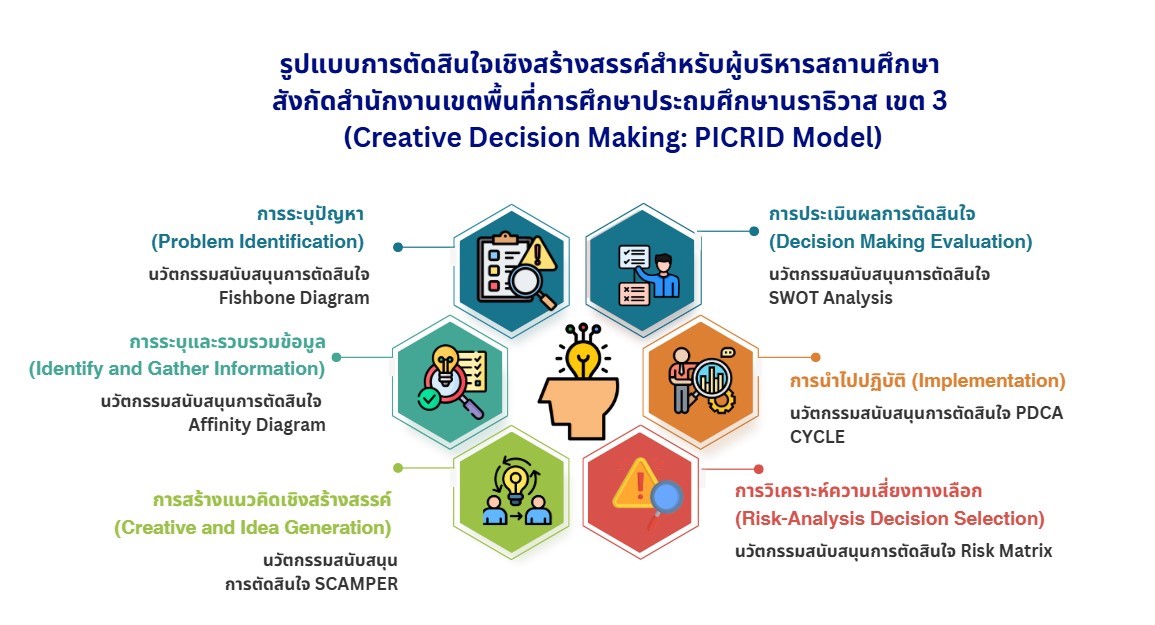
The result revealed that the creative decision-making model (PICRID Model) consists of six processes (1) Problem Identification, using the Fishbone Diagram, based on the Creative Problem-Solving Theory (2) Identifying and Gathering Information, using the Affinity Diagram, grounded in the Rational Decision-Making Model (3) Creative and Idea Generation, employing the SCAMPER technique, based on the Creative Thinking Theory; (4) Risk-Analysis Decision Selection, using the Risk Matrix, aligned with the Risk Management Theory (Garrick, 1981); (5) Implementation, using the PDCA Cycle, reflecting the Continuous Improvement Theory; and (6) Decision-Making Evaluation, using SWOT Analysis, based on the Strategic Planning Theory. A key strength of the model is its integration of systematic decision-making steps with innovative thinking concepts, significantly enhancing the creative decision-making process.
Article Details

This work is licensed under a Creative Commons Attribution-NonCommercial-NoDerivatives 4.0 International License.
References
กองทุนเพื่อความเสมอภาคทางการศึกษา. (2566, 9 กุมภาพันธ์). รู้แต่ทำไม่ได้! ทำไมนโยบายการศึกษาไทยจึงไม่สัมฤทธิ์ผล: มุมมองจากกระบวนการทางนโยบาย. https://www.eef.or.th/research-on-thai-education-policy/
กระทรวงศึกษาธิการ. (2546). พระราชบัญญัติการศึกษาแห่งชาติ พ.ศ. 2542 และแก้ไขเพิ่มเติม (ฉบับที่ 2) พ.ศ. 2545. โรงพิมพ์องค์การรับส่งสินค้าและพัสดุภัณฑ์.
จิติมา วรรณศรี. (2563). นวัตกรรมสู่การพัฒนาสถานศึกษา. รัตนสุวรรณการพิมพ์.
ชัชรินทร์ เลิศยศบดินทร์. (2567). คุณภาพของเยาวชนไทยผ่านผลสอบ PISA 2022. วารสารสถาบันวิชาการป้องกันประเทศ, 15(2), 25-35. https://so04.tci-thaijo.org/index.php/ndsijournal/article/ view/276911/186349
นงลักษณ์ วิรัชชัย. (2555). สถิติชวนใช้ (พิมพ์ครั้งที่ 2). ไอคอนพริ้นติ้ง.
สถาบันทดสอบทางการศึกษาแห่งชาติ (สทศ.). (2566, 12 เมษายน). สรุปผลการทดสอบทางการศึกษาระดับชาติขั้นพื้นฐาน (O-NET) ป.6 ปีการศึกษา 2565. https://www.niets.or.th/th/catalog/view/497/10
สถาบันวิจัยเพื่อการพัฒนาประเทศไทย (ทีดีอาร์ไอ). (2565, 13 ธันวาคม). ทีดีอาร์ไอ ชี้ผลสอบ PISA ส่งสัญญาณเตือนระบบการศึกษาไทยมีปัญหา ทำคนไทยไม่พร้อมรับมือโลกที่เปลี่ยนแปลง. https://tdri. or.th/2023/12/pisa-2022/
สถาบันส่งเสริมการสอนวิทยาศาสตร์และเทคโนโลยี. (2566, 6 ธันวาคม). การแถลงข่าวผลการประเมิน PISA 2022. https://pisathailand.ipst.ac.th/news-21/
สำนักงานสภาพัฒนาการเศรษฐกิจและสังคมแห่งชาติ. (2565). แผนพัฒนาเศรษฐกิจและสังคมแห่งชาติ ฉบับที่ 13 (พ.ศ. 2566-2570). https://www.nesdc.go.th/article_attach/article_file_202303071 73518.pdf
สีทอง บุญนำ. (2566). เรื่องเล่าความเหลื่อมล้ำทางการศึกษา และแนวทางการจัดการศึกษาเพื่อสร้างความเสมอภาคทางการศึกษาของนักเรียนระดับมัธยมศึกษาในกรุงเทพมหานคร [วิทยานิพนธ์ปริญญามหาบัณฑิต, มหาวิทยาลัยศิลปากร]. DSpace. http://ithesis-ir.su.ac.th/dspace/bitstream/12 3456789/4787/1/640620055.pdf
เสมอกาญจน์ โสภณหิรัญรักษ์, สุรวิทย์ อัสสพันธุ์ และธิดา ทับพันธุ์. (2566). การศึกษาและพัฒนาองค์ประกอบด้านสมรรถนะในการแก้ปัญหาเชิงสร้างสรรค์จากกระบวนการแก้ปัญหาเชิงสร้างสรรค์. วารสารบัณฑิตศึกษา มหาวิทยาลัยราชภัฏวไลยอลงกรณ์ ในพระบรมราชูปถัมภ์, 17(3), 219-224. https://so02.tci-thaijo.org/index.php/JournalGradVRU/article/view/ 261030/178168
Adanne, E. (2024). A Meta-Analysis of Data-Driven School Leaders and School Effectiveness in the 21st Century. Journal of Human Resource and Sustainability Studies, 12(1), 204-225. https://doi.org/10.4236/jhrss.2024.121011
Aldawsari, H. K., Shahat, H. A., Gaber, S. A., Al-Ruwaili, H. A., Aldughaysh, A. M., & Mohmed, T. A. (2023). Developing Productive Thinking Skills in the Field of Artistic Works Using the SCAMPER Strategy for Twice Exceptional Students. International Journal of Learning, Teaching and Educational Research, 22(12), 1-20. https://doi.org/10.26803/ijlter.22.1 2.1
Al-Kubaisi, H., & Shahbal, S. (2021). The Focus of Educational Leadership on Student Learning; Reflection and Assessment-Vanderbilt Assessment of Leadership in Education. Webology, 18(3), 1699-1720.
Austin, S., & Stanley, S. (2022). Educational Criticism and Connoisseurship: A Case Study Example. In S. G. Harding & A. D. Krug (Eds.), Conceptual Analyses of Curriculum Inquiry Methodologies (pp. 223-251). Routledge.
Blašková, M., Tumová, D., & Mičiak, M. (2022). Taxonomy of Factors Involved in Decision-Making to Sustain Organization Members’ Creativity. Administrative Sciences, 12(1), 39. https://doi.org/10.3390/admsci12010039
Bovee, C. L. (1993). Management. McGraw-Hill.
Chkheidze, S. (2023). Role OF Leader in Educational Management. Pupil: International Journal of Teaching, Education and Learning. 7. 171-179. https://doi.org/10.20319/pij tel.2023.72.171179.
Cohen, M., March, J., & Olsen, J. (1972). A Garbage Can Model of Organization Choice. Administrative Science Quarterly. 17. 1-25. https://doi.org/10.2307/2392088.
Creswell, J. W., & Plano Clark, V. L. (2011). Designing and Conducting Mixed Methods Research (2nd ed.). Sage.
Kamari, A. (2023). From Decision Theory to Informed Decision-Making in the Design of Sustainable High-Performance Buildings. Sustainability. 15. 15784. https://doi.org/10. 3390/su152215784.
Daniels, D., McBrayer, J. S., Griffin, M., Norman, T., Pannell, S., & Fallon, K. (2021). School Leaders’ and Teachers’ Preparedness for the Online K-12 Setting: Student Learning and Engagement, Curriculum and Instruction, and Data-Driven Decision-Making. Journal of Online Learning Research, 7(3), 269-291.
Duhoe, A., & Segbefia, S. (2023). Role of Administrators in Promoting Positive School Environment For Tutors and Student Well-Being: A Case Study of Some Schools in Ghana. International Journal of Education & Well-Being (IJEW). 1. 14-30. https://doi. org/10.62416/ijwb-14.
Eisner, E. W. (1976). Educational Connoisseurship and Criticism: The Form and Functions in Educational Evaluation. The Falmer.
Ertas, H., & Kotboga, A. (2022). Teachers’ Views on Creative Leadership Behaviors Displayed by School Principals. Asya Studies-Academic Social Studies/Akademik Sosyal Araştırmalar, 6(21), 135-146. https://doi.org/10.31455/asya.1126004
Ertem, H. Y. (2021). Examination of System of Transition to Upper-secondary Schools from Lower-secondary Schools in Terms of Student, Class, and School Level Variables. Problems of Education in the 21st Century, 79(2), 194-206. https://doi.org/10.33225/ pec/21.79.194
Gouda, H. (2023). Impact of Leadership Styles on Decision-Making and Problem-Solving: Classical Faculty Leaders at Egyptian Governmental Universities. Arab Journal of Administration, 43(2), 343-354. https://doi.org/10.21608/aja.2023.299838
Gurel, E., & Tat, M. (2017). SWOT Analysis: A Theoretical Review. The Journal of International Social Research, 10, 994-1006.
Griffiths, D. E. (1959). Administrative Theory. Appleton-Century-Crofts.
Hallinger, P., & Heck, R. H. (1996). Reassessing the Principal’s Role in School Effectiveness: A Review of Empirical Research, 1980-1995. Educational Administration Quarterly, 32(1), 5-44. https://doi.org/10.1177/0013161X96032001002
Hariri, A., Muslim, S., Ekohariadi, E., & Yundra, E. (2021). The Effect of Creative Thinking in Improving Decision Making. Management Science Letters, 11(6), 1765-1770. https:// doi.org/10.5267/j.msl.2021.2.006
Hassan, S. M. (2023). SCAMPER as a Creative Idea Generation Method: Case Study on Graphic Design Students. Information Sciences Letters, 12(4), 1417-1426. http://dx.doi.org/10. 18576/isl/120453
Hisprastin, Y., & Musfiroh, I. (2021). Ishikawa Diagram dan Failure Mode Effect Analysis (FMEA) sebagai Metode yang Sering Digunakan dalam Manajemen Risiko Mutu di Industri. Beranda, 6(1), 1-7. https://doi.org/10.24198/mfarmasetika.v6i1.27106
Hoy, W. K., & Miskel, C. G. (1991). Educational Administration: Theory, Research, and Practice. McGraw-Hill.
Ivancevich, J. M., et al. (1989). Management: Principles and function (4th ed.). Richrad D.Trwin.
Jones, E. R. (2023, November 29). Affinity Diagram. The Decision Lab. https://thedecisionlab .com/reference-guide/organizational-behavior/affinity-diagram
Kaplan, S., & Garrick, B.J. (1981) On the Quantitative Definition of Risk. Risk Analysis,
, 11-27. http://dx.doi.org/10.1111/j.1539-6924.1981.tb01350.x
Khoyaled, S. (2023). Impact of Education Policies for Accessing Quality Education. International Journal of Education and Learning Research, 6(1), 57-75.
Leithwood, K., & Jantzi, D. (2006). Transformational School Leadership for Large-Scale Reform: Effects on Students, Teachers, and their Classroom Practices. School Effectiveness and School Improvement, 17(2), 201-227. https://doi.org/10.1080/092 43450600565829
Likert, R. (1967). The Human Organization: Its Management and Value. McGraw-Hill.
Mbua, E. M. (2023). Effectiveness of Instructional School Leadership in Public Secondary Schools in Buea. American Journal of Leadership and Governance, 8(1), 1-18. https://doi.org/10.47672/ajlg.1362
Miles, M. B., & Huberman, A. M. (1994). Qualitative data analysis: An expanded sourcebook (2nd ed.). SAGE.
Mustafa, G., Hisham-Ul-Hassan, K., & Cheema, F. (2023). Role of Administrator in School Improvement at Secondary School Level: A Qualitative Study. Pakistan Journal of Humanities and Social Sciences. 11. https://doi.org/10.52131/pjhss.2023.1102.0398.
Nguyen, V., Chau, C. K. B., & Tran, T. (2023). PDCA from Theory to Effective Applications: A Case Study of Design for Reducing Human Error in Assembly Process. Advances in Operations Research, 2023(8007474), 1-9. https://doi.org/10.1155/2023/8007474
Osborn, A. (1953). Applied Imagination: Principles and Procedures of Creative Problem Solving. Charles Scribner's Sons.
Othman, S. A., Ibrahim, M. B., Salleh, M. J., & Md Sidek, S. S. (2024). (2024). School Leaders’ Leadership Practices and Their Influence on Crisis-Related Problem-Solving and Decision-Making: A Multi-Site Case Study. IIUM Journal of Educational Studies, 12(1), 50-73. https://doi.org/10.31436/ijes.v12i1.515
Palazzo, M. (2024). The SWOT Analysis: An Evolving Decision-Making Model. In Rethinking Decision-Making Strategies and Tools: Emerging Research and Opportunities (pp. 53-70). Emerald. https://doi.org/10.1108/978-1-83797-204-320241004
Parnes, S., Osborn, A. & Noller, R. (2016). Creative Problem-Solving Tools & Techniques Resource Guide. Creative Education Foundation.
Pavlenchyk, N., Pavlenchyk, A., Skrynkovskyy, R., & Tsyuh, S. (2023). The Influence of Management Creativity on the Optimality of Management Decisions Over Time: An Innovative Aspect. Journal of Eastern European and Central Asian Research (JEECAR), 10(3), 498-514. https://doi.org/10.15549/jeecar.v10i3.1318
Plunkett, W. R., & Attner, R. F. (1994). Introduction to management (5th ed.). Wadsworth.
Puccio, G. J., Murdock, M. C., & Mance, M. (2011). Creative Leadership: Skills that Drive Change (2nd ed.). SAGE.
Şahin, F. (2021). The Role of School Administrators in Organizational Learning Processes. Research in Educational Administration and Leadership, 6(4), 833-868. https://doi. org/10.30828/real/2021.4.3
Sakdiyah, S., Eltivia, N., & Afandi, A. (2022). Root Cause Analysis Using Fishbone Diagram: Company Management Decision Making. Journal of Applied Business, Taxation and Economics Research, 1(6), 566-576. https://doi.org/10.54408/jabter.v1i6.103
Siagian, A. F., Ibrahim, M., & Supardi, Z. A. I. (2023). Creative-Scientific Decision-Making Skills Learning Model for Training Creative Thinking Skills and Student Decision Making Skills. Nurture, 17(1), 10-17. https://doi.org/10.55951/nurture.v17i1.141
Simon, H. A. (1957). Administrative Behavior: A Study of Decision-Making Processes in Administrative Organizations (2nd ed.). Macmillan.
Spillane, J. P., Halverson, R., & Diamond, J. B. (2004). Towards a Theory of Leadership practice: A Distributed Perspective. Journal of Curriculum Studies, 36(1), 3-34. https://doi.org/10.1080/0022027032000106726
Stoner, J. A. F. (1978). Management. Prentice-Hall.
Stufflebeam, D. L. (2000). The CIPP Model for Evalutaion. In D. L. Stufflebeam, G. F. Madaus, & T. Kellaghan (Eds.), Evalutaion Models: Viewpoints on Educational and Human Services Evaluation (2nd ed., pp. 280-317). Kluwer Academic.
Tamm, T., Hallikainen, P., & Tim, Y. (2021). Creative Analytics: Towards Data-Inspired Creative Decisions. Information Systems Journal, 32(5), 729-753. https://doi.org/10.1111/ isj.12369
Tannenbaum, R. (1950). Managerial Decision-Making. Journal of Business, 23(1), 22-39.
Torrance, E. P. (1988). The Nature of Creativity as Manifest in its Testing. In R. J. Sternberg (Ed.), The Nature of Creativity: Contemporary Psychological Perspectives (pp. 43-75). Cambridge University Press.
Uca, M., & Alizadehebadi, L. (2021). Risk Analysis and Assessment Using Decision Matrix Risk Assessment Technique in Sports: The Case of Boxing. Pakistan Journal of Medical & Health Sciences, 15(10), 2971-2976. https://doi.org/10.53350/pjmhs2115102971
