Developing Challenges for Physical Education Student Teachers Based on 21st Century Skills and Competencies
Article Sidebar
Main Article Content
Abstract
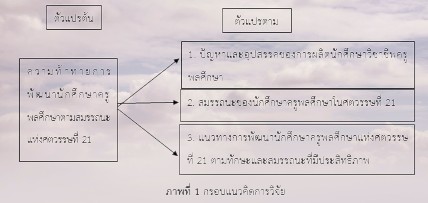
This study on the challenges in producing physical education student teachers with 21st-century skills and competencies aimed to: 1) examine the problems and obstacles in producing physical education student teachers, 2) investigate the competencies of physical education student teachers in the 21st century, and 3) explore the guidelines for developing physical education student teachers based on effective skills and competencies. Content analysis was employed to collect and analyze data from relevant academic sources.
The results of the study revealed that: 1) The main problems and obstacles in producing physical education student teachers include learning management, teaching, academic knowledge, sports coaching, technology use, teamwork, creativity, integration of local identity, shortage of resources, insufficient teaching equipment, and the changes in technology and society, all of which affect effective teaching and learning. 2) The study of competencies showed that student teachers need to develop learning management, teaching, academic knowledge, sports coaching, technology use, teamwork, creativity, integration of local identity, technology skills, learning design skills, assessment, and classroom management skills to meet the demands of teaching in the digital age. 3) The guidelines for development emphasize improving learning management, teaching, academic knowledge, sports coaching, technology use, creativity, integration of modern local identities, practical teaching, and building partnerships with external partners such as schools, communities, and sports organizations, in order to strengthen skills and competencies relevant to the 21st century. This research is crucial for planning and developing the preparation of quality physical education teachers to support future educational and social development.
Article Details

This work is licensed under a Creative Commons Attribution-NonCommercial-NoDerivatives 4.0 International License.
References
คณะกรรมการมาตรฐานวิชาชีพ. (2560). มาตรฐานวิชาชีพครู 2560. สำนักงานคณะกรรมการมาตรฐานวิชาชีพ. https://www.ksp.or.th/ksp2018/wp-content/uploads
ภูรี ณรงค์วานิช และนนทนันต์ เผ่าภูรี. (2567). การศึกษาสมรรถนะครูพลศึกษาในศตวรรษที่ 21 ในสังกัดสํานักงานเขตพื้นที่การศึกษามัธยมศึกษานครสวรรค์. Journal of MCU Ubon Review, 9(2), 1967-1980. https://so06.tci-thaijo.org/index.php/mcjou/article/view/275345/185364
ณัฐวุฒิ ฉิมมา. (2566). การพัฒนาหลักสูตรฝึกอบรมเพื่อเสริมสร้างสมรรถนะด้านนวัตกรรมและเทคโนโลยีในการจัดการเรียนรู้พลศึกษา. [วิทยานิพนธ์ปริญญาดุษฏีบัณฑิต, มหาวิทยาลัยนเรศวร]. https://nuir. lib.nu.ac.th/dspace/bitstream/123456789/5836/3/NatthawutChimma.pdf?utm_source =chatgpt.com
ศูนย์ฝึกประสบการณ์วิชาชีพครู คณะครุศาสตร์ มหาวิทยาลัยราชภัฏบุรีรัมย์. (2567). คู่มือการนิเทศฝึกประสบการณ์วิชาชีพครู (ฉบับปี 2567). https://anyflip.com/vvrha/kzku/basic
American Sport Education Program (ASEP). (2020). Preparing physical education teachers for the 21st century: Challenges and recommendations. Human Kinetics.
American Sport Education Program (ASEP). (2021). 21st Century Skills and Challenges in Physical Education Teacher Education. In N. LaVoi, T.
American Sport Education Program (ASEP). (2021). Preparing physical educators for the 21st century: A national agenda.
American Sport Education Program (ASEP). (2021). Preparing 21st century physical education teachers: A standards-based approach. Champaign, IL: Human Kinetics.
Commonwealth of Australia. (1992). Barriers to providing physical education and physical activity in schools: institutional constraints, budget limits, time allocations, lack of facilities and equipment [PDF]. ERIC. https://files.eric.ed.gov/fulltext/EJ910415.pdf
Damanik, D., & Widodo, P. (2024). Exploring teaching creativity in transmitting digital literacy, grit, and instructional quality. Education Sciences, 14(4), 384. https://www.mdpi.com /2227-7102/14/4/384
Department for Education (DfE). (2020). Initial teacher training: physical education. https:// www.gov.uk/government/publications/initial-teacher-training-criteria
Department for Education (DfE). (2021). The skills needed by initial teacher training (ITT) students in physical education (PE) in the 21st century. https://www.gov.uk/govern ment/publications/research-review-series-pe/research-review-series-pe?utm_source= chatgpt.com
Department for Education (DfE). (2023). Physical education curriculum and teacher development strategy. https://www.gov.uk/government/publications
Elo, S., & Kyngäs, H. (2008). The qualitative content analysis process. Journal of Advanced Nursing, 62(1), 107–115. https://doi.org/10.1111/j.1365-2648.2007.04569.x
Finnish National Board of Education (FNBE). (2022). National Curriculum for Physical Education. Helsinki: Finnish National Agency for Education.
Ha, S., & Fan, X. (2025). Technology use among physical education teachers before, during, and after the COVID-19 pandemic: A connectivist approach. ResearchGate. https:// www.researchgate.net/publication/385154274
Hardman, K. (2008). The situation of physical education in schools: A global perspective. Hacettepe Journal of Sport Sciences, 19, 1–22.
Ibragimova, E., Uraimov, S., Baitassov, Y., Yuldasheva, S., Kutlimuratova, D., & Litwinowa, M. (2025). Influence of digital technologies on students’ physical activity and intrinsic motivation for physical activity: experience of using fitness apps. Retos, 67, 1162–1173. https://www.researchgate.net/publication/391559896_Digital_motivation_fitnes s_apps_and_student_physical_activity
LaVoi, N. M., Baghurst, T., Woods, C., & Brown, P. (2021). Preparing physical education teacher candidates for the 21st century: Challenges and solutions. Journal of Teaching in Physical Education, 40(2), 185–196.
Martín-Rodríguez, A., & Madrigal-Cerezo, R. (2025). Technology-Enhanced Pedagogy in Physical Education: Bridging Engagement, Learning, and Lifelong Activity. Education Sciences, 15(4), 409. https://doi.org/10.3390/educsci15040409
Office of Academic and Educational Standards. (2021). Guidelines on teacher competency development for 21st century education. Ministry of Education.
Office of the National Economic and Social Development Board. (2018). The Twelfth National Economic and Social Development Plan (2017–2021). NESDB.
Office of the Secretariat of the Education Council. (2017). Education in Thailand 2017. Ministry of Education.
Organisation for Economic Co-operation and Development (OECD). (2018). The future of education and skills: Education 2030. Author.
Patton, M. Q. (2002). Qualitative research and evaluation methods (3rd ed.). Sage.
Tulyakul, S., & Khun inkeeree, H. (2019). Classroom management strategies and motivation for teaching towards teaching effectiveness among physical education teachers in Southern Thailand (Doctoral dissertation, Universiti Utara Malaysia). https://etd.uum.edu.my/8499/?utm_source=chatgpt.com
Wee, E. H., Cheng, W. F., & Chin, N.-S. (2021). Teachers’ perceived barriers to implementation of physical education: examining the administration of physical education programme and the provision of non-human resources. Collegium Antropologicum, 45(3), 191–200. https://www.researchgate.net/publication/357054273
