
The Anatomy of Anxiety: Evolution, Mechanics, and Cross-Cultural Appeal of the Thriller Genre
Article Sidebar
Main Article Content
Abstract
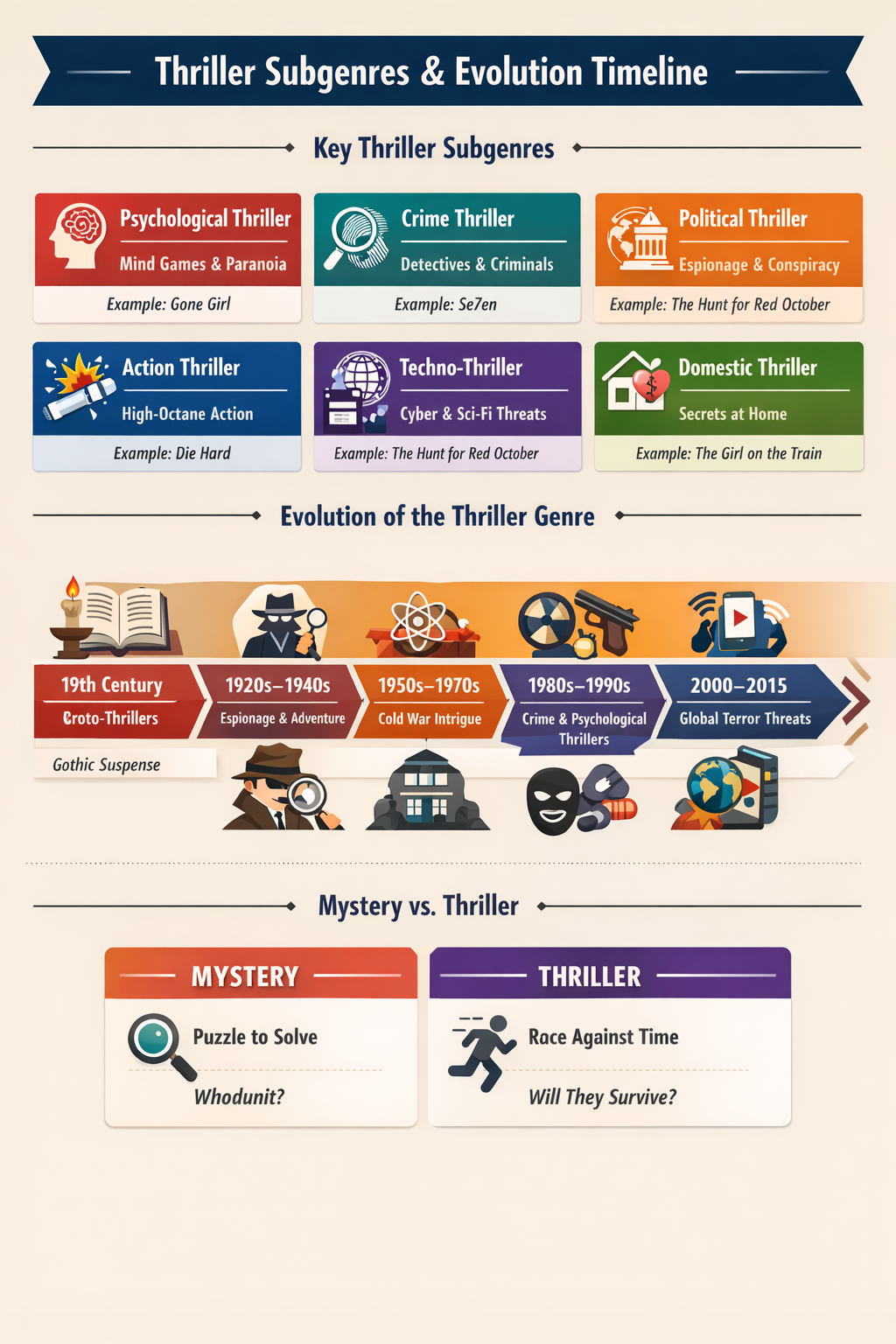
This paper aims to provide the historical context and the current trends to show that thriller is an ever-appealing genre. It establishes a robust definition of the thriller, systematically distinguishing it from the related genres of mystery and suspense through its core emphasis on visceral reaction, relentless pacing, and life-or-death stakes. The analysis meticulously catalogues the genre's extensive subgenres, chronicles the contributions of its key pioneers from Stevenson to Hitchcock, and examines the cultural factors that influence its narrative formulas through the lens of genre theory. A significant focus is placed on the psychological and sociological underpinnings of the crime thriller's enduring popularity, arguing that its appeal stems from its grounding in relatable realities, its facilitation of vicarious experience, and its engagement with universal human fears. Drawing on genre theory, reader-response criticism, and market analysis, this paper concludes that the thriller's core mechanics—suspense, action, and the primal struggle for survival—possess a unique capacity to transcend cultural boundaries, solidifying its status as a persistently dominant and adaptable narrative form in the global marketplace of ideas.
Article Details

This work is licensed under a Creative Commons Attribution-NonCommercial-NoDerivatives 4.0 International License.
References
Bhandari, R. (2020). Emergence of thrillers as a major genre in the Indian OTT space: A critical analysis [Unpublished master’s dissertation]. S. K. Somaiya Degree College of Arts, Science and Commerce.
Browder, L. (2006). Dystopian romance: True crime and the female reader. The Journal of Popular Culture, 39(6), 928-953.
Buchan, J. (2014). The thirty-nine steps (Vol. 1). Open Road Media.
Cawelti, J. G. (1976). Adventure, mystery, and romance: Formula stories as art and popular culture. University of Chicago Press.
De Fels, J. (1975). Popular literature in Thailand. Journal of the Siam Society, 63(2), 219-38.
Foojai, S. (2023). Detective Boys With Love:“Recoded” Generic Conventions in Thai Detective/Crime-BL Fiction [Master's thesis]. National Yang Ming Chiao Tung University).
Forsyth, F. (2012). The day of the jackal. Penguin.
Frantz, S. S., & Selinger, E. M. (Eds.). (2014). New approaches to popular romance fiction: Critical essays. McFarland.
Gerrig, R. (2018). Experiencing narrative worlds. Routledge.
Greene, T. (2018). The Odyssey: A New Translation by Peter Green. University of California Press.
Iwabuchi, K. (2002). Recentering globalization: Popular culture and Japanese transnationalism. Duke University Press.
Kaewkaen, A. (2023). Haunted Pasts and Contested Presents: Essays on Thai Gothic Fiction, Nationalism and Identity [Doctoral dissertation]. Washington University in St. Louis.
King, S. (2010). Danse macabre. Simon & Schuster.
Louis, S. R. (2017). Strange Case of Dr. Jekyll and Mr. Hyde.
Miller, M., White, B., & Scrivner, C. (2024). Surfing uncertainty with screams: predictive processing, error dynamics, and horror films. Philosophical Transactions of the Royal Society B, 379(1895), 20220425.
Mittell, J. (2004). Genre and television: From cop shows to cartoons in American culture. Routledge.
Morrell, J. P. (2008). Bullies, bastards and bitches: How to write the bad guys of fiction. Penguin.
Noor, N., Arslan, M. F., Noor, H., Latif, T., & Maqbool, F. (2025). Constructing Suspense and Psychological Tension: A Corpus-Based Stylistic Analysis of Contemporary Crime Thriller Fiction. Wah Academia Journal of Social Sciences, 4(2), 424-450.
Patkachar, U. (2024). The increasing popularity of Thai ghost films lends itself to the export potential of the Thai film industry. Journal of Communication and Management NIDA, 10(1), 53–66.
Perchtold-Stefan, C., Rominger, C., Ceh, S., Sattler, K., Veit, S.-V., & Fink, A. (2025). Out of the dark – Psychological perspectives on people's fascination with true crime. British Journal of Psychology. Advance online publication. https://doi.org/10.1111/bjop.700 38
Radway, J. A. (1991). Reading the romance: Women, patriarchy, and popular literature. University of North Carolina Press.
Sheaffer, R. (2005). The Da Vinci Code cult: a critical look at Dan Brown's The Da Vinci Code. Skeptic (Altadena, CA), 11(4), 22-27.
Smuts, A. (2021). The paradox of suspense. In E. N. Zalta (Ed.), The Stanford encyclopedia of philosophy (Winter 2021 ed.). https://plato.stanford.edu/archives/win2021/entries/pa radox-suspense/
Truffaut, F. (1983). Hitchcock. Simon & Schuster.
Wongwilatnurak, N., & Wongwilatnurak, S. L. (2024). The impact of spooky entertainment in Thailand on Gen-Z audiences. [ผลกระทบของสื่อบันเทิงสยองขวัญในประเทศไทยต่อผู้ชมเจน แซด]. Journal of communication and innovation NIDA, 11(1), 23-43.
Yun, H. (2025). The Changing Status of the Detectives in the Novels of Agatha Christie and Keigo Higashino: From Rational Authority to Human Exploration. Humanities and Social Science Research, 8(1), p27-p27.
Zemboy, J. (2010). The detective novels of Agatha Christie: A reader's guide. McFarland.
