
Factors Affecting the Application of Cosmeceutical Product Dealers Through Online Channels
Article Sidebar
Main Article Content
Abstract
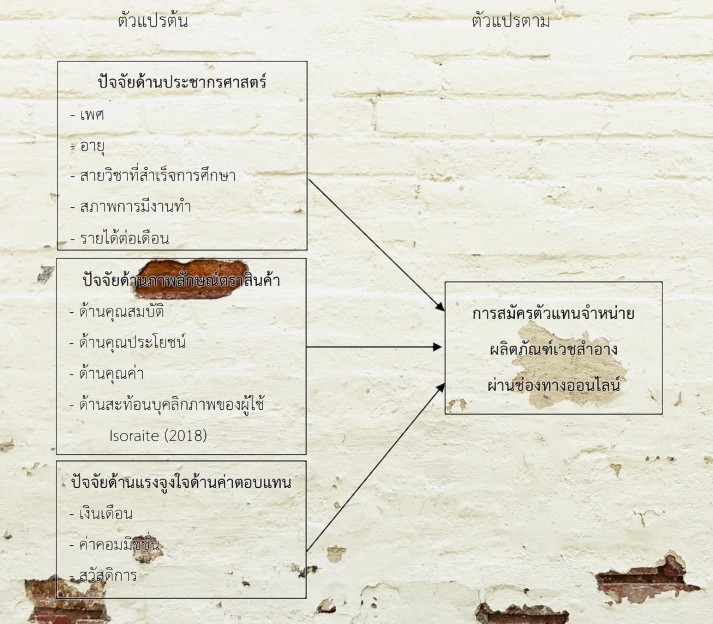
This research aims to: 1) study the brand image factors affecting applications to become cosmeceutical product distributors through online channels; 2) study the compensation motivation factors affecting such applications; and 3) compare these applications by demographic factors. The population consisted of new graduates in Songkhla Province. The sample comprised 400 respondents selected by convenience sampling, and a questionnaire was used as the data collection instrument. The statistics used for data analysis were frequency, percentage, mean, standard deviation, multiple regression analysis, t-test, and one-way ANOVA.
The findings revealed that: 1) brand image affected applications through online channels by 42.7%, with the statistically significant predictors being brand image in terms of user personality (β = .522) and product attributes (β = .202); 2) compensation motivation factors affected applications through online channels by 56.7%, with the statistically significant predictors being salary-based compensation (β = .380), welfare benefits (β = .233), and commission-based compensation (β = .211); and 3) new graduates with different ages, fields of study, and employment status differed in their applications to become cosmeceutical product distributors through online channels. This findings expand knowledge on the decision-making behavior of new graduates in the context of online work and provide strategic guidance for entrepreneurs in developing brand image and designing compensation structures aligned with target groups in order to improve the effectiveness of online distributor recruitment and selection.
Article Details

This work is licensed under a Creative Commons Attribution-NonCommercial-NoDerivatives 4.0 International License.
References
กัญญ์วรา ไทยหาญ, พวงเพ็ญ ชูรินทร์ และสิญาธร นาคพิน. (2562). ความสัมพันธ์ระหว่างภาพลักษณ์ ตราสินค้า คุณค่าตราสินค้ากับความจงรักภักดีในตราสินค้าของผู้ใช้เครื่องสำอางนำเข้าจากต่างประเทศในอำเภอเมือง จังหวัดสุราษฎร์ธานี. วารสารวิทยาการจัดการ, 6(1), 95–120.
กรุงเทพธุรกิจ. (2567, 22 ตุลาคม). ปี 67 ตลาดความงามขยายตัว 9.5% ดันเครื่องสำอาง Soft Power ของไทย. https://www.bangkokbiznews.com/health/well-being/1133071
จรุ ถิ่นพระบาท, เอื้องฟ้า เขากลม, นูรีตา และสุมอ และฉวิวรรณ ขาวสองเมือง. (2566). ความพึงพอใจในค่าตอบแทนที่ส่งผลต่อแรงจูงใจในการทำงานของบุคลากรองค์การบริหารส่วนตำบลควนกรด อำเภอทุ่งสง จังหวัดนครศรีธรรมราช. วารสารมหาจุฬานาครทรรศน์, 10(6), 128–135.
ดาวเดือน โลหิตปุระ, นิมิต จิวะสันติการ และจินตนา จันเรือน. (2564). ความสัมพันธ์ของการได้รับค่าตอบแทนที่ส่งผลต่อแรงจูงใจในการทำงานของพนักงานห้างสรรพสินค้าในอำเภอเมือง จังหวัดลำปาง. วารสารการบริหารนิติบุคคลและนวัตกรรมท้องถิ่น, 7(1), 225–235.
ณัฐฌา เสรีวัฒนา. (2563). ภาพลักษณ์ตราสินค้า คุณภาพการบริการ และคุณค่าตราสินค้าที่มีอิทธิพลต่อความภักดีและการตัดสินใจซื้อผลิตภัณฑ์ร้านไทย-เดนมาร์ค มิลค์แลนด์ของผู้บริโภคในเขตกรุงเทพมหานคร [วิทยานิพนธ์มหาบัณฑิต]. มหาวิทยาลัยศรีนครินทรวิโรฒ.
นันทิตา เพชราภรณ์, นพปฎล ขิงทอง, นิชนันท์ คงศรี, นันทพร ห้วยแก้ว และกาญจนาวดี สำลีเทศ. (2568). อิทธิพลของภาพลักษณ์ตราสินค้าและการสื่อสารการตลาดโดยผู้มีอิทธิพลบนสื่อออนไลน์ที่ส่งผลต่อการตัดสินใจใช้บริการคลินิกเสริมความงามของผู้บริโภค Generation Y ในเขตกรุงเทพมหานคร. วารสารมนุษยศาสตร์และสังคมศาสตร์ร่มพฤกษ์, 43(1), 36–56.
พิศาล วิเศษวงษา และราเชนทร์ นพณัฐวงศกร. (2565). แรงจูงใจในการทำงานของพนักงานขายรถยนต์ยี่ห้อ ISUZU ในเขตกรุงเทพมหานคร. วารสารบัณฑิตศึกษามหาจุฬาขอนแก่น, 9(4), 207–218.
พงศ์ศรัณย์ วงศ์ชนเดช, ศศกัญญ์ เนตรสุวรรณ, อัชญา กล้าเวช และปัณณทัต จอมจักร. (2568). อิทธิพลของภาพลักษณ์ตราสินค้าและบทความรีวิวโดยผู้บริโภคที่มีผลต่อความเชื่อมั่นและความไว้วางใจซึ่งนำไปสู่การตัดสินใจซื้อซ้ำผลิตภัณฑ์ในกลุ่มเวชสำอาง. Journal of Business Administration and Languages, 13(1), 92–104.
พงศ์สุทธิ ศิริทิทวน. (2565). ปัจจัยที่มีอิทธิพลต่อการตัดสินใจเลือกสมัครงานกับบริษัท Startup ของประชาชนวัยทำงาน ในกรุงเทพมหานคร [การศึกษารายบุคคลปริญญามหาบัณฑิต]. มหาวิทยาลัยธุรกิจบัณฑิตย์.
พวงรัตน์ ทวีรัตน์. (2540). วิธีวิจัยทางพฤติกรรมศาสตร์และสังคมศาสตร์. สำนักทดสอบทางการศึกษา มหาวิทยาลัยศรีนครินทรวิโรฒประสานมิตร.
เพชรรัตน์ อรรถเวที และณกมล จันทร์สม. (2568). ปัจจัยภาพลักษณ์ตราสินค้าและการรับรู้คุณภาพที่มีอิทธิพลต่อประสบการณ์ของลูกค้าและการตัดสินใจซื้อผลิตภัณฑ์เสริมอาหารจากสมุนไพรสำหรับผู้สูงอายุ. วารสารการจัดการโซ่คุณค่าและกลยุทธ์ธุรกิจ, 4(3), 22–38.
ยุทธ ไกยวรรณ์. (2561). หลักสถิติวิจัยและการใช้โปรแกรม SPSS (พิมพ์ครั้งที่ 5). สำนักพิมพ์แห่งจุฬาลงกรณ์มหาวิทยาลัย.
แสงสุข พิทยานุกูล. (2567). อิทธิพลของแรงจูงใจ ความสามารถ และโอกาสที่ส่งผลต่อความตั้งใจประกอบธุรกิจให้ประสบความสำเร็จของผู้ประกอบการไทย. วารสารบริหารธุรกิจศรีนครินทรวิโรฒ, 15(2), 129–149.
อภิชยา นิเวศน์. (2564). แรงจูงใจที่ส่งผลต่อการตัดสินใจเลือกเข้าทำงานในนิคมอุตสาหกรรมโรจนะ 1 จังหวัดพระนครศรีอยุธยาของคนงานรายวันชาวกัมพูชา ลาว และเมียนมา. วารสารวิชาการ มหาวิทยาลัยนอร์ทกรุงเทพ, 10(1), 1–10.
Chen, Y., & Chen, H. (2023). Compensation systems and distributor motivation in online cosmetic businesses. Journal of Business Research, 156, 113–125.
Fauzia, N. W. A., & Albari. (2024). The influence of brand image, brand loyalty, and word of mouth (WOM) on purchase intention for brand Somethinc. Indonesian Journal of Economics, Business, Accounting, and Management (IJEBAM), 2(4), 31–46. https://doi. org/10.63901/ijebam.v2i4.68
Herzberg, F., Mausner, B., & Snyderman, B. B. (1959). The motivation to work (2nd ed.). John Wiley & Sons.
Hwang, J., & Lee, K. (2021). Financial incentives and participation intention in online direct selling platforms. International Journal of Retail & Distribution Management, 49(8), 1021–1038.
Isoraite, M. (2018). Brand image development. Coforum, 1(14), 1–6.
Keller, K. L. (2013). Strategic brand management: Building, measuring, and managing brand equity. (4th ed.). Pearson Education.
Kotler, P., & Keller, K. L. (2016). Marketing management (15th ed.). Pearson Education.
Kotler, P., & Keller, K. L. (2021). Marketing management (15th ed.). Pearson Education.
Milkovich, G. T., Newman, J. M., & Gerhart, B. (2022). Compensation (14th ed.). McGraw-Hill Education.
Pratiwi, V. A., Nugroho, R. H., Prabowo, B., & Kusumasari, I. R. (2025). The influence of brand image, brand trust, and brand awareness on purchase intention: A study on Generation Z users by U provider in Surabaya. Indonesian Interdisciplinary Journal of Sharia Economics (IIJSE), 8(3), 11380–11390. https://doi.org/10.31538/iijse.v8i3.6901
Robbins, S. P., & Judge, T. A. (2022). Organizational behavior (19th ed.). Pearson Education.
Solomon, M. R. (2020). Consumer behavior: Buying, having, and being (13th ed.). Pearson Education.
Statista. (2023). Cosmetics and personal care market worldwide. Statista Research Department.
Yamane, T. (1973). Statistics: An introductory analysis. Harper & Row.
