
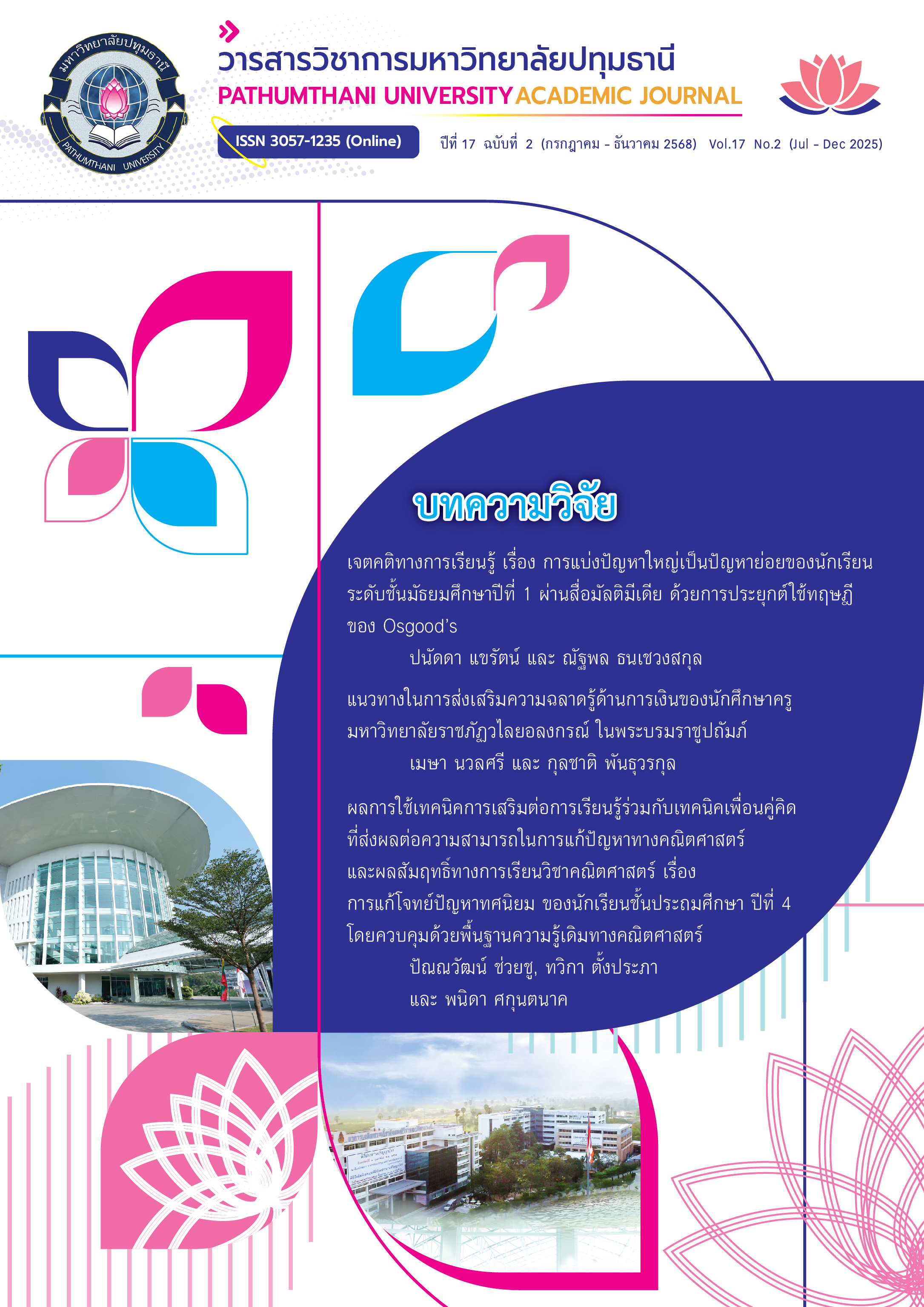
THE GUIDELINES FOR PROMOTING FINANCIAL LITERACY AMONG STUDENT TEACHERS AT VALAYA ALONGKORN RAJABHAT UNIVERSITY UNDER THE ROYAL PATRONAGE
Keywords:
Financial literacy , Pre-service teachers , Rajabhat Universities , Guidelines for promoting financial literacyAbstract
This survey study aimed to 1) study the financial literacy levels of student teachers, 2) compare their financial literacy by gender, cumulative GPA, and year of study, and 3) propose appropriate strategies for enhancing their financial literacy. The sample comprised 200 student teachers from Valaya Alongkorn Rajabhat University, derived from stratified random sampling. Data were collected through a 30-item, 5-point Likert questionnaire. The reliability was.912 based on Cronbach’s alpha reliability coefficient method. In addition, focus group discussions were conducted to gain qualitative insights. Quantitative data were analyzed using frequency, percentage, mean, standard deviation, t-test for independent samples and F-test for one–way ANOVA, qualitative data were analyzed using content analysis.
Findings revealed that 1) overall financial literacy was at a high level ( =3.80, S.D.=.43). Among the three dimensions, financial attitude scored highest, while financial behavior scored lowest. No significant differences were found by gender, GPA, or year of study. Based on these results, five key recommendations were developed: 1) integrate financial-management content into the teacher-education curriculum; 2) offer hands-on financial-decision workshops; 3) create a personalized financial-advisory platform; 4) foster a savings culture via student clubs and peer groups; and 5) leverage external financial networks to expand resources and opportunities.
References
โชคลาภ มั่นคง และคณะ. (2567). “ความฉลาดรู้ทางการเงินในการเตรียมความพร้อมเข้าสู่สังคมผู้สูงอายุ” วารสารบริหารธุรกิจราชมงคลสุวรรณภูมิ. ปีที่ 1 ฉบับที่ 2. หน้า 43-63.
ธิติ ธาราสุข, มนัสวาสน์ โกวิทยา และ สุวิธิดา จรุงเกียรติกุล. (2566). “การวิเคราะห์องค์ประกอบเชิงยืนยันทักษะด้านการเงินที่ส่งผลต่อการเป็นหนี้ของครู”. Journal of Roi Kaensarn Academi. ปีที่ 8 ฉบับที่ 12. หน้า 339-353.
พัชราภา อินทพรต, วัยวุฑฒ์ อยู่ในศิล และ สิรินธร สินจินดาวงศ์. (2566). “ความฉลาดรู้ทางการเงินของนักศึกษาระดับปริญญาตรี สถาบันระดับอุดมศึกษาเอกชน” วารสารสังคมศาสตร์และวัฒนธรรม. ปีที่ 7 ฉบับที่ 4. หน้า 1-14.
รัตนวัชร์ เพ็ญรัตนหิรัญ. (2567). “การพัฒนาชุดกิจกรรมเพื่อส่งเสริมการปรับตัวและความฉลาดรู้ทางการเงินโดยใช้วิธีเรียนรู้แบบใช้ปัญหาเป็นฐานสำหรับนักศึกษาครูชั้นปีที่ 1” วารสารศึกษาศาสตร์ มสธ. ปีที่ 17 ฉบับที่ 2. หน้า 19-37.
วชิรา เครือคำอ้าย และชวลิต ขอดศิริ. (2567). “การออกแบบการจัดการเรียนรู้เชิงระบบร่วมกับแนวทางการวางแผนการเงินเพื่อสร้างวินัยการเงินของนักศึกษาในฐานวิถีชีวิตใหม่” วารสารบัณฑิตศึกษา มหาวิทยาลัยราชภัฏวไลยอลงกรณ์. ปีที่ 18 ฉบับที่ 1. หน้า 228-243.
ศิริชัย กาญจนวาสี. (2552). ทฤษฎีการทดสอบแบบดั้งเดิม. (พิมพ์ครั้งที่ 6). กรุงเทพมหานคร : คณะครุศาสตร์ จุฬาลงกรณ์มหาวิทยาลัย.
สํานักงานราชบัณฑิตยสภา. (2562). พจนานุกรมศัพท์ศึกษาศาสตร์ร่วมสมัยชุดความฉลาดรู้ (literacy). กรุงเทพมหานคร : สํานักงานราชบัณฑิตยสภา.
อรรถพล คณิตชรางกูร. (2567). “การพัฒนากิจกรรมการเรียนรู้โดยใช้ปัญหาเป็นฐานเพื่อส่งเสริมความฉลาดรู้ด้านการเงินสำหรับนักศึกษาครู” วารสารมนุษยศาสตร์และสังคมศาสตร์ มหาวิทยาลัยนครพนม, ปีที่ 14 ฉบับที่ 2. หน้า 319-333.
Best, J. W. (1970). Research in education. New Jersey: Prentice Hall, Inc.
De Vellis, R. F. (2016). Scale development: Theory and applications. (4th ed.). CA: SAGE Publications.
Lusardi, A. (2020). Dollars and sense: The case for teaching personal finance. [Online]. From https://siepr.stanford.edu/news/dollars-and-sense-case-teaching-personal-finance.
Lusardi, A., & Mitchell, O. S. (2014). “The economic importance of financial literacy: Theory and evidence” Journal of Economic Literature. Vol 52 No 1. pp. 5-44.
Nunnally, J. C. (1967). Psychometric theory. New York: McGraw-Hill.OECD. (2020). OECD Economic Surveys: Thailand 2020: Economic Assessment, OECD Publishing: Paris. [Online]. From https://doi.org/10.1787/ad2e50fa-en.
Downloads
Published
How to Cite
Issue
Section
License
Copyright (c) 2025 เมษา นวลศรี

This work is licensed under a Creative Commons Attribution-NonCommercial-NoDerivatives 4.0 International License.
บทความที่ได้รับการตีพิมพ์เป็นลิขสิทธิ์ของวารสารมหาวิทยาลัยปทุมธานี
ข้อความที่ปรากฎในบทความแต่ละเรื่อง เป็นความคิดเห็นส่วนตัวของผู้เขียน กองบรรณาธิการไม่จำเป็นต้องเห็นด้วยเสมอไป และไม่มีส่วนรับผิดชอบใด ๆ ถือเป็นความรับผิดชอบของผู้เขียนแต่เพียงผู้เดียว


