
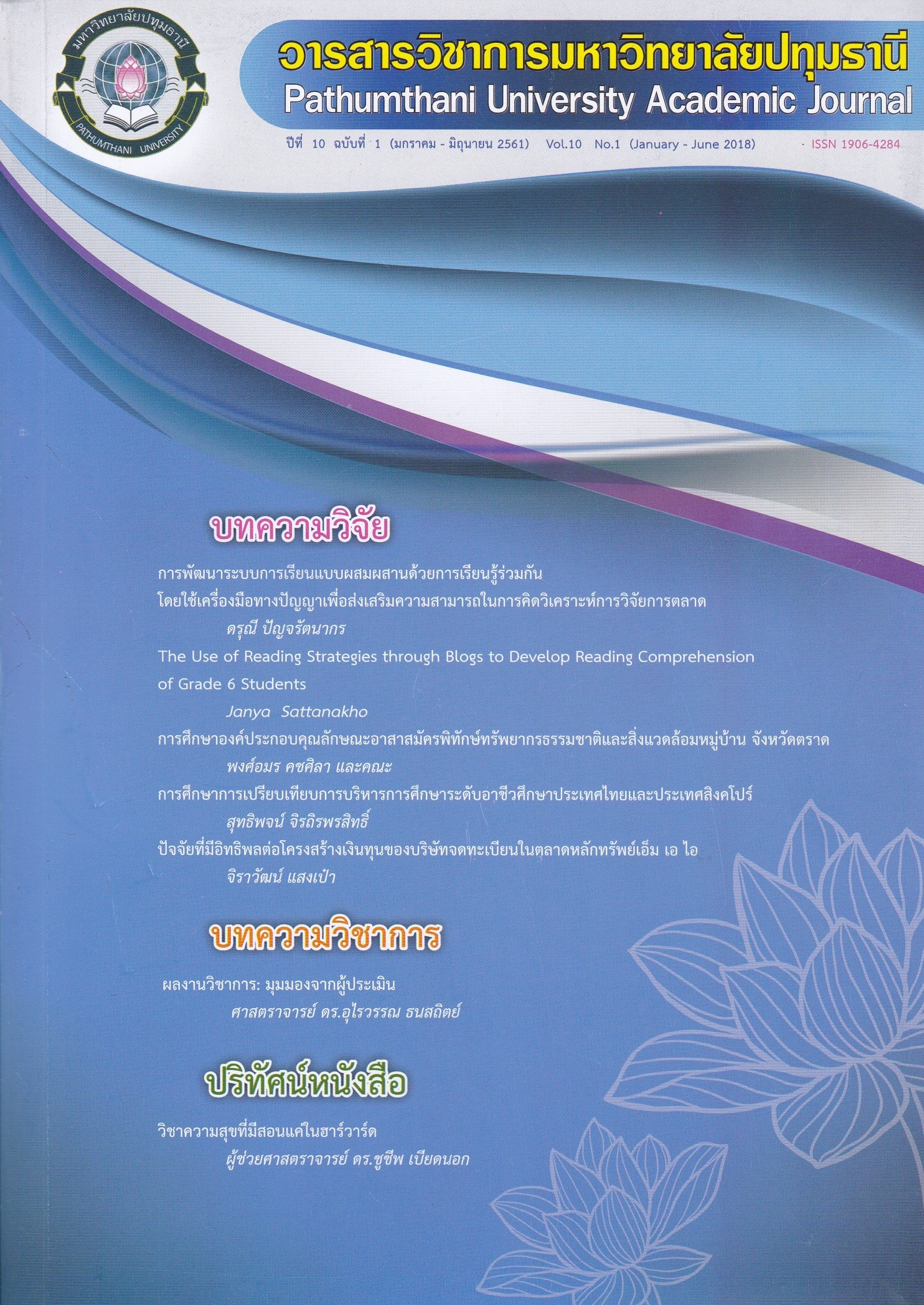
การใช้กลวิธีการอ่านผ่านบล็อกเพื่อพัฒนาความเข้าใจในการอ่านภาษาอังกฤษของนักเรียนชั้นประถมศึกษาปีที่ 6
คำสำคัญ:
Reading Strategies, Blogs, Reading Comprehensionบทคัดย่อ
In this research, the effect of using reading strategies through blogs to develop English reading comprehension on grade 6 students was investigated, as well as, the students’ opinion towards the use of reading strategies through blogs was examined. Samples were 14 grade 6 students studying at Ban Nonrae School, Nachauek District, under Maha Sarakham Primary Educational Service Area Office 2. The research tools were lesson plans using reading strategies through blogs activities, inventory, blogs, reading comprehension test, and students’ opinion questionnaire. Data were analyzed to find out the means (X), standard deviation (S.D.), and t-test. The results indicated that mean scores for posttest after using reading strategies were higher than those for pre-test with statistically significant differences at .05 level, and were higher than the criterion set of 60 percent with statistically significant differences at .05 level as well. As for students’ opinion towards the use of reading strategies through blogs, the students had positive opinion of all items. Conclusively, the use of reading strategies through blogs supported to develop English reading comprehension on grade 6 students, as well as, the students had positive opinion of using reading strategies through blogs.
เอกสารอ้างอิง
2. Duffy, Peter and Bruns, Axel. (2006). “The use of blogs, wikis and RSS in education: A conversation of possibilities.” In Proceedings Online Learning and Teaching Conference 2006. Pp. 31-38. Brisbane.
3. Hong, WANG. (2008). “Exploring educational use of blogs in U.S. education.” In US-China education review. 5(10): 34-38. McNamara, D. S. (2009). “The importance of teaching reading strategies,” In Perspectives on Language and Literacy. 35(2): 34-40.
4. McNamara, D. S., ed. (2007). Reading comprehension strategies: Theory, interventions, and technologies. Mahwah, NJ : Erlbaum.
5. Moon, Dosik and Lim, Dong Kyun. (2013). “Using weblogs in foreign language classrooms: Possibilities and challenges.” In International Journal of Software Engineering and Its Applications. 7(5): 121-128.
6. Pardo, Laura S. (2004, November). “What every teacher needs to know about comprehension.” In The Reading Teacher. 58(3): 272-281.
7. Pearson Education. (2013). National evaluation series. [Online]. Accessed 2013, December. 9. from http://gg.gg/4dbyb.
8. Pinkman, Kathleen. (2005). “Using blogs in the foreign language classroom: encouraging learner independence.” The JALT CALL Journal. 1(1): 12-24.
9. Place, Janice Becker. (2012). Blogging about summer reading: The learning and engagement of high school students using interactive technology. Ph.D. Dissertation. University of Rhode Island and Rhode Island College. Roberts, J. C. and Roberts, K. A. (2008). “Deep reading, cost/benefit, and the construction of meaning: Enhancing reading comprehension and deep learning in Sociology courses.” Teaching Sociology, 36(2): 125-140. Usa Noytim. (2010). “Weblogs enhancing EFL students’ English language learning.” In Procedia Social and Behavioral Sciences. 2(2010): 1127-1132. Van Epps, Casey. (2012). Blogging as a strategy to support reading comprehension skills. Master’s Thesis. School of Education. St. John Fisher College. Ward, Jason M. (2004). “Blog Assisted Language Learning (BALL): Push button publishing for the pupils.” In TEFL Web Journal. 3(1): 1-16
ดาวน์โหลด
เผยแพร่แล้ว
รูปแบบการอ้างอิง
ฉบับ
ประเภทบทความ
สัญญาอนุญาต
บทความที่ได้รับการตีพิมพ์เป็นลิขสิทธิ์ของวารสารมหาวิทยาลัยปทุมธานี
ข้อความที่ปรากฎในบทความแต่ละเรื่อง เป็นความคิดเห็นส่วนตัวของผู้เขียน กองบรรณาธิการไม่จำเป็นต้องเห็นด้วยเสมอไป และไม่มีส่วนรับผิดชอบใด ๆ ถือเป็นความรับผิดชอบของผู้เขียนแต่เพียงผู้เดียว


