
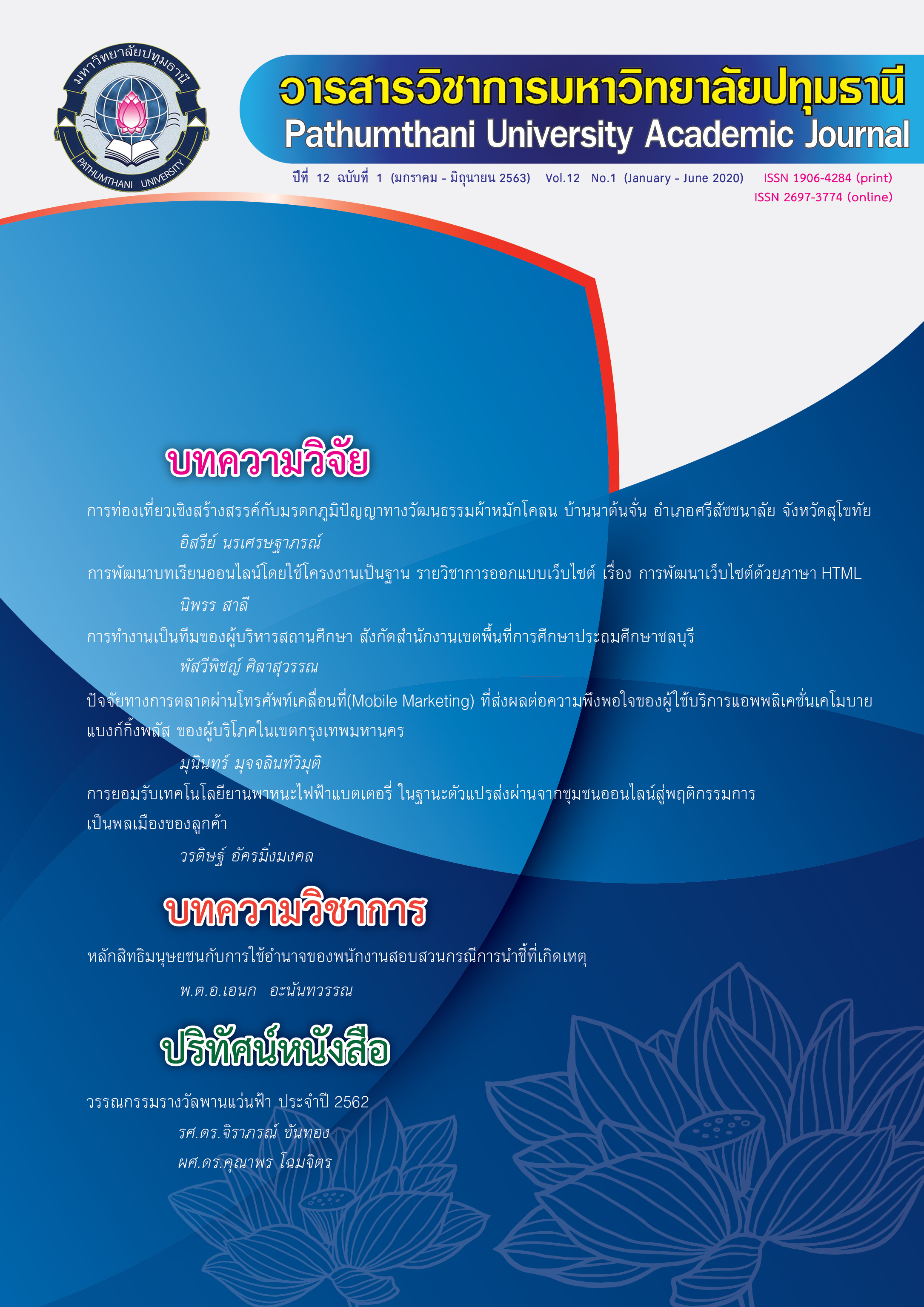
การยอมรับเทคโนโลยียานพาหนะไฟฟ้าแบตเตอรี่ ในฐานะตัวแปรส่งผ่านจากชุมชนออนไลน์สู่พฤติกรรมการเป็นพลเมืองของลูกค้า
คำสำคัญ:
ชุมชนออนไลน์ การยอมรับและการใช้เทคโนโลยี พฤติกรรมการเป็นพลเมืองของลูกค้า รถยนต์ไฟฟ้าแบตเตอรี่บทคัดย่อ
งานวิจัยนี้มีวัตถุประสงค์เพื่อศึกษาอิทธิพลของชุมชนออนไลน์ที่ส่งผลไปยังพฤติกรรมการเป็นพลเมืองของลูกค้าโดยมีทฤษฎีการยอมรับและการใช้เทคโนโลยีเป็นตัวแปรส่งผ่านทั้งอิทธิพลทางตรงและทางอ้อมในอุตสาหกรรมรถยนต์ไฟฟ้าแบตเตอรี่ โดยใช้แบบสอบถามเป็นเครื่องมือในการเก็บรวบรวมข้อมูลจากสมาชิกในชุมชนออนไลน์ที่นำเสนอเนื้อหาเกี่ยวข้อง จำนวน 400 ตัวอย่าง โดยวิธีการสุ่มแบบสะดวก สถิติที่ใช้ในการวิเคราะห์ข้อมูลได้แก่ ความถี่ ร้อยละ ค่าเฉลี่ย ค่าเบี่ยงเบนมาตรฐาน และตัวแบบสมการโครงสร้าง
ผลการศึกษาพบว่ากลุ่มตัวอย่างเป็นเพศชายมากกว่าหญิง มีอายุระหว่าง 24-40 ปี สถานภาพ โสด การศึกษาระดับปริญญาตรี ประกอบธุรกิจส่วนตัว และมีรายได้เฉลี่ยต่อเดือน ต่ำกว่า 30,000 บาท ซึ่งพบว่าชุมชนออนไลน์มีอิทธิพลต่อการยอมรับเทคโนโลยีและพฤติกรรมตามเป็นพลเมืองของลูกค้าเฉพาะในส่วนพฤติกรรมพิเศษนอกเหนือบทบาท การยอมรับเทคโนโลยีมีอิทธิพลต่อพฤติกรรมการเป็นพลเมืองของลูกค้า และชุมชนออนไลน์มีอิทธิพลต่อการยอมรับเทคโนโลยีและพฤติกรรมตามเป็นพลเมืองของลูกค้าโดยมีการยอมรับเทคโนโลยีเป็นตัวแปรส่งผ่านอย่างมีนัยสำคัญ ที่ระดับความเชื่อมั่น 0.05
เอกสารอ้างอิง
Bagozzi P. Richard amd Dholakia M. Utpal. 2002. Intentional social action in virtual communities. Journal of Interactive Marketing 16 (2) 2-21.
DeLone H. William and McLean R. Ephraim. 1992. Information systems success: The quest for the dependent variable. Information Systems Research 3 60-95.
Groth Markus. 2005. Customers as good soldiers: examining citizenship behaviors in internet service Deliveries. Journal of Management 31 (1) 7-27.
Gruen Thomas. 1995. The outcome set of relationship marketing in consumer markets. International Business Review 4 (4) 447-469.
Hennig-Thurau Thorsten, Gwinner P. Kevin, Walsh Gianfranco, Gremler D. Dwayne. 2004. Electronic word-of-mouth via consumer-opinion platforms: What motivates consumers to articulate themselves on the Internet?. Journal of Interactive Marketing 18 (1) 38-52.
Hsu Li-Chun. 2017. Investigating community members’ purchase intention on Facebook fan page: From a dualistic perspective of trust relationships. Industrial Management and Data System 117 766-800.
Islam Jamid and Rahman Zillur. 2016. Examining the effects of brand love and brand image on customer engagement: An empirical study of fashion apparel brands. Journal of Global Fashion Marketing, 7:1, 45-59
Laroche Michel, Habibi Reza Mohammad, Richard Marie-Odile. 2013. To be or not to be in social media: How brand loyalty is affected by social media? International Journal of Information Management 33 76-82.
McAlexander H. James, Schouten W. John and Koenig F. Harold. 2002. Building Brand Community. Journal of Consumer Research 27 412-431.
Okazaki S. 2007. Mobile marketing referral among the Japanese youth: does viral marketing work? 36th EMAC Conference, 22-25 May 2007. Reykjavik.
Rheingold Howard. 2001. The Virtual Community: Introduction The virtual community: Homesteading on the electronic frontier. W New York, NY: HarperPerennial
Smith, C., Organ, D.W., Near, J.P. 1983. Organizational citizenship behavior: Its nature and antecedents Journal of Applied Psychology 68 (4) 653-663.
Tsai Ming-Tien, Cheng Nai-Chang, Chen Kun-Shiang. 2011. “Understanding online group buying intention: the roles of sense of virtual community and technology acceptance factors” Total Quality Management 22 (10): 1091-1104.
Venkatesh Viswanath, Morris G. Michael, and Davis B. Gordon. 2003. “User acceptance of information technology: Toward a unified view.” MIS Quarterly 27 (3): 425-478.
Venkatesh Viswanath, Thong Y.L. James, and Xu Xin. 2012. Consumer acceptance and use of information technology: extending the unified theory of acceptance and use of technology MIS Quarterly 36 (1) 157-178.
Wang Hua, Fulk Janet, Mclaughlin Margaret. 2011. “Understanding Online Community Participation: A Technology Acceptance Perspective” Commnuication Research 39 (6) 781-801.
ดาวน์โหลด
เผยแพร่แล้ว
รูปแบบการอ้างอิง
ฉบับ
ประเภทบทความ
สัญญาอนุญาต
บทความที่ได้รับการตีพิมพ์เป็นลิขสิทธิ์ของวารสารมหาวิทยาลัยปทุมธานี
ข้อความที่ปรากฎในบทความแต่ละเรื่อง เป็นความคิดเห็นส่วนตัวของผู้เขียน กองบรรณาธิการไม่จำเป็นต้องเห็นด้วยเสมอไป และไม่มีส่วนรับผิดชอบใด ๆ ถือเป็นความรับผิดชอบของผู้เขียนแต่เพียงผู้เดียว


