
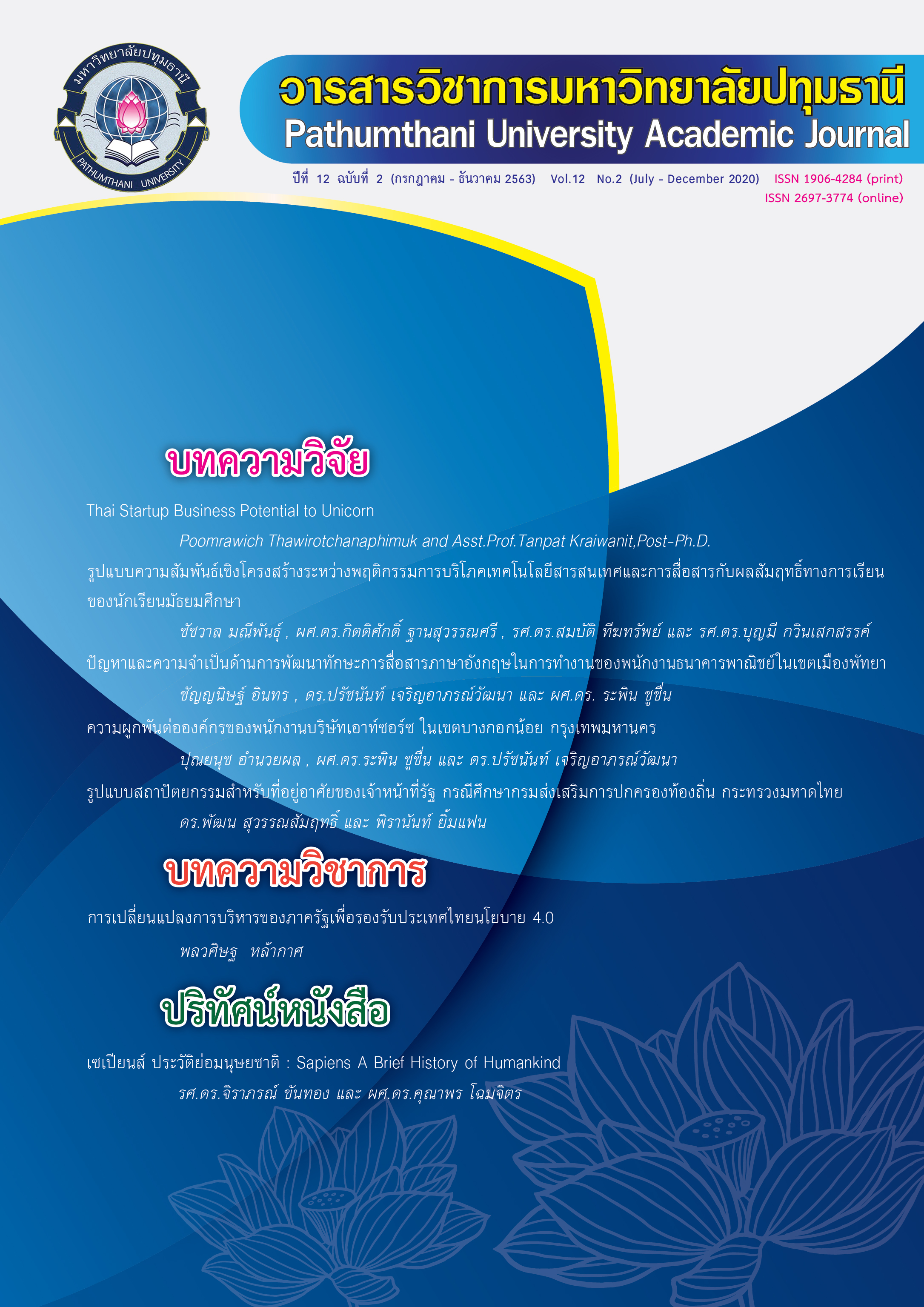
การเปลี่ยนแปลงการบริหารของภาครัฐเพื่อรองรับประเทศไทย 4.0
คำสำคัญ:
การบริหารภาครัฐ, ประเทศไทย4.0บทคัดย่อ
ประเทศไทย ได้มีนโยบาย 4.0 เพื่อเป็นโมเดลในการพัฒนาเศรษฐกิจ ให้สามารถหลุดจาก กับดักประเทศรายได้ปานกลาง (Middle income trap) กับดักความเหลื่อมล้ำของความมั่งคั่ง และกับดักความไม่สมดุลในการพัฒนา เพื่อเตรียมความพร้อมในการอย่างยั่งยืน โดยเฉพาะในปัจจุบันที่โลกเข้าสู่การปฏิวัติอุตสาหกรรมยุคที่ 4 รัฐบาลได้วางแผนยุทธศาสตร์ชาติ 20 ปีที่ ด้วยการสร้างความเข้มแข็งจากภายใน ควบคู่ไปกับการเชื่อมโยงกับประชาคมโลก โดยภาครัฐ เป็นหนึ่งในเสาหลักที่เป็นร่วมมือระหว่าง ภาครัฐ ภาคเอกชน และมหาวิทยาลัยที่จะทำงานงานวิจัย เข้าสู่อุตสาหกรรมและสังคม โดยขับเคลื่อนผ่านกลไกให้ทุกภาคส่วนเข้ามามีบทบาทร่วมกันในการพัฒนาคุณภาพชีวิตให้ดีขึ้น ดังนั้นการปรับตัวบทบาทของภาครัฐ จำเป็นต้องปฏิรูปภาครัฐและพัฒนาโครงสร้างระบบการทำงาน ที่เกี่ยวข้องกับนโยบาย 4.0 สร้างการมีส่วนร่วมของภาครัฐ สร้างระบบการทำงานแบบอัจฉริยะ เพื่อเตรียมความพร้อมของบุคลากร การบูรณาการร่วมกัน ไปสู่ระบบเศรษฐกิจมูลค่าสูงอย่างเต็มรูปแบบเพื่อก้าวสู่ประเทศที่พัฒนาแล้ว
เอกสารอ้างอิง
Decode “Thailand 4.0” .(2016) .New Economy: crossing over the middle-income trap. Thairath. Retrieved 22 April 2020 from http:// www.thairath.co.th/content/613903
Digital Economy Promotion Agency. (2017). Digital Economy Promotion Agency inaugurates Tech Startup Club. Retrieved 10 May 2020, from http://www.depa.or.th/th/newsA7-tech-startup-club.
Dutta, Soumitra, Lanvin, Bruno, and Wunsch-Vincent, Sacha. (2018). The Global Innovation Index 2016: Winning with Global Innovation. Cornell University, INSEAD and WIPO, Geneva.
Jiraprapha Akkarabavorn, Anuchart Charoenwongmit and Jaruwan Yonrakang. (2009) . The management of the changing. 3rd edition. Bangkok: Office of the Public Sector Development Commission. Cabinet and Royal Gazette Publishing Office.
Kasetsat University. (2016) . Blueprint and action plan for Thailand 4.0, driving model for Thailand 4.0 Model to Bring Security, Wealth and Stability to Thailand. Retrieved 10 March 2020 from http://www.digital.forrest.ku.ac.th/TFCC/TCERN 2017/PW/Thailand_4.0_PM.pdf
Koopman, C., Mitchell, M.D. & Thierer, A.D. (2015). The sharing economy and consumer protection regulation: the case for policy change. The Journal of Business, Entrepreneurship & the Law: SSRN Electronic Journal SSRN Journal
Ministry of Industry. (2016). National Strategic Development Plan Thai 4.0 (B.E.2560-2579). Retrieved May 22 2020 from http://www.oie.go.th/sites/default/files/attachments/industry_plan/thailandindustrialdevelopmentstrategy4.0.pdf.
National Productivity Institute.(2018). Thailand 4.0 Country Development Model for Sustainable, Prosperous, and Sustainable Development Retrieved May 15 2020 from http://www.ftpi.or.th/ 2016
Peerasit Patanakul and Pinto, Jeffrey K.. (2014). Examining the Roles of Government Policy on Innovation. The Journal of High Technology Management Research.
Sarel, Michael. (1996). Growth in East Asia: What we can and what we cannot infer (Vol. 1). International Monetary Fund .
Schedler, K. & Proeller, I. (2007). Chapter 1 public management as a cultural phenomenon. S.l.: Emerald Group Publishing Limited.OECD. (2015). OECD Digital Economy Outlook. Paris: S.N.
Software Industry Promotion Agency (Public Organization) (SIPA). (2015).Software market. Retrieved May 12 2020 from
https://www.aripfan.com/sipa-software-market-thai/
Suwit Mesinsee. (2016). Thailand 4.0 . Retrieved 10 April 2020 from http://www.Th-th.facebook.om
Thailand Productivity Institute and the Federation of Thai Industries .(2016). Improvement of Thai Industrial Sector to Accommodate Future Management. Retrieved 10 May 2020 from http://www.Ftpi.or.Th/download/member-le/productivity_world/pw119/p-world-issue119-Nov-Dec-15-Future.pdf/9835.
The Global Open Data Index .(2017).The open statistic .Retrieved on May 18 2020 from http://2015.index.okfn.org/dataset/
The World Bank. (2018). Ease of doing business index Catalog Ease of doing business index. Retrieved on May 10 2020 from https://data.worldbank.org/indicator/IC.BUS.EASE.XQ
The World Bank. (2018). GDP (current US$). Retrieved on February 1 2020 from http://data.worldbank.org/indicator/NY.GDP.MKTP.CD?locations= TH&view=chart.
Thipsarin Pakthanakul and Totsapol Chiaochanprapan. (2016). Open Government Data to Open Government: Innovation in Thailand’s Public Administration in the Digital Era. The 18th King Prajadhipok's Institute Conference (2016), Revitalizing Thai Democracy . Bangkok: King Prajadhipok's Institute Conference,
Wichan Chaiorn (2016). Academic Focus Thailand 4.0. Retrieved on 8 May 2020 from http://dl.parliament.go.th/handle/lirt/493129,2
Woralak Sriyai. (2013). Less racing for government scholarship, focusing more on “crime-disaster”, low brain-drain in face of low wages. Retrieved on 8 April 2020 from http://www.tcijthai.com/news/2013/02/scoop/1984.
World Economic Forum .(2018).The Global Competitiveness Report 2017-2018 . Retrieved on June 12 2020 from https://www.weforum.org/reports/the-global-competitiveness-report-2017-2018
ดาวน์โหลด
เผยแพร่แล้ว
รูปแบบการอ้างอิง
ฉบับ
ประเภทบทความ
สัญญาอนุญาต
บทความที่ได้รับการตีพิมพ์เป็นลิขสิทธิ์ของวารสารมหาวิทยาลัยปทุมธานี
ข้อความที่ปรากฎในบทความแต่ละเรื่อง เป็นความคิดเห็นส่วนตัวของผู้เขียน กองบรรณาธิการไม่จำเป็นต้องเห็นด้วยเสมอไป และไม่มีส่วนรับผิดชอบใด ๆ ถือเป็นความรับผิดชอบของผู้เขียนแต่เพียงผู้เดียว


