
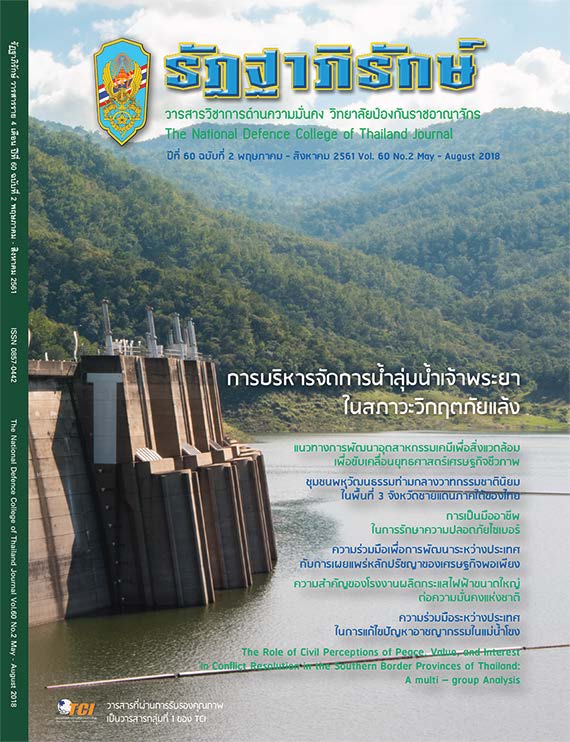
Water Management in The Chao Phraya River Basin during Drought Crisis
Keywords:
Water ManagementAbstract
The objectives of this Research are to analyse the minimum quantity
essential for utilisation in various activities, to evaluate the satisfaction out
of government relief measures to help the farmers affected by water scarcity
and to offer effective water management practices and relief measures
for those affected during the crisis, through the study and analysis of the
processes, types and characteristics of the national strategies and policies
of Thailand’s water management with focuses on clarity, specificity and
capability in the transformation of relevant policies into practices. The
Research has gathered secondary data on water resource development plan
and water management, in addition to the information received from in-depth
interviews with water management experts, responses of a questionnaire
from 1,025 concerned government officials and farmers in all 13 provinces
under the responsibility of the Regional Irrigation Offices 10, 11 and 12 by
using statistical tools in an effort to obtain the results of the Research.
The results of the study show that the minimum quantity of water
needed for various activities in the Chao Phraya River Basin is 18 million
cubic metres a day, in terms of 7, 8 and 3 million cubic metres respectively
for public consumption, ecological balance maintenance and agricultural
purposes. Therefore, the study suggests that a total of 3,258 cubic metres of
water budget should be reserved for overall utilisation during the dry season
while an additional quantity of 1,098 cubic metres is reserved for any dry
spell during May and June, totalling 4,356 cubic metres, as in 2017.
Regarding the relief measures for the farmers affected by water
scarcity in 2015, the study found that the affected farmers were very
satisfied with the measures to allow debt payment delay or payment period
extension for the farmers who owe to financial institutions, to increase water
budget, to increase the efficiency of water utilisation and to create jobs in
order to increase the income of affected farmers. Most of the interviewed
farmers believed the problems and challenges in water management were
due mainly to the lack of water reserves and water budget resources,
efficient water management, cooperation from the general public and farmers
and effective public relations. Meanwhile they also cited the cooperation
from the farmers and general public in following government regulations
and advice and the integrated efforts and cooperation among concerned
government agencies as the most important factors in water management
during the drought crisis. In addition, 93.46 percent of the farmers said they
were fairly satisfied up to most satisfied with the water management of the
Royal Irrigation Department during the drought crisis in 2015.
In order to achieve good practices in water management in the Chao
Phraya River Basin during the drought crisis, the study found that there should
be certain preparations in four major areas. For water management policies,
there should be the review and amendment of all concerned regulations
and laws in relation to the reliefs and aids for crisis affected farmers so that
such reliefs and aids will be in harmony with the government operations
in affected areas and rendered to the affected farmers promptly. For water
budget management, the drought risk management system should be
developed at national and provincial levels, with an integration of a national
disaster related database and the development of appropriate tools and
technology for water management with a focus on information exchange
and cooperation among related groups of scientists. For water utilisation
demand management, there should be an agricultural zoning to be in line
with projected quantity of water in the future and a promotion of less water
consuming plants of agricultural areas to replace dry season rice growing.
Also, for knowledge creation, public participation and public relations, the
knowledge on drought crisis and relief measures and related skills, as well
as a learning mechanism in all possible dimensions of crisis management
systems, should be promoted; the participation of government sector, private
sector and public sector should be encouraged while crisis warning systems
and public information accessibility should also be made with help from
information technology and the efficient public relations on drought crisis
should be conducted to promote the awareness and understanding among
the general public for future adjustment and readiness in the time of crisis.
Downloads
Published
Issue
Section
License
บทความ ข้อเขียน หรือความคิดเห็นในนิตยสารนี้เป็นของผู้เขียน ไม่ผูกพันกับวิทยาลัย ป้องกันราชอาณาจักรและทางราชการแต่อย่างใด

