
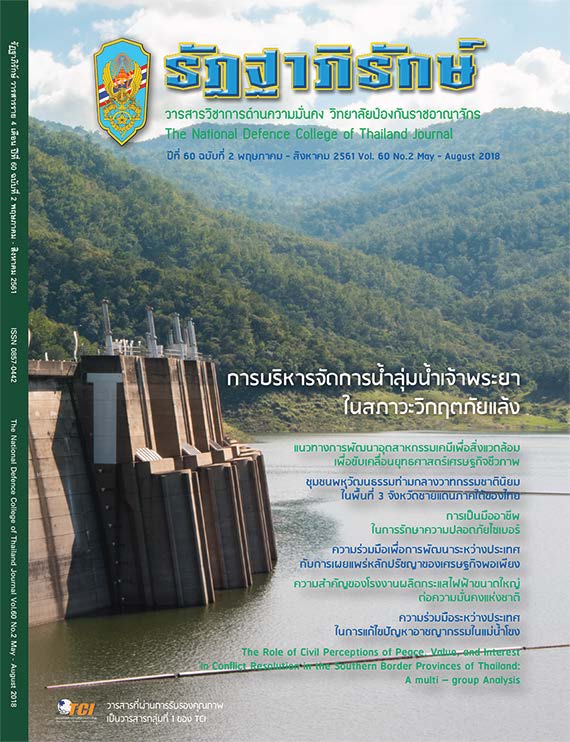
The Role of Civil Perceptions of Peace, Value and Interest in Conflict Resulution in the Southern Border Provinces of Thailand: A multi-group Analysis
Keywords:
civil perception of peace, civil perception of value, civil perception of interest, conflict resolution program, conflict resolution process, conflict resolution outcome, Southern Border Provinces of Thailand conflictAbstract
This study explores the relationships between the perceptions of peace,
value and interest and the conception of conflict resolution for the conflict in the
southern border provinces of Thailand focusing on the outcome and the process
of the conflict resolution program for the two civil population groups – adult and
youth. It used structural equation modelling (SEM) and Chi square statistics for the
empirical analysis of data and a focus group method in collecting expert opinions
on the subjects for a qualitative analysis in which both results are compared. The
data were collected by questionnaires during the period of October 2017 to January
2018 in the three border provinces of Thailand, Pattani, Yala and Narathiwat for 200
adults and 300 youths. The study finds that adult and youth groups are significantly
different in terms of self-advocacy regarding power distribution, peace, value
and interest. In addition, for both groups, the perception of interest and the effect
of conflict environment were significant while the perception of peace and the
perception of value was not. As the perception of interest was oriented towards
the national interest and having a negative relationship with the conception of
conflict resolution as a one whole program, or as a composing components of
output and process of the conflict resolution program; it suggests that the civil
populations perceive the ‘national interest centric’ approach to conflict resolution
as having the negative effects on the conflict resolution program. Lastly, the adult
and youth groups are significantly different in regard of the strength of the effect
of the perception of interest on the conflict resolution program; that is the youth
group is more strongly against the ‘national centric’ approach than the adult group.
The expert opinions suggest that adults adopt a more conservative and moderate
position with gradual change towards a local empowerment and governance
while youths are impatient and adopt a more radical position of social and political
changes. In general, it agrees with the empirical results that the adult and youth
groups differ in many respects in the perceptions of peace, value and interest and
the conceptions of conflict resolution.
Downloads
Published
Issue
Section
License
บทความ ข้อเขียน หรือความคิดเห็นในนิตยสารนี้เป็นของผู้เขียน ไม่ผูกพันกับวิทยาลัย ป้องกันราชอาณาจักรและทางราชการแต่อย่างใด

