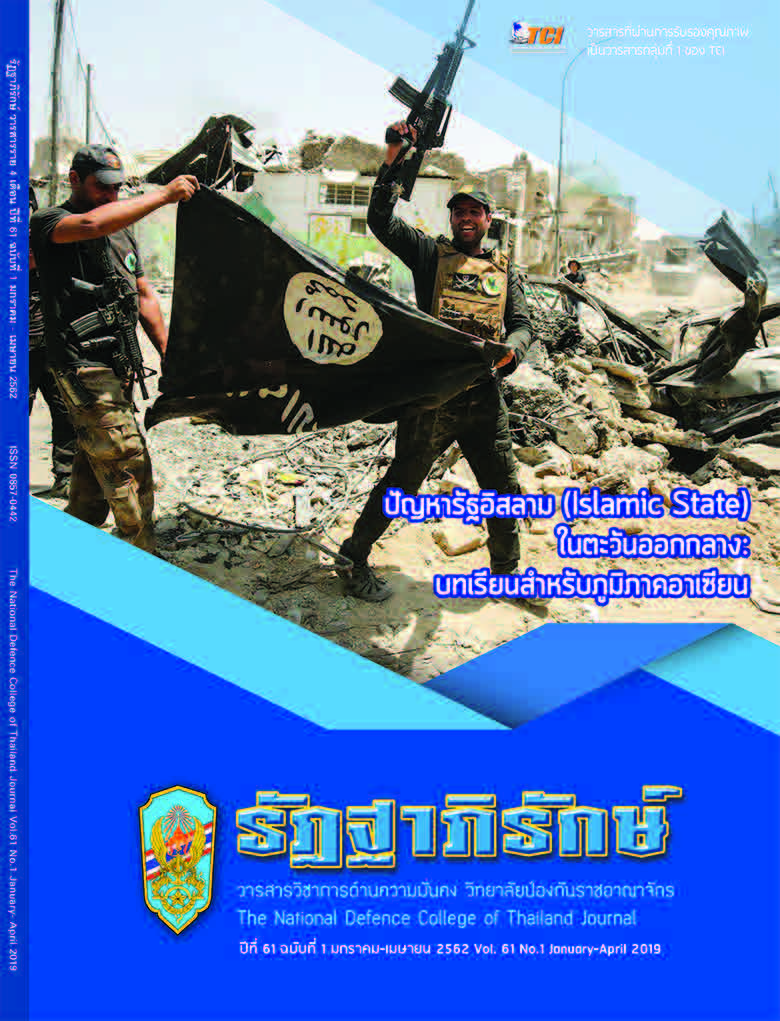
The Problem of Islamic State in the Middle East:the Lesson for the ASEAN Region
Keywords:
Islamic State, Terrorism, ASEAN Community, Middle EastAbstract
After the 9/11 incident, on 11 September 2001, had shaken the world, the
United States declared “War on terror” to hunt down Osama bin Laden, the founder
of Al-Qaeda, who believed to be the mastermind behind the incident. Although the
operation was declared a success after 10 years of hunting, it cannot bring back peace to
the world and the region. Instead, it has created a more extreme terrorist group aiming
to establish an Islamic State as the centre and leader of all Islamic worlds known as
“Caliphate”. Later on, the group had successfully occupied part of Iraq and Syria and
declared the establishment of “Islamic State of Iraq and the Levant” and called itself
“Islamic State” or “IS”. With the hard suppression and support of major powers such
as Russia and the United States, Syria and Iraq were able to seize territory back from IS.
Nonetheless, IS is still able to operate around the world by using social media as a tool
to spread its ideology. In ASEAN, the world has witnessed the capture of Marawi, the
city in Mindanao, the Philippines, by Maute who call themselves the “Islamic State of
Lanao”. The Philippines government had spent 5 months to seize back the town and
the Maute’s brothers were killed in the combat. However, the terrorist groups affiliated
to IS are still operating in several countries of ASEAN such as Malaysia, Indonesia and
the Philippines. The formation of the establishment of an Islamic State in the Middle
East has resulted in intensified acts of terrorism around the world and ASEAN.
With the significance of the IS activities, this paper seeks to suggest lessons learned
and proposes policies to strengthen and prevent the expansion of terrorism in the
ASEAN’s region and Thailand. The scope of this research is the study of establishment
of Islamic states in the Middle East compared with terrorist activities in ASEAN through
5 factors namely; history, geopolitics, internal factors, external factors and development
of the situation.
Finally, I do hope that information from in-depth interviews with Thai and
international experts will make the paper more valuable.
Downloads
Published
Issue
Section
License
บทความ ข้อเขียน หรือความคิดเห็นในนิตยสารนี้เป็นของผู้เขียน ไม่ผูกพันกับวิทยาลัย ป้องกันราชอาณาจักรและทางราชการแต่อย่างใด

