
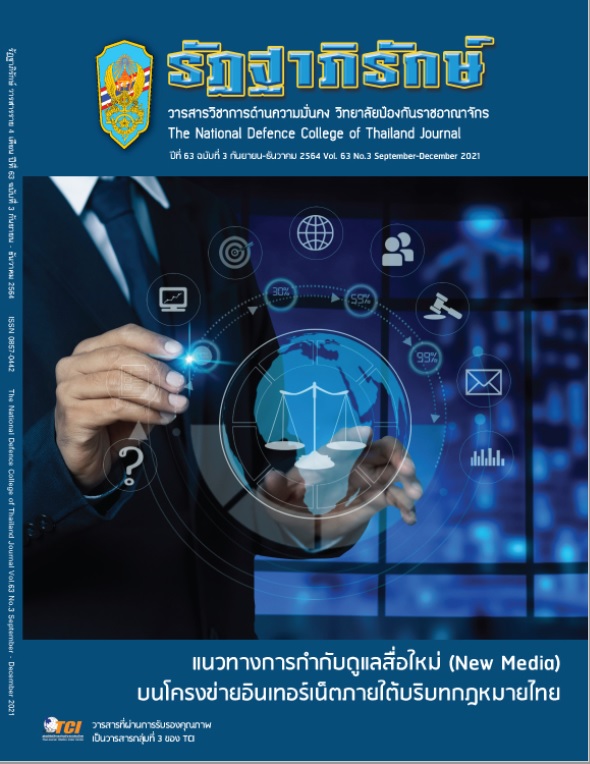
New Media over the Internet: Regulation under Thai Law
Keywords:
Regulation, New Media, Internet, Thai LawAbstract
The goals of this research are to investigate the trend of new media services on the Internet in different regions and in Thailand, as well as the international regulatory frameworks that are implemented in various countries in comparison to Thai practices. It also intends to investigate the issues and legal gaps that have arisen as a result of the proliferation of new media. Then, some recommendations and regulatory practices will be proposed to solve the issues that have prevented Thailand from effectively utilizing digital technologies to drive the country as planned in the 20-year National Strategy, while minimizing the negative effects on the economy, society, and national security.
This is a qualitative and descriptive study that gathered primary data through in-depth interviews with experts in the new media industry and related fields. Furthermore, secondary data is collected from literature studies on concepts and practices in new media regulation, as well as existing documents from a seminar on Over-the-Top Broadcasting Services in Thailand, which aggregated the opinions and arguments of new media industry stakeholders. The acquired data is analyzed using qualitative content analysis to compare and synthesize in order to identify key issues and make recommendations on the regulation of the new media on Internet in the Thai legal context
The study discovered that the emergence of New Media on the Internet has a significant impact on Thailand's national security, especially in the aspect of culture, national value, morality, and citizen disharmony. It also identified the primary issues causing ineffective new media regulation in Thai context, which are the law enforcement on new media, the efficiency of the law enforcement procedure and the proportion and balance of the existing laws.
According to the study, policymakers should move quickly to appoint the NBTC as the convergence services regulator, and to shift the law enforcement procedure for public harms from criminal justice to administrative order. The regulation without new media service blockage is also suggested for the operating guidelines. Moreover, regulating procedures should be as extensive as necessary and emanate from all parties involved. Regulation using technical mechanisms such as the CDN system is also recommended in order to prevent or block public harm while also improving the quality of new media services.
Downloads
Published
Issue
Section
License

This work is licensed under a Creative Commons Attribution-NonCommercial-NoDerivatives 4.0 International License.
บทความ ข้อเขียน หรือความคิดเห็นในนิตยสารนี้เป็นของผู้เขียน ไม่ผูกพันกับวิทยาลัย ป้องกันราชอาณาจักรและทางราชการแต่อย่างใด

