
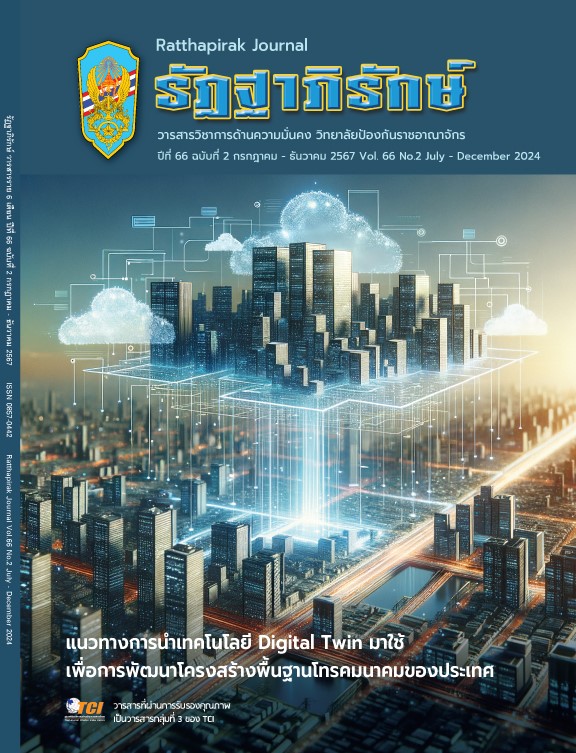
Approach for Digital Twin Technology Adoption for National Telecommunication Infrastructure Development
Keywords:
Digital Twin, Digital infrastructure, Telecommunication resourcesAbstract
This research was conducted because it was seen that many countries tend to drive economic and social development policy by emphasizing on digital infrastructure elevation as a foundation of such development and utilizing new technologies as key elements. Digital Twin, emerged from new technological convergence, therefore, is interesting to be adopted for the development. For this reason, this research aims at (1) examining Digital Twin process and adoption practice in other countries, (2) analyzing problems, obstacles, and key success factors, and (3) proposing policy recommendation for promotion of Digital Twin adoption for telecommunication infrastructure development.
The research was found that Digital Twin consisted of three main parts; real space containing physical objects, virtual space containing 3D virtual objects, and the link for data flow from real space to virtual space. Digital Twin has been widely put into practice in smart city and industrial development. However, when considering ecosystem, it still faces key challenges such as lack of ultra-broadband infrastructure and expertise. Therefore, it is necessary to form top-down and bottom-up policies, to design human-centric application, to elevate data security and to stimulate innovation development, which are considered as key success factors.
It can be proposed that policy recommendations include the need for telecommunication resource allocation for available utilization, promotion of critical backbone network deployment, promotion of variety of device to support massive interconnection, promotion of data center investment in the country, and enhancement of collaboration to fulfil the growth and development of Digital Twin ecosystem.
References
Attaran, M. & Celik, B.G. (2023). Digital Twin: Benefits, use cases, challenges, and opportunities. Decision Analytics Journal, 6 (2023). (Online). Available : https://www.sciencedirect.com/science/article/pii/S277266222300005X.
Evans, N.D. (2022). Digital twins are primed to revolutionize the infrastructure industry. (Online). Available : https://www.cio.com/article/404679/digital-twins-are-primed-to-revolutionize-the-infrastructure-industry.html.
Greives, M. (2015). Digital Twin : Manufacturing excellence through virtual factory replication. (Online). Available : https://www.researchgate.net/publication/ 275211047_Digital_Twin_Manufacturing_Excellence_through_Virtual_Factory_Replication.
KPMG. (2018). The Changing Landscape of Disruptive Technologies: Tech disruptors outpace the competition. (Online). Available : https://assets.kpmg.com/ content/dam/kpmg/pl/pdf/2018/06/pl-The-Changing-Landscape-of-Disruptive- Technologies-2018.pdf.
Li, Q. (2564). ความสัมพันธ์เชิงสาเหตุของปัจจัยการสร้างสรรค์นวัตกรรมจากงานประจำที่ส่งผลต่อประสิทธิภาพการปฏิบัติงานของบุคลากรสายสนับสนุน มหาวิทยาลัยราชภัฏเชียงใหม่. (รายงานวิจัยกองทุนวิจัยมหาวิทยาลัยราชภัฏเชียงใหม่ วิทยาลัยนานาชาติ). มหาวิทยาลัยราชภัฏเชียงใหม่.
Portulans Institute. (2023). Network Readiness Index 2023 Trust in a Network Society : A crisis of the digital age? (Online). Available : https://download.networkreadinessindex.org/reports/nri_2023.pdf.
Wang, Y., Su, Z., Guo, S., Dai, M., Luan, H. T., & Liu, Y. (2023). A Survey on Digital Twins: Architecture, Enabling Technologies, Security and Privacy, and Future Prospects. (Online). Available : http://doi.org/10.36227/techrxiv.2. 1972416.v1.
World Economic Forum. (2022). Digital Twin Cities : Framework and Global Practices. (Online). Available : https://www.weforum.org/reports/digital-twin-cities-framework-and-global-practices.
Zhu, Y. (2022). Shanghai harnessing 'digital twin' technology to improve city management. (Online). Available : https://www.shine.cn/news/metro/2202151932.
กสทช., สำนักงาน. (2564). รายงานผลการจัดให้มีโครงข่ายโทรคมนาคมเพื่อให้บริการโทรคมนาคม เคลื่อนที่สากล (International Mobile Telecommunications - IMT) ย่านความถี่ 2600 เมกะเฮิรตซ์ (ครบ 1 ปี).
ถิรพิรุฬห์ ทองคำวิฑูรย์. ผู้อำนวยการส่วนวิศวกรรมคลื่นความถี่ สำนักบริหารคลื่นความถี่ สำนักงาน กสทช. สัมภาษณ์. 23 มิถุนายน 2566
ธนาคารแห่งประเทศไทยและสำนักงาน กสทช. (2563). ข้อมูลรายงานความพร้อมของอุตสาหกรรม ในการนำเทคโนโลยี 5G มาใช้ในประเทศไทย. (ออนไลน์). เข้าถึงได้จาก : https://www.nbtc.go.th/Information/ผลการศึกษาวิจัย/47950.aspx.
นิรุตม์ จีนอยู่. ที่ปรึกษาด้านเทคโนโลยีสารสนเทศและนวัตกรรม และที่ปรึกษาด้านเทคโนโลยี สารสนเทศ สำนักส่งเสริมและบริการวิชาการพระจอมเกล้าเจ้าคุณทหารลาดกระบังสถาบันเทคโนโลยีพระจอมเกล้าเจ้าคุณทหารลาดกระบัง. สัมภาษณ์. 9 มิถุนายน 2566
ปราณธีร์ รังแก้ว. (2555). กระบวนการนำเครื่องบดย่อยขยะเอนกประสงค์ไปใช้ในเขตอำเภอสารภี จังหวัดเชียงใหม่. วิทยานิพนธ์ปริญญามหาบัณฑิต คณรัฐศาสตร์, มหาวิทยาลัยเชียงใหม่.
วรกาน ลิขิตเดชาศักดิ์. หัวหน้าเจ้าหน้าที่ฝ่ายเทคโนโลยีเครือข่ายโทรคมนาคม บริษัท หัวเว่ย เทคโนโลยี (ประเทศไทย) จำกัด. สัมภาษณ์. 23 มิถุนายน 2566
ศิวะนันท์ ศิวพิทักษ์. (2563). ทฤษฎีด้านนวัตกรรม. วารสารเซนต์จอห์น, 23(32). (ออนไลน์). เข้าถึง ได้จาก : https://sju.ac.th/pap_file/a96c0e1e91fc860c1ee2e155f088ab71.pdf
ศูนย์เทคโนโลยีอิเล็กทรอนิกส์และคอมพิวเตอร์แห่งชาติ. (2566). สรุปสถิติเครือข่ายอินเทอร์เน็ต ประจำเดือน. (ออนไลน์). เข้าถึงได้จาก : http://internet.nectec.or.th/webstats/ bandwidth.iir?Sec=bandwidth.
ส่งเสริมเศรษฐกิจดิจิทัล, สำนักงาน. (2563). Digital Twin คู่เสมือนดิจิทัลในยุคแห่งนวัตกรรม. (ออนไลน์). เข้าถึงได้จาก : https://www.depa.or.th/th/article-view/article1-2563
ส่งเสริมเศรษฐกิจดิจิทัล, สำนักงาน. (2564). บทสรุปผู้บริหารข้อเสนอแผนพัฒนาเมืองอัจฉริยะ “ภูเก็ต เมืองอัจฉริยะ” โดย สำนักงานจังหวัดภูเก็ต. (ออนไลน์). เข้าถึงได้จาก : https://manage.depa.or.th/storage/app/media/SmartCity/Tab_SmartCity/13_Phuket%20Smart%20City.pdf
Downloads
Published
Issue
Section
License
Copyright (c) 2024 Ratthaphirak Journal

This work is licensed under a Creative Commons Attribution-NonCommercial-NoDerivatives 4.0 International License.
บทความ ข้อเขียน หรือความคิดเห็นในนิตยสารนี้เป็นของผู้เขียน ไม่ผูกพันกับวิทยาลัย ป้องกันราชอาณาจักรและทางราชการแต่อย่างใด

