
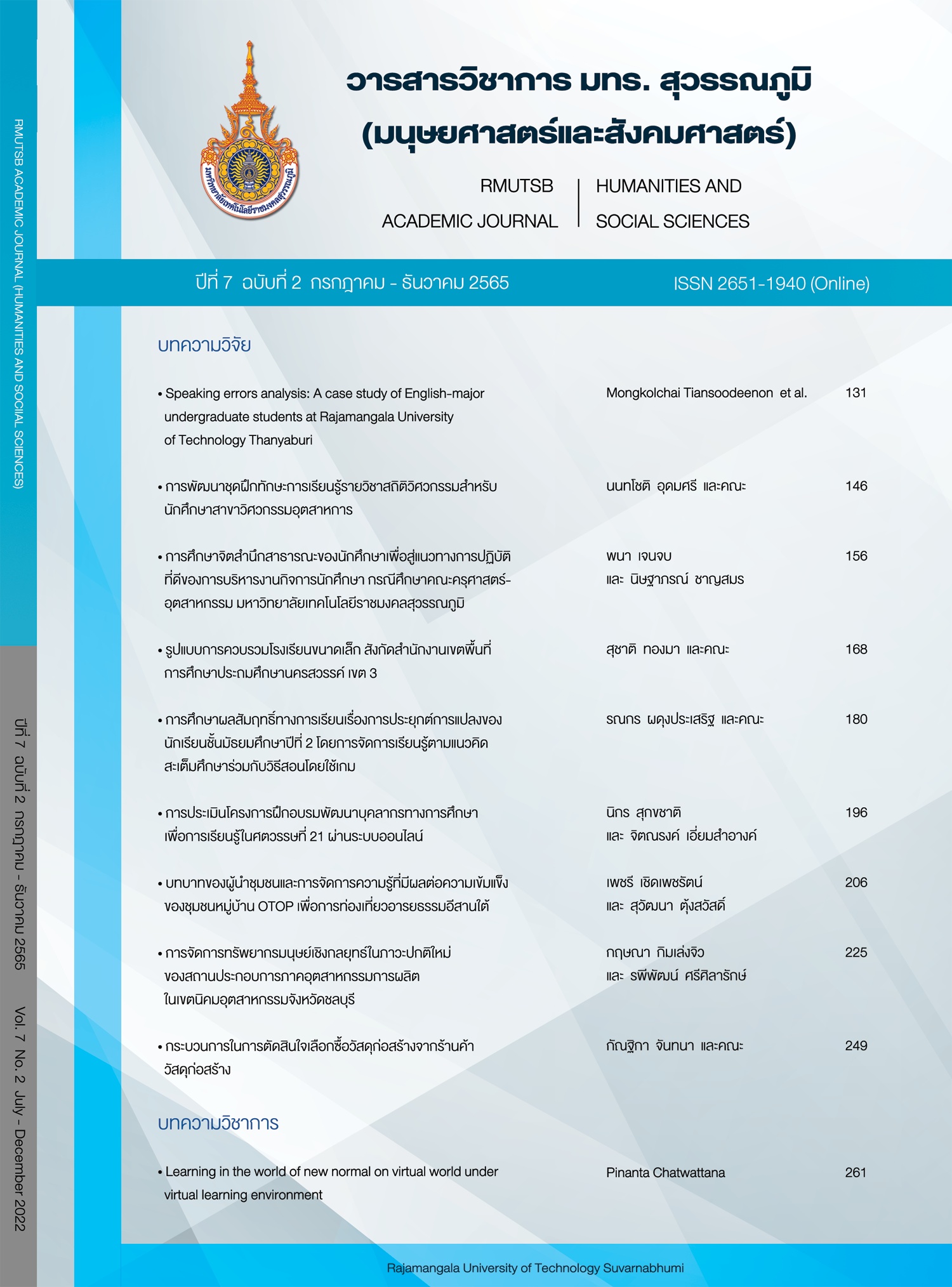
บทบาทของผู้นำชุมชนและการจัดการความรู้ที่มีผลต่อความเข้มแข็ง ของชุมชนหมู่บ้าน OTOP เพื่อการท่องเที่ยวอารยธรรมอีสานใต้
Article Sidebar
Main Article Content
บทคัดย่อ
การวิจัยครั้งนี้มีวัตถุประสงค์ เพื่อศึกษาบทบาทของผู้นำชุมชนและการจัดการความรู้ที่มีผลต่อความเข้มแข็งของชุมชน หมู่บ้าน OTOP เพื่อการท่องเที่ยวอารยธรรมอีสานใต้ โดยใช้แบบสอบถามเป็นเครื่องมือในการรวบรวมข้อมูล กลุ่มตัวอย่างในการวิจัย คือ ผู้นำชุมชนหมู่บ้าน OTOP เพื่อการท่องเที่ยวอารยธรรมอีสานใต้ จำนวน 228 คน วิเคราะห์ผลด้วยสถิติเชิงพรรณนา โดยค่าความถี่ ค่าร้อยละ ค่าเฉลี่ย และส่วนเบี่ยงเบนมาตรฐาน ทดสอบสมมติฐานด้วยสถิติเชิงอนุมานโดยวิธีการวิเคราะห์ถดถอยพหุคูณ ผลการวิจัยพบว่าบทบาทผู้นำและการจัดการความรู้ส่งผลเชิงบวกต่อความเข้มแข็งของชุมชนหมู่บ้าน OTOP เพื่อการท่องเที่ยวอารยธรรมอีสานใต้ โดยใช้สัมประสิทธิ์ในการพยากรณ์เท่ากับร้อยละ 66.20 (AdjR2=0.66) โดยบทบาทผู้นำชุมชนด้านศาสนา ศิลปวัฒนธรรม จารีตประเพณี และภูมิปัญญาท้องถิ่น ด้านการบริหารจัดการและสนับสนุนการปฏิบัติภารกิจของส่วนราชการและองค์การปกครองส่วนท้องถิ่น และการจัดการความรู้ด้านการแบ่งปันแลกเปลี่ยนความรู้ และด้านบ่งชี้ความรู้ ส่งผลเชิงบวกอย่างมีนัยสำคัญทางสถิติที่ระดับ 0.01 และ 0.05
Article Details

อนุญาตภายใต้เงื่อนไข Creative Commons Attribution-NonCommercial-NoDerivatives 4.0 International License.
เอกสารอ้างอิง
Akhavan, P., Jafari, M., & Fathian, M. (2015). Exploring the failure factors of implementing knowledge management system in the organizations. Journal of knowledge management practice, 37(2), 207-218.
Community Development Department. (2018). OTOP village project management manual for tourism OTOP village 8 routes. Retrieved May 22, 2018, form https://korat.cdd.go.th (in Thai)
Community News Station: CNS. (2018). Visit OTOP village for tourism (OTOP village 8 routes). Retrieved November 14, 2018, form https://www.cdd.go.th (in Thai)
Cronbach, L. J. (1970). Essentials of psychological testing. New York: Harper and Row.
Department of Local Administration. (1994). Subdistrict council and subdistrict administrative organization act. Bangkok: Department of Provincial Administration Ministry of Interior. (in Thai)
Hunnak, C. (2016). The leader’s characteristics in strengthened community corresponding to sustainable agricultural: A study of Ban Klong Yong Cooperative Limited, Phutthamonthon district, Nakhonpathom province. Academic Services Journal Prince of Songkla University, 27(2), 131-138. (in Thai)
Hunnak, C., Plainbangyang, S., & Atsvadachachanyut, W. (2017). Strengthening community development through the knowledge management process in organic farming in Nakhon Pathom province. Academic Services Journal Prince of Songkla University, 28(2), 158-166. (in Thai)
Khaimook, K. (2003). Fundamental statistics. Bangkok: Saifon. (in Thai)
Kongkhum, S., & Sungrugsa, N. (2015). The development of knowledge management model for shadow puppet (Nang Talung) local wisdom to strengthen local culture. Silpakorn Educational Research Journal, 7(1), 242-255. (in Thai)
Kotchawet, S. (2013). The relationship between the operations of council of community leaders and the strength of communities in Bangsaphan district, Prachuapkhirikhan province. Bangkok: Silpakorn University. (in Thai)
Leela, P., & Karnchanaporn, L. (2013). Community leaders behavior concerning community empowerment promotion: A case study of Amphoe Cha-Am, Changwat Petchaburi. Silpakorn Educational Research Journal, 5(2), 181-192. (in Thai)
Meksuwan, A., & Wingwon, B. (2015). Role of leadership and member participation in driving toward the strength of Sewing Community Enterprises, Ban Mae Hawl, Hangchat district, Lampang province. The Golden Teak: Humanity and Social Science Journal, 21(3), 20-31. (in Thai)
Office of the Public Sector Development Commission: OPDC. (2005). Knowledge management manual. Retrieved August 24, 2018, from http://www.afaps.ac.th/kmcorner/km58/km_web/KMplanmanual.pdf (in Thai)
Orr, E., & Persson, M. (2015). Performance indicators for measuring performance of activities. In Knowledge Management Projects (Master’s thesis). The University of Gothenburge, Gothenburge.
Phokanit, K., & Nooyot, K. (2016). The role of leaders in developing local community: A case study of chief executive of Nasiaw Sub-district Administrative Organization. Journal of MCU Peace Studies, 5(suppl.), 67-76. (in Thai)
Phungramphan, P. (2013). Knowledge management guidelines of subdistrict and village headmen in promoting collaboration between provincial staff and local authority staff for developing community strength. Bangkok: Chulalongkorn University. (in Thai)
Prasunin, J. (2019). Knowledge management of community capital to support sustainable management of communities in Mae Pao Sub-district, Phaya Mengrai District, Chiang Rai Province. Journal Humanities & Social Sciences, 37(1), 60-79. (in Thai)
Ponsri, I. (2008). The role of leader in relation to the strengthening community: a study of Ban Chad, Tambon Namtang, Srimuengmai district, Ubonrachathni province. Ubon Ratchathani: Ubon Ratchathani University. (in Thai)
Rovinelli, R. J., & Hambleton, R. K. (1997). On the use content specialists in the assessment of criterion reference test validity. Dutch Journal of Educational Research, 2(1), 49-60.
The Thailand Research Fund (TRF). (2009). Foundational theory of community strength. Bangkok: The Thailand Research Fund. (in Thai)
Wisethnagara, S., & Khanewan, P. (2013). The role of subdistrict administrative organization to reinforce the strength of community, Banyang Subdistrict, Lamplaimat District, Buriram Province. Journal of Burirum Rajabhat University, 5(2), 121-133. (in Thai)
Wanthong, P., & Cheyjanya, P. (2015). The communication strategies for convey wisdom of silk weaving of Prathun village. Bangkok: National Institute of Development Administration.
