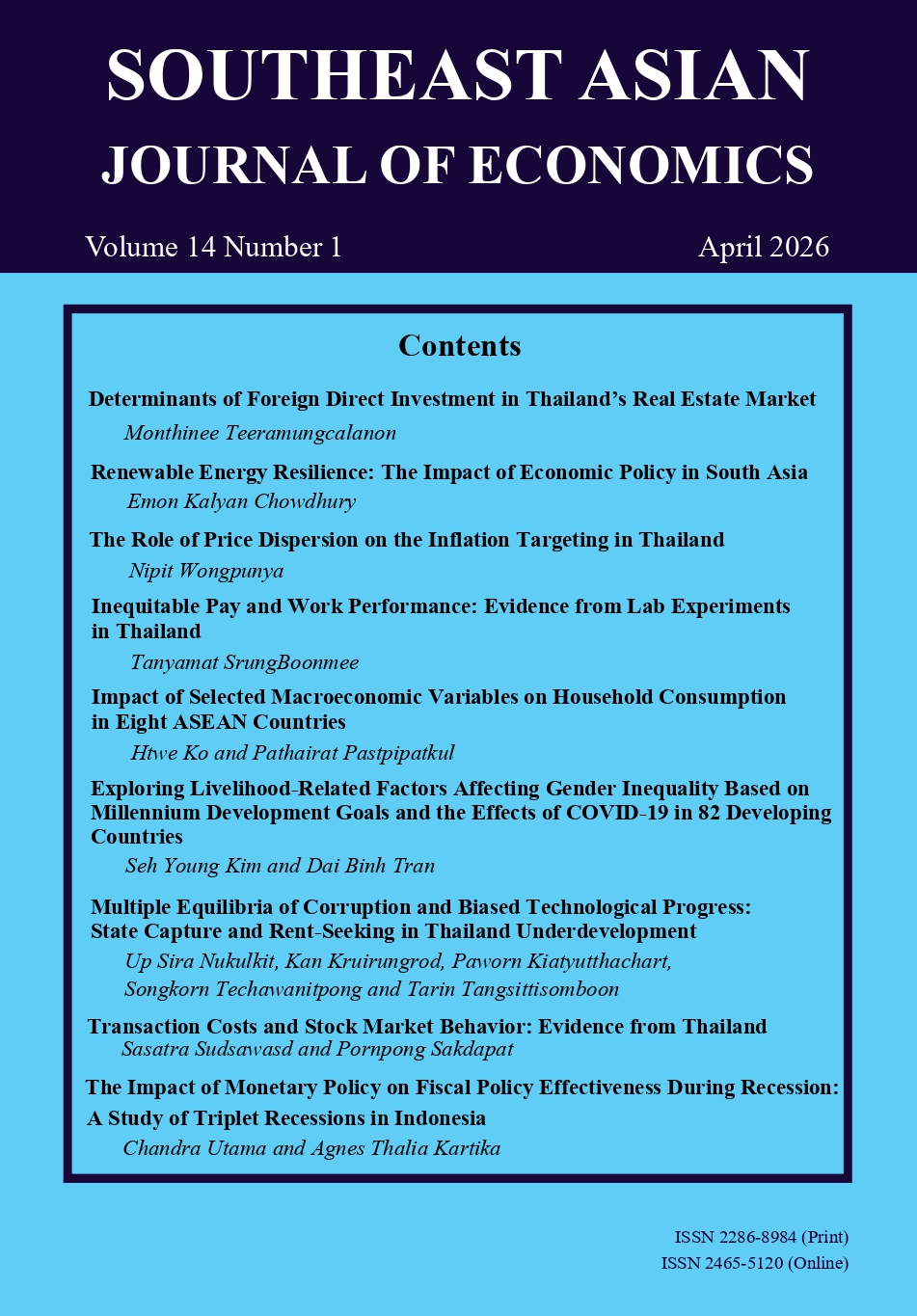
Impact of Selected Macroeconomic Variables on Household Consumption in Eight ASEAN Countries
Keywords:
household consumption, Bayesian variable selection methods, dynamic panel models, ASEANAbstract
This paper identifies macroeconomic factors alongside income growth that influence changes in household consumption across ASEAN (excluding Lao PDR and Vietnam due to data limitations) from 2010 to 2022. We use a mix-order variable selection using Bayesian additive regression trees (BART) and Bayesian adaptive sampling for variable selection (BASAD) methods to choose the important input variables in explaining household final consumption (HFC). We then employ both cross-sectional autoregressive distributed lags (CS-ARDL) and Bayesian dynamic multivariate panel models to examine determinants of household consumption. The mix-order variable selection method reveals output growth in service sectors, population growth, and unemployment rates as important factors among input predictors influencing the changes in HFC, in addition to income growth during the studied periods. The Bayesian dynamic multivariate model shows two main findings: (1) Fixed effects show a positive correlation between income growth and service sector output growth with HFC, while population growth and unemployment rates have a negative nexus with HFC, and (2) time-varying effects of all independent variables are positively correlated with HFC. CS-ARDL model estimation results indicate a positive short-run effect of income growth, population growth, and unemployment, but a negative effect in the long run between income growth and unemployment with HFC. This paper not only contributes to a deeper understanding of the macroeconomic determinants of household consumption in ASEAN countries but also discusses the study’s limitations and directions for future research.
Downloads
Published
How to Cite
Issue
Section
Categories
License
Copyright (c) 2026 SOUTHEAST ASIAN JOURNAL OF ECONOMICS

This work is licensed under a Creative Commons Attribution-NonCommercial-NoDerivatives 4.0 International License.
The submission of a manuscript implies that the paper is an original work and has not been published elsewhere. The author(s) authorize the journal to reproduce or distribute the paper in printed or other electronic forms.