
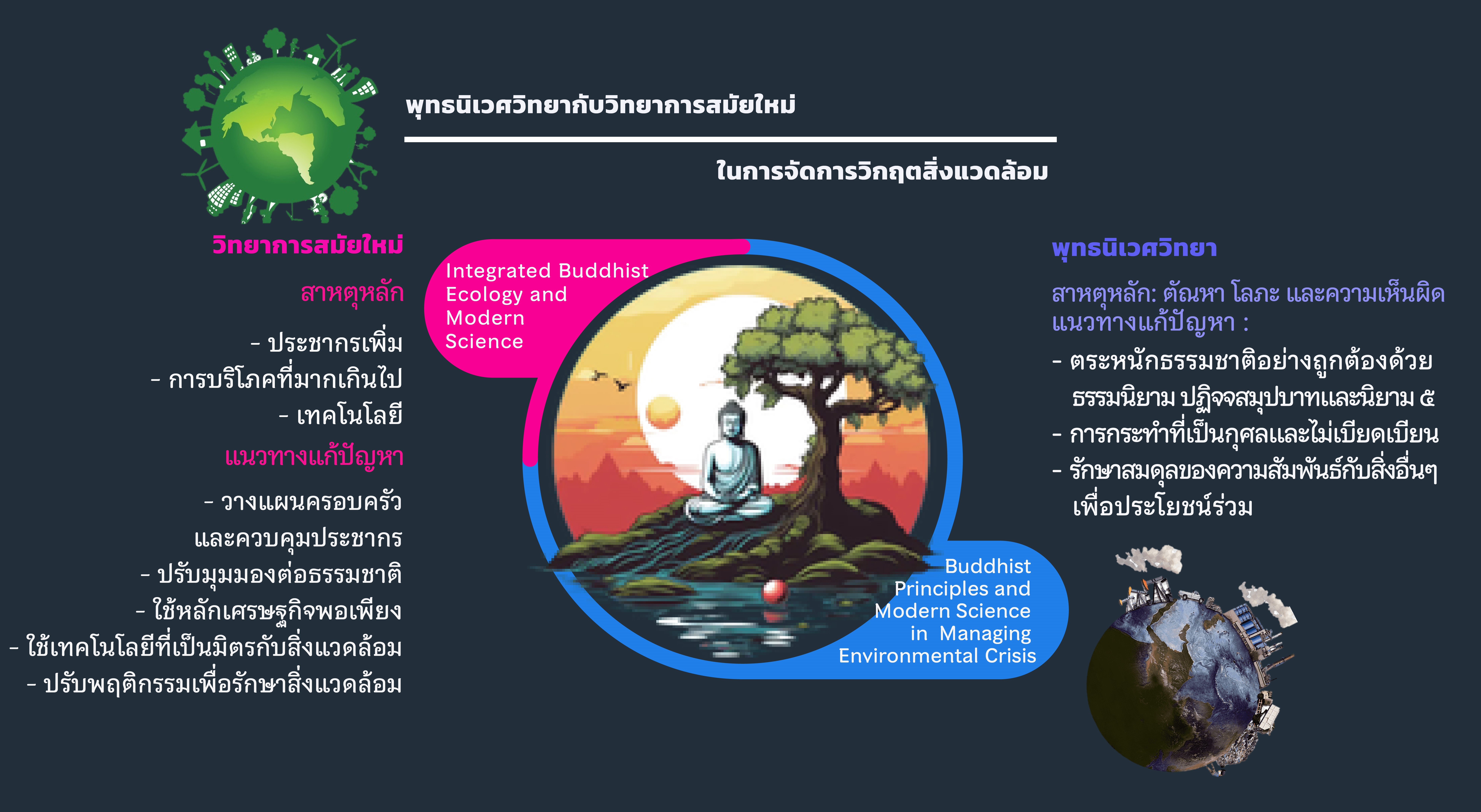
Integrated Buddhist Ecology and Modern Science: The Confrontation between Buddhist Principles and Modern Science in Managing Environmental Crisis
Article Sidebar
Main Article Content
Abstract
This academic article aims to examine the principles of Buddhist ecology, analyze the relationship between Buddhist teachings and modern science, and synthesize an integrated approach for addressing contemporary environmental crises. The study employs documentary research by reviewing the Pāli Canon, commentaries, academic books, and relevant scholarly publications. The collected data are analyzed through content analysis and conceptual synthesis.
The findings reveal that Buddhist ecology is fundamentally grounded in the principles of dependent origination, the interconnectedness of all living beings, compassion, moderation, and mindful consumption. These principles are highly compatible with modern ecological perspectives and sustainable development. Integrating Buddhist ethical principles with appropriate scientific knowledge and technological innovation can promote the sustainable use of natural resources, minimize environmental degradation, and foster ecological responsibility at the individual, community, and societal levels. This integrated approach provides a meaningful framework for environmental management and contributes to sustainable development by balancing human well-being with ecological integrity.
Article Details

This work is licensed under a Creative Commons Attribution-NonCommercial-NoDerivatives 4.0 International License.
เรื่องลิขสิทธิ์/เป็นความคิดเห็นของผู้เขียน
References
Books :
David R. Kinsey. (1998). Ecology and religion. Translated by Lapaphan Supamantra. Bangkok: Suan Ngern Mee Ma. (in Thai)
Mahachulalongkornrajavidyalaya University. (2539). Thai Tripitaka. Bangkok: Mahachulalongkornrajavidyalaya University Printing House. (in Thai)
Phra Brahmagunabhorn (P.A. Payutto). (2000). Sustainable Development. 7th ed. Bangkok: Komol Keemthong Foundation. (in Thai)
Phra Brahmagunabhorn (P.A. Payutto). (2013). Buddhist Dictionary: A Compilation of Dharma Teachings. 24th edition. Bangkok: Dhamma Sabha Buddhist Printing House. (in Thai)
Buddhadasa Bhikkhu. (1988). Dhamma and Instinct. Bangkok: Phra Nakhon Printing. (in Thai)
Sucheep Punyanupap. (2013). Comparative Religion. 6th ed. Bangkok: Mahamakut Buddhist University. (in Thai)
Translated Books :
John Lane. (2012). Timeless Simplicity: Living Creatively in a Consumer Society. Translated by Sodsai Khantiworapong. Bangkok: Suan Ngern Mee Ma. (in Thai)
Manfred Steger. (2010). Globalization: A Very Short Introduction. Translated by Woraphot Wongkitrungruang. Bangkok: Open Worlds. (in Thai)
Stefan Harding. (2013). Gaia: The Living World: Science and Insight. Translated by Khemlakkhana
Deeprapat. Bangkok: Suan Ngern Mee Ma. (in Thai)
Wanthana Siwa. (2003). Water Wars: The Shifting of Power from Community to Private Sector and Interests. Translated by Sirilak Manawongcharoen. Bangkok: Suan Ngern Mee Ma. (in Thai)
Journal article :
Paul R. Ehrlich. (2014). Human impact: the ethics of I=PAT. Ethics in Science and Environmental Politics. 1(4);11-18.
Website :
Experiments on the relationship between living organisms and their biological environment. [Online]. Accessed March 16, 2026. Source of Access. www. sciencelab /senior/item01.php.
Hamilton Barnes. The good and bad effects of technology on the environment. [online]. Accessed March 3, 2026. Source of Access. www. hamilton-barnes.co.uk/effects-technology-environment/.
Medthai. Family Planning. [online]. Accessed March 27, 2026. Source of Access. www. medthai.com.
Rex Weyler. Does human scale matter? [online]. March 25, 2026. Source of Access. www.green peace.org.
Setthapong Malisuwan. The End of Gasoline-Powered Cars. [Online]. Accessed March 19, 2026. Source of Access. www. money2know.com.
หนังสือ :
พระพรหมคุณาภรณ์ (ป.ปยุตฺโต). (2543). การพัฒนาที่ยั่งยืน. พิมพ์ครั้งที่ 7. กรุงเทพมหานคร: มูลนิธิโกมลคีมทอง.
พระพรหมคุณาภรณ์ (ป.อ. ปยุตฺโต). (2556). พจนานุกรมพุทธศาสตร์ ฉบับประมวลธรรม. พิมพ์ครั้งที่ 24. กรุงเทพมหานคร: โรงพิมพ์พระพุทธศาสนาของธรรมสภา.
พุทธทาสภิกขุ. (1988). ธรรมะกับสัญชาตญาณ. กรุงเทพมหานคร: การพิมพ์พระนคร.
วันทนา ศิวะ. (2546). สงครามน้ำ: การเปลี่ยนถ่ายอำนาจจากชุมชนสู่เอกชน และผลประโยชน์. แปลโดย ศิริลักษณ์ มานะวงศ์เจริญ. กรุงเทพมหานคร: สวนเงินมีมา.
มหาวิทยาลัยมหาจุฬาลงกรณราชวิทยาลัย. (2539). พระไตรปิฎกฉบับภาษาไทย ฉบับมหาจุฬาลงกรณราชวิทยาลัย. กรุงเทพมหานคร: โรงพิมพ์มหาจุฬาลงกรณราชวิทยาลัย.
สุชีพ ปุญญานุภาพ. (2556). ศาสนาเปรียบเทียบ. พิมพ์ครั้งที่ 6. กรุงเทพมหานคร: มหามกุฎราชวิทยาลัย.
หนังสือแปล :
David R. Kinsey. (2541). Ecology and religion: นิเวศวิทยากับศาสนา. แปลโดย ลภาพรรณ ศุภมัน ตรา. กรุงเทพมหานคร: สวนเงินมีมา.
John Lane. (2012). ความเรียบง่ายไร้กาลเวลา: การมีชีวิตอย่างสร้างสรรค์ในสังคมบริโภค. แปลโดย สดใส ขันติวรพงศ์. พิมพ์ครั้งที่ 4. กรุงเทพมหานคร: สวนเงินมีมา.
Manfred Steger. (2553). โลกาภิวัตน์: ความรู้ฉบับพกพา Globalization: A Very Short Introduction. แปลโดย วรพจน์ วงศ์กิจรุ่งเรือง. กรุงเทพมหานคร: โอเพ่นเวิลด์ส.
หนังสืออิเล็กทรอนิกส์ (e-Book)
การทดลองเรื่องความสัมพันธ์ของสิ่งมีชีวิตกับสภาวะแวดล้อมทางชีวภาพ. [ออนไลน์]. วันที่สืบค้น 16 มีนาคม 2026 แหล่งที่เข้าถึงข้อมูล www. sciencelab/senior/item01/.
ภรณี ภู่ประเสริฐ. บทบาทสตรีไทยและความเท่าเทียมในสังคม. [ออนไลน์]. สืบค้นเมื่อ 19 กันยายน 2568 แหล่งที่เข้าถึงข้อมูล. www. thaihealth.or.th.
เศรษฐพงศ์ มะลิสุวรรณ. จุดจบของรถใช้น้ำมัน. [ออนไลน์]. วันที่สืบค้น 19 มีนาคม 2026. แหล่งที่เข้าถึง ข้อมูล www. money2know. Com.
Medthai. การวางแผนครอบครัว. [online]. วันที่สืบค้น 27 มีนาคม 2026. แหล่งที่เข้าถึงข้อมูล. www. medthai.com.
