
Development of Knowledge Package from the Tipitaka to Enhance Happiness of Personnel in Business Organization
Article Sidebar
Main Article Content
Abstract
This dissertation contained 3 objectives; 1) study the ways to enhance happiness in the Tipitaka, 2) study the construct of personnel happiness in business organization, 3) developing the knowledge package from Tipitaka to enhance the personnel happiness in business organization. It was mixed research, using Exploratory Sequential Design, qualitative research using documentary analysis, from the Tipitaka, while quantitative research to confirm the effectiveness of the knowledge package developed by using the knowledge package for training to the 30 employee samples of a private organization. The outcomes were measured by workplace happiness indexes in 9 dimensions before and after the training and periodic post-training follow-up. Statistical measures considered were frequency, percentage, mean, standard deviation, and paired t-test result.
The results revealed that:
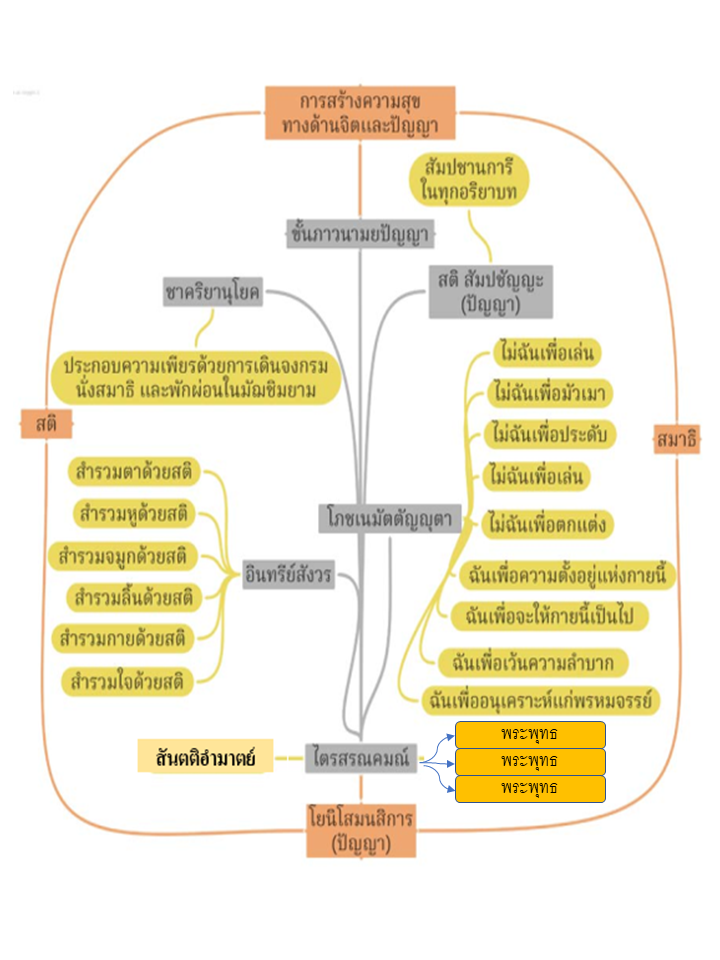
- Enhancement of happiness from the Tipitaka, analyzed from Gaṇakamoggallānasutta and Girisutta mentioned to a person who holds unshakable faith in the Buddha’s teaching called Saddhānusārī. The researcher derived at 3 conceptual frameworks; 1) conceptual framework “A Development of Knowledge Package Found in Tipitaka to Enhance the Personnel Happiness in Business Organization”, 2) conceptual framework “A Knowledge Package Buddhist Morality: Achieving growth somatically, 3) conceptual framework “Knowledge Package of Mind and Wisdom Training to Enhance Happiness.”
- Total Happiness indexes of the employees in 9 dimensions were; happy body, happy heart, happy money, happy brain, happy soul, happy relax, happy family, happy society, and happy work life. After the employees attended the 3-day training “Mindfulness Building according to Saddhānusārī”, it indicates that 67.3 scores of the employees were normal happy and more than before the employees attended training course, it indicated that 46.8 scores of the employees were low happy. By an analysis found that increase scores had statistically significant at 0.001, means that personal in Business Organization after pass this training course can increase positive effect on happiness of employees in the organization.
- Effectiveness Index of the ‘Knowledge Package from Tipitaka to Enhance the Personal Happiness in Business Organization has 27.9%, explained that this training course had positive effect on progress in the development of happiness of employees in the organization.
This research had created a knowledge innovation which combines knowledge of happiness enhancement in Tipitaka with new knowledge for managing of personnel happiness in an organization and ADDIE Model called “A Knowledge Package from Tipitaka to Enhance the Happiness of Personnel in Business Organization”. This training course can increase positive effect on happiness of employees in the organization. The researcher distributed public the free book and video clip.
Article Details

This work is licensed under a Creative Commons Attribution-NonCommercial-NoDerivatives 4.0 International License.
Copyright Notice
The content and information in the articles published in Journal of MCU Palisueksabuddhaghosa Review, are regarded as opinions and responsibilities of article author only. It definitely does not mean that the editor must agree or share any responsibility to the author.
Articles, information, content, figure etc. that have been published in the Journal of MCU Palisueksabuddhaghosa Review is considered as the copyright of the Journal. If any individual or organization will to bring any parts of article for promote or to do anything, must be licensed only in official form from the Journal of MCU Palisueksabuddhaghosa Review.
The content and information in the articles published in Journal of MCU Palisueksabuddhaghosa Review, are regarded as opinions and responsibilities of article author only. It definitely does not mean that the editor must agree or share any responsibility to the author.
Articles, information, content, figure etc. that have been published in the Journal of MCU Palisueksabuddhaghosa Review is considered as the copyright of the Journal. If any individual or organization will to bring any parts of article for promote or to do anything, must be licensed only in official form from the Journal of MCU Palisueksabuddhaghosa Review.
References
กระทรวงดิจิตอลเพื่อเศรษฐกิจและสังคม สำนักงานสถิติแห่งชาติ. สรุปผลที่สำคัญ การสำรวจ
สุขภาพจิต(ความสุข) ของคนในประเทศไทย พ.ศ. 2563. กรุงเทพมหานคร: ห้างหุ้นส่วนจำกัด บางกอกบล็อก, 2564.
พระมหาปิยภัทร์ จิรปุณญโชติ.“การพัฒนารูปแบบบทเรียนออนไลน์ รายวิชาวัฒนธรรมเพื่อชีวิตสำหรับนักศึกษาระดับปริญญาตรี”. วิทยานิพนธ์การศึกษามหาบัณฑิต สาขาวิชาเทคโนโลยีการศึกษา. บัณฑิตวิทยาลัย: มหาวิทยาลัยศรีนครินทรวิโรฒ,2555.
พระมหาสุพจน์ สุเมโธ (พานทอง). “ไตรสิกขาสู่การพัฒนาการเรียนรู้”. วารสารครุศาสตร์ปริทรรศ์ฯ ปีที่ 2 ฉบับที่2 (พฤษภาคม-สิงหาคม พ.ศ. 2546): 82-93.
พระมหาสุทิตย์ อาภากโร และคณะ. “การสร้างและพัฒนาตัวชี้วัดความสุขของประชาชนตามหลักคำสอนของพระพุทธศาสนา”. รายงานวิจัย. สถาบันวิจัยพุทธศาสตร์ มหาวิทยาลัยมหาจุฬาลงกรณราชวิทยาลัย, 2558.
มหาจุฬาลงกรณราชวิทยาลัย. พระไตรปิฎกบาลี ฉบับมหาจุฬาเตปิฏกํ 2500. กรุงเทพมหานคร:โรงพิมพ์มหาจุฬาลงกรณราชวิทยาลัย, 2535.
วัชรพล วิบูลยศริน. “ประยุกต์ใช้ ADDIE Model ในหลักการออกแบบการสอนบนเว็บ เพื่อการสอนสนทนาภาษาไทยเบื้องต้นสำหรับชาวต่างประเทศ”. วารสารศรีนครินทรวิโรฒวิจัยและพัฒนา (สาขามนุษยศาสตร์และสังคมศาสตร์). ปีที่ 6 ฉบับที่ 12 (กรกฎาคม – ธันวาคม 2557).
ศิรินันท์ กิตติสุขสถิต และคณะ. คู่มือการวัดความสุขด้วยตนเอง (Happinometer: The Happiness Self Assessment). พิมพ์ครั้งที่1. นครปฐม: สถาบันวิจัยประชากรและสังคม มหาวิทยาลัยมหิดล, 2555).
ศิริพรรณ ตันติวิวัฒนพันธ์.“ศึกษาความสัมพันธ์ระหว่างพฤติกรรมตามหลักไตรสิกขากับความสุขของบุคลากรในองค์กรเอกชน”. วิทยานิพนธ์พุทธศาสตรมหาบัณฑิต สาขาวิชาชีวิตและความตาย. บัณฑิตวิทยาลัย มหาวิทยาลัยมหาจุฬาลงกรณราชวิทยาลัย, 2561.
สุพิชญา วงศ์วาสนา. “ปัจจัยผลกระทบทางลบจาก COVID-19 ส่งผลต่อความสุขในการทำงานของพนักงานฝ่ายการโดยสาร กรณีศึกษา บริษัทบางกอกไฟลท์ เซอร์วิสเซล จำกัด (BFS)”. วารสารรัชต์ภาคย์ .ปีที่15 ฉบับที่ 39 (มีนาคม – เมษายน 2564): 15-30.
โสวิทย์ บำรุงภักดิ์. “การพัฒนาความสุขของคนไทยตามหลักพุทธศาสนา”. วารสารปณิธาน. ปีที่ 16 ฉบับที่ 2 (กรกฏาคม-ธันวาคม 2563); 128.
สถาบันวิจัยประชากรและสังคม มหาวิทยาลัยมหิดล. ผลการสำรวจความสุขคนทำงาน(ในองค์กร)ปี 2561 ไตรมาส1 (มกราคม -มีนาคม 2561). พิมพ์ครั้งที่1. นนทบุรี: บริษัท อัพทรูยู ครีเอทนิว จำกัด, 2561.
สมเด็จพระพุทธโฆษาจารย์ (ป.อ. ปยุตฺโต). พุทธธรรม ฉบับปรับขยาย. พิมพ์ครั้งที่ 55.
กรุงเทพมหานคร: โรงพิมพ์มหาจุฬาลงกรณราชวิทยาลัย, 2562.
Nastasi, B.K. and Schensul, S.L.. “Contributions of qualitative research to the validity of intervention research”. School Psychology. Vol.43 No.3 (2005): 177-195.
Peterson (2003) Peterson, C.. “Bringing ADDIE to Life: Instructional Design at Its Best".
Educational Multimedia & Hypermedia. Vol.12 No.3 (2003): 227-241.
TIME Magazine. The science of Meditation, [ออนไลน์], แหล่งที่มา: http://www.chombunghospital.com/cbhsite/index.php/blog/k2/item/11-sci [August 2003].
