
THE MODEL OF VIPASSANA PRACTICE WITH METTĀ CETO VIMUTTI FOR NIRODHA-SAMĀPATTI ATTAINMENT
Article Sidebar
Main Article Content
Abstract
This research paper focuses on 3 objectives: 1) study the Vipassana practice based on Mettācetovimutti, 2) to study the Vipassana practice based on Mettācetovimutti for Nirodhasamāpatti, and 3) to study the Model of Vipassana Practice with Mettācetovimutti for Nirodhasamāpatti attainment. It was qualitative research conducted by document investigation and reliable interviews of 7 insight masters, 4 religious scholars, and 5 practitioners/person.
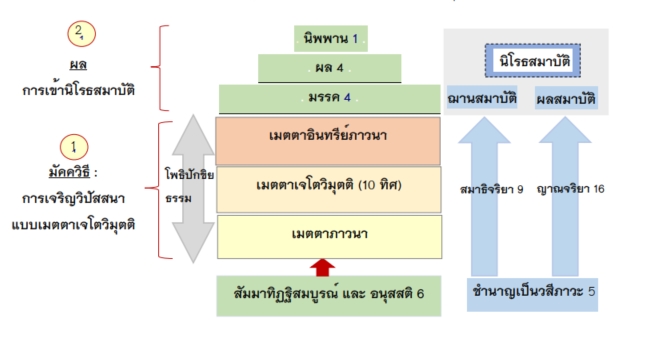
The findings of research showed that practice starts from being completed right views, together with the six reflections or Anussati, thus following the model: 1) Mettābhāvanā refers to spread lovingkindness to all without limit called Appamaññā; 2) Mettācetovimutti or spread lovingkindness trance to develop into the 8 stages of Samāpatti; and 3) Mettā-indariya or cultivation of the five Indariya, Bodhipakkhiyadhamma, cutting off the first five Samyojana with both Samathabala and Vipassanābala, then entering into Nirodhasamāpatti. Its attainment is divided into 2 phases: (1) practicing Mettācetovimutti until it is achieved, that is, abandoning the sensual desires and attaining the 8 stages of Samāpatti, thus cultivating the 5 faculties until it was fully established, extinguishing the 3 Sangkhāra naturally in several times, and (2) practicing its entering and staying for review the 8 Samāpatti as skills called Vasībhāva along with developing wisdom in order to let go of the five higher Samyojana to become lighter and the mind becomes freed from profound defilements, practitioner enters into wishing to enter such state and increases the time of staying. The next step is to abandon the five higher Saṃyojana by developing Animittācetovimutti, that is, spreading loving-kindness with the intention of equanimity for abandoning the sign of attachment on permanence, happiness, self, craving, deceit, and ignorance, and for attaining Arahantship through Ubhatobhāgavimutti or the eight Vimokkha experiencer type,
Article Details

This work is licensed under a Creative Commons Attribution-NonCommercial-NoDerivatives 4.0 International License.
Copyright Notice
The content and information in the articles published in Journal of MCU Palisueksabuddhaghosa Review, are regarded as opinions and responsibilities of article author only. It definitely does not mean that the editor must agree or share any responsibility to the author.
Articles, information, content, figure etc. that have been published in the Journal of MCU Palisueksabuddhaghosa Review is considered as the copyright of the Journal. If any individual or organization will to bring any parts of article for promote or to do anything, must be licensed only in official form from the Journal of MCU Palisueksabuddhaghosa Review.
The content and information in the articles published in Journal of MCU Palisueksabuddhaghosa Review, are regarded as opinions and responsibilities of article author only. It definitely does not mean that the editor must agree or share any responsibility to the author.
Articles, information, content, figure etc. that have been published in the Journal of MCU Palisueksabuddhaghosa Review is considered as the copyright of the Journal. If any individual or organization will to bring any parts of article for promote or to do anything, must be licensed only in official form from the Journal of MCU Palisueksabuddhaghosa Review.
References
พระภาวนาพิศาลเมธี วิ.. ลำดับการปฏิบัติสติปัฏฐาน 4 แนวธัมมานุสารี. (กรุงเทพมหานคร: หจก.ประยูรสาส์นไทย การพิมพ์, 2565.
พระโสภณมหาเถระ (มหาสีสยาดอ). วิปัสสนานัย เล่ม 2. พระพรหมโมลี (สมศักดิ์ อุปสโม) ตรวจชำระ. แปลและเรียบเรียงโดย พระคันธสาราภิวงศ์. กรุงเทพมหานคร: หจก. ประยูรสาส์นไทย การพิมพ์, 2555.
พระอธิการประกาสิทธิ์ สุจิณฺโณ (กลิ่นชื่น). “วิเคราะห์ความสัมพันธ์ระหว่างสติและสัมปชัญญะ เพื่อการปฏิบัติกรรมฐานในพระไตรปิฎก”. วารสาร มจร บาฬีศึกษาพุทธโฆสปริทรรศน์. ปีที่ 9 ฉบับที่ 2 (พฤษภาคม - สิงหาคม 2566).
มหาจุฬาลงกรณราชวิทยาลัย. พระไตรปิฎกภาษาบาลี ฉบับมหาจุฬาเตปิฏกํ. 2500. กรุงเทพมหานคร : โรงพิมพ์รุ่งเรืองธรรม, 2506.
มหาจุฬาลงกรณราชวิทยาลัย. พระไตรปิฎกภาษาไทย ฉบับมหาจฬาลงกรณราชวิทยาลัย. กรุงเทพมหานคร : โรงพิมพ์มหาจุฬาลงกรณราชวิทยาลัย, 2539.
วรรณสิทธิ ไวทยะเสวี. คู่มือการศึกษา พระอภิธัมมัตถสังคหะ ปริจเฉทที่ 4 วิถีสังคหวิภาค. พิมพ์ครั้งที่ 7. นครปฐม: มูลนิธิแนบมหานีรานนท์, 2559.
