
A Model of Public Mind Development with the Buddhist Integration
Article Sidebar
Main Article Content
Abstract
This dissertation article contained 3 objectives: 1) study theory, principle of public mind development, 2) study the Buddhist teaching supporting public mind and, 3) presenting a model of public mind development based on Buddhist integration. It was qualitative research with field work and in-depth interview of 16 key performants, then it had been analyzed and synthesized, finally written in descriptive report.
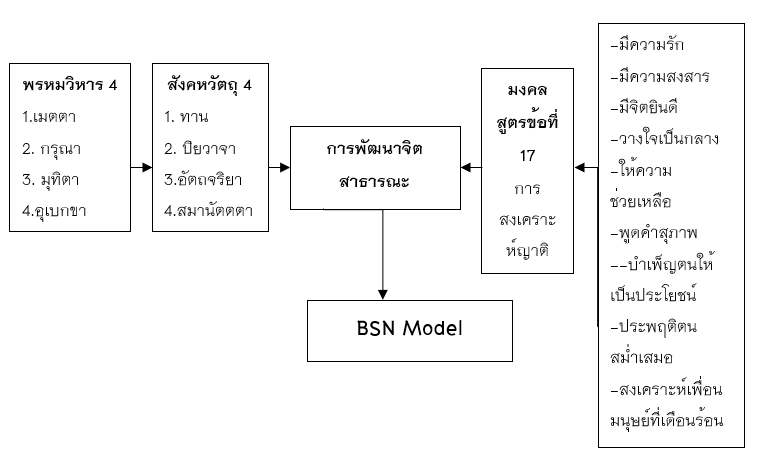
The research results revealed that development model of public mind based on Buddhist integration consists of: 1) 4 Brahmavihāra showed that a person with public mind should perform loving-kindness called Mettā, compassion, good wishes, and a desire for others’ happiness. For Karuṇā, one should be compassionate wishing others free from all suffering, safe and giving hands when seeing others suffering and difficulty as he can. For Muditā, one becomes delighted when seeing fellow humans experiencing happiness together, without jealousy. For Upekkhā, one should remain equal and impartial towards fellow human beings, treating them equally without discrimination, 2) 4 Sanghavatthu showed that for Dāna or giving, one with public mind should help others with a generous spirit, sharing one’s possessions for the benefit of those experiencing various forms of suffering. For Piyavācā, one should speak gently and pleasingly, creating a positive impression on fellows through speech as communication is the first step of good relationships among people. For Atthacariyā, one should behave in ways that are beneficial to others, helping and supporting people who are in difficulties. For Samānattatā, one always behaves consistently, being fair and impartial, ensuring mutual respect and equality. 3) For 17th Mangala or assistance to relatives, one assists human beings as if they were one’s own relatives through offering support, helps, materials, and knowledge with loving, compassion and kindness with sincerity. The knowledge framework derived from research is in the form of the ‘BSN Model.’
Article Details

This work is licensed under a Creative Commons Attribution-NonCommercial-NoDerivatives 4.0 International License.
Copyright Notice
The content and information in the articles published in Journal of MCU Palisueksabuddhaghosa Review, are regarded as opinions and responsibilities of article author only. It definitely does not mean that the editor must agree or share any responsibility to the author.
Articles, information, content, figure etc. that have been published in the Journal of MCU Palisueksabuddhaghosa Review is considered as the copyright of the Journal. If any individual or organization will to bring any parts of article for promote or to do anything, must be licensed only in official form from the Journal of MCU Palisueksabuddhaghosa Review.
The content and information in the articles published in Journal of MCU Palisueksabuddhaghosa Review, are regarded as opinions and responsibilities of article author only. It definitely does not mean that the editor must agree or share any responsibility to the author.
Articles, information, content, figure etc. that have been published in the Journal of MCU Palisueksabuddhaghosa Review is considered as the copyright of the Journal. If any individual or organization will to bring any parts of article for promote or to do anything, must be licensed only in official form from the Journal of MCU Palisueksabuddhaghosa Review.
References
มหาวิทยาลัยมหาจุฬาลงกรณราชวิทยาลัย. พระไตรปิฏกภาษาไทย ฉบับมหาจุฬาลงกรณราช
วิทยาลัย. กรุงเทพมหานคร: โรงพิมพ์ มหาจุฬาลงกรณราชวิทยาลัย. 2539.
กุลทิพย์ ศาสตระรุจ. การถอดบทเรียนกระบวนการสื่อสารของกลุ่มเยาวชนในจิตสำนึกสาธารณะ.
รายงานวิจัย. กรุงเทพมหานคร: มหาวิทยาลัยธุรกิจบัณฑิตย. 2551.
พระเจ้าบรมวงศ์เธอ กรมพระจันทบุรีนฤนาถ. ปทานุกรม บาลี ไทย อังกฤษ สันสกฤต.
กรุงเทพมหานคร: ห้างหุ้นส่วนจำกัด ศิวพร. 2513.
พระเทพดิลก (ระแบบ ฐิตญาโณ). นิเทศธรรม. กรงเทพมหานคร: บริษัทแปดสิบเจ็ด (2545) จำกัด.
พระธรรมธีรราชมหามุนี (โชดก ณาณสิทฺธิ ป.ธ. 9). มงคล 38. กรุงเทพมหานคร : คณะกรรมการ
วิปัสสนาธุระ. 2536.
พระธรรมปิฎก (ป.อ.ปยุตฺโต). พจนานุกรมพุทธศาสตร์ ฉบับประมวลธรรม. พิมพ์ครั้งที่ 30.
กรุงเทพมหานคร: ผลิธัมม์. 2558.
พระพรหมคุณาภรณ (ป.อ.ปยุตฺโต). เครื่องวัดความเจริญของชาวพุทธ (อารยวัฑฒิ).
กรุงเทพมหานคร: บริษัท สหธรรมิก จำกัด. 2552.
พระพรหมคุณาภรณ (ป.อ.ปยุตฺโต). จะพัฒนาคนกันอยางไร. นครปฐม: วัดญาณเวศกวัน. 2557.
พระพรหมคุณาภรณ (ป.อ.ปยุตฺโต). วินัยเรื่องใหญ่กว่าที่คิด. นครปฐม: วัดญาณเวศกวัน. 2538.
ระวี ภาวิไล. ชีวิตดีงาม. พิมพ์ครั้งที่ 2. (กรุงเทพมหานคร: สำนักพิมพ์ผีเสื้อ. 2537.
วิลเลียม เคลาสเนอร์. พุทธศาสนาตามแบบชาวบ้านในภาคอีสาน. พระนคร: โรงพิมพ์ศิวพร.
สำนักวิชาการและมาตรฐานการศึกษา. แนวทางพัฒนาการวัดและประเมินคุณลักษณะอันพึง
ประสงค์ตามหลักสูตรแกนกลางการศึกษาขั้นพื้นฐาน พุทธศักราช 2551.
พิมพ์ครั้งที่ 2. กรุงเทพมหานคร: โรงพิมพ์ชุมนุมสหกรณ์การเกษตรแห่งประเทศไทย
จำกัด. 2553.
เหวง โตจิราการ. การเสริมสร้างจิตสาธารณะ. กรุงเทพมหานคร: ประสานมิตร. 2553.
อนุพนธ์ คำปัน และคณะ. “การศึกษาองค์ประกอบของจิตสาธารณะของนิสิตนักศึกษา
ในสถาบันอุดมศึกษาในเขตกรุงเทพมหานคร”. วารสารสังคมศาสตร์
มหาวิทยาลัยศรีนครินทรวิโรฒ. ปีที่ 18 ฉบับที่ 18. (มกราคม-ธันวาคม 2558).
