
Form of Establishment of Legal Center for Integrated Buddhist Sangha
Article Sidebar
Main Article Content
Abstract
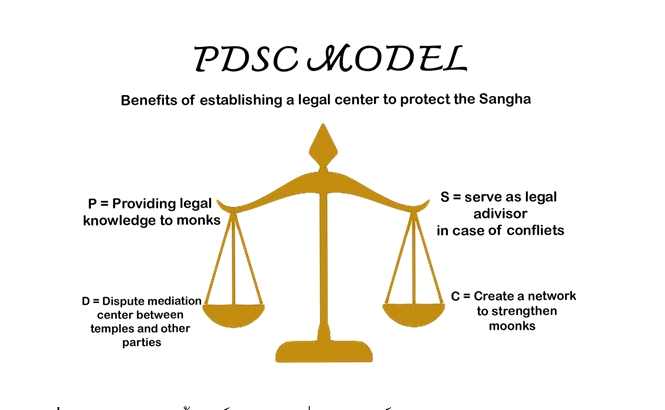
This dissertation investigated on 4 objectives namely: 1) to study the protection of the Sangha as appeared in Theravada Buddhist scriptures, 2) to study the way to establish a Legal Unit for the Sangha, and 3) to propose a model of a Legal Unit establishment for Sangha integrated with Buddhism. It was qualitative research focusing on document study and depth-interview of 23 key informants. Its results found that Provincial legal centers and legal consultation centers should have four duties as follows: 1) Providing legal knowledge to Buddhist Bhkkhus, 2) It is a unit for resolving disputes between temples and other parties, villagers, communities, and Sangha, 3) legal advisor when conflicts arise, 4) it functions as a legal institutions providing education and develop of the Sangha through creating a network to strengthen the Sangha. The center with the said 4 important factors leads to beneficial for establishing a legal center to protect the Sangha with integrated Buddhist principle. Its model gained from research is "PDSC MODEL" consisting of; 1) Providing legal knowledge, (P) 2) Dispute Mediating, (D) 3) Serve as a Legal advice in case of conflicts (S), 4) Creating a network for the strength of Buddhist Sangha (C),
Article Details

This work is licensed under a Creative Commons Attribution-NonCommercial-NoDerivatives 4.0 International License.
Copyright Notice
The content and information in the articles published in Journal of MCU Palisueksabuddhaghosa Review, are regarded as opinions and responsibilities of article author only. It definitely does not mean that the editor must agree or share any responsibility to the author.
Articles, information, content, figure etc. that have been published in the Journal of MCU Palisueksabuddhaghosa Review is considered as the copyright of the Journal. If any individual or organization will to bring any parts of article for promote or to do anything, must be licensed only in official form from the Journal of MCU Palisueksabuddhaghosa Review.
The content and information in the articles published in Journal of MCU Palisueksabuddhaghosa Review, are regarded as opinions and responsibilities of article author only. It definitely does not mean that the editor must agree or share any responsibility to the author.
Articles, information, content, figure etc. that have been published in the Journal of MCU Palisueksabuddhaghosa Review is considered as the copyright of the Journal. If any individual or organization will to bring any parts of article for promote or to do anything, must be licensed only in official form from the Journal of MCU Palisueksabuddhaghosa Review.
References
คณะกรรมการมหามกุฎราชวิทยาลัย. (2535). วินัยวินิจฉัย. พิมพ์ครั้งที่ 14. กรุงเทพมหานคร: โรงพิมพ์มหามกุฎราชวิทยาลัย,
ปลื้ม โชติษฐยางกูร. (2553). คำบรรยายกฎหมายคณะสงฆ์. พิมพ์ครั้งที่ 2. กรุงเทพมหานคร: โรงพิมพ์มหาจุฬาลงกรณราชวิทยาลัย,
ประชาไท. (2565). โลกวัชชระ: ใครคือผู้กำหนดพฤติกรรมที่เหมาะสมของพระ. [ออนไลน์]. แหล่งที่มา: https://www.prachatai.com/journal/2017/11/73914 [6 กันยายน 2565].
พระธรรมกิตติวงศ์ (ทองดี สุรเตโช) ป.ธ. 9 ราชบัณฑิต. (2548). พจนานุกรมเพื่อการศึกษาพุทธศาสน์ ชุด คำวัด. กรุงเทพมหานคร: วัดราชโอรสาราม,
พระธรรมปิฎก (ป.อ. ปยุตฺโต). (2546). พจนานุกรมพุทธศาสตร์ ฉบับประมวลธรรม. พิมพ์ครั้งที่ 12.กรุงเทพมหานคร: โรงพิมพ์มหาจุฬาลงกรณราชวิทยาลัย.
มหาจุฬาลงกรณราชวิทยาลัย. (2539). พระไตรปิฎกภาษาไทย ฉบับมหาจุฬาลงกรณราชวิทยาลัย. กรุงเทพมหานคร: โรงพิมพ์มหาจุฬาลงกรณราชวิทยาลัย.
มติชนออนไลน์. (2565). รายงานพิเศษ: องค์กรปกครองคณะสงฆ์ไทยในสภาวะ “อ่อนแรง-เชื่องช้า-ไม่ทันโลก”. [ออนไลน์]. แหล่งที่มา: https://www.matichon.co.th/education/news_ 3115588 [6 กันยายน 2565].
