
A Model of Welfare Management of the Thai Sangh Council
Article Sidebar
Main Article Content
Abstract
This dissertation there are 3 objectives. namely 1) to study the management of public welfare by the Thai Sangha, 2) to study Buddhist principles that promote the management of public welfare by the Thai Sangha, and 3) to propose a model for managing public welfare of the Thai Sangha. It is a qualitative research using document research and in-depth interviews with 23 key informants/people to analyze the content data. and present descriptive information.
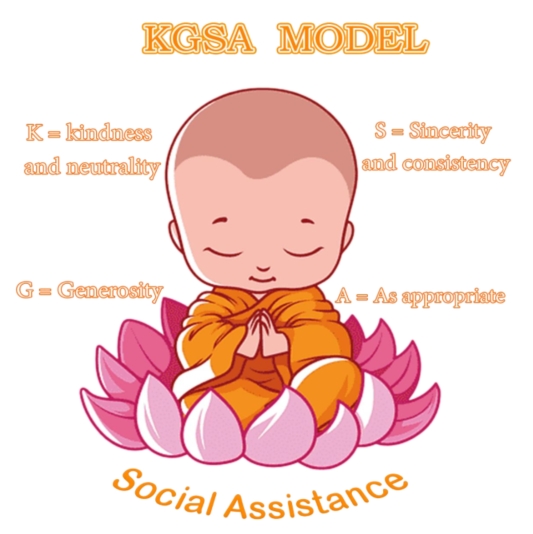
The research results found that Public welfare work in Buddhist affairs Proceed to drive benefits in times of crisis. The Sangha is an important organization for helping and supporting. with basic necessary objects By using the 5 main principles of Buddhism: They are 1) The 4 biases include chandākāti, dosākāti, mohākāti, and bhayākāti. 2) The 4 brahmāvihāra include loving-kindness, kindness, mudita, and upekkha. 3) The 4 saṅgahavatthu include dāna, piyavācā, atthacariya, samānattā 4) The 7 sāraniyadhamma include physical kamma, verbal kamma, and mano kamma. Satharanaphokī 5) Sappurisadhamma 7 includes knowing principles, knowing goals, knowing oneself, knowing moderation, knowing time, knowing community, knowing people, taking steps to help society in material ways that do not go against the Dhamma and Vinaya. The Thai Sangha's model for public welfare management is the "KGSA" model, which is 1) K = Help society with kindness and neutrality. G = Help society with generosity. S = Help society with sincerity and regularity. A = Help society as appropriate.
Article Details

This work is licensed under a Creative Commons Attribution-NonCommercial-NoDerivatives 4.0 International License.
Copyright Notice
The content and information in the articles published in Journal of MCU Palisueksabuddhaghosa Review, are regarded as opinions and responsibilities of article author only. It definitely does not mean that the editor must agree or share any responsibility to the author.
Articles, information, content, figure etc. that have been published in the Journal of MCU Palisueksabuddhaghosa Review is considered as the copyright of the Journal. If any individual or organization will to bring any parts of article for promote or to do anything, must be licensed only in official form from the Journal of MCU Palisueksabuddhaghosa Review.
The content and information in the articles published in Journal of MCU Palisueksabuddhaghosa Review, are regarded as opinions and responsibilities of article author only. It definitely does not mean that the editor must agree or share any responsibility to the author.
Articles, information, content, figure etc. that have been published in the Journal of MCU Palisueksabuddhaghosa Review is considered as the copyright of the Journal. If any individual or organization will to bring any parts of article for promote or to do anything, must be licensed only in official form from the Journal of MCU Palisueksabuddhaghosa Review.
References
มหาจุฬาลงกรณราชวิทยาลัย. Z2539). พระไตรปิฎกภาษาไทย ฉบับมหาจุฬาลงกรณราชวิทยาลัย. กรุงเทพมหานคร: โรงพิมพ์มหาจุฬาลงกรณ ราชวิทยาลัย.
พระมหาวิเชียร ชาญณรงค์. (2547). “บทบาทพระสงฆ์ในการนาหลักธรรมมาใช้ทากิจกรรมงานพัฒนาชุมชน เพื่อ ลด ละ เลิก อบายมุข: ศึกษาเฉพาะกรณีพระครูศีลาวราภรณ์”. วิทยานิพนธ์ศิลปศาสตรมหาบัณฑิต. บัณฑิตวิทยาลัย: มหาวิทยาลัยธรรมศาสตร์.
พระมหาบุญมี อธิปุญฺโญ. (2544).“บทบาทของพระสังฆาธิการพัฒนาสังคม: ศึกษากรณีพระธรรมวิสุทธิมงคล (บัว ญาณสมฺปนฺโน)”. วิทยานิพนธ์ศาสนศาสตรมหาบัณฑิต. บัณฑิตวิทยาลัย: มหาวิทยาลัยมหามกุฏราชวิทยาลัย.
พระมหาสุภา อุทฺโท. (2541). “บทบาทของพระสงฆ์ต่อสังคมไทยใน 2 ทศวรรษหน้า”. วิทยานิพนธ์สังคมสงเคราะห์ศาสตรมหาบัณฑิต. บัณฑิตวิทยาลัย: มหาวิทยาลัยธรรมศาสตร์.
พระมหาอนันต์ ดอนนอก. (2540).“บทบาทของพระสงฆ์ในการพัฒนาชุมชนตามโครงการอบรมประชาชนประจาตำบล ในจังหวัดนครราชสีมา”. วิทยานิพนธ์สังคมสงเคราะห์ศาสตรมหาบัณฑิต. บัณฑิตวิทยาลัย: มหาวิทยาลัยธรรมศาสตร์.
สุทธิพงศ์ ตันตยาพิศาลสุทธิ์. (2541). พระราชบัญญัติคณะสงฆ์ กฎกระทรวง กฎมหาเถรสมาคม พร้อมด้วยระเบียบและคำสั่งมหาเถรสมาคมที่เกี่ยวกับการคณะสงฆ์และการพระศาสนา. กรุงเทพมหานคร: โรงพิมพ์ กรมการศาสนา.
สำนักงานพระพุทธศาสนาแห่งชาติ. ข้อมูลวัดและพระสงฆ์ 2553. [ออนไลน์]. แหล่งที่มา: http://www.onab.go.th/ [31 สิงหาคม 2565].
สำนักงานสถิติแห่งชาติ. จำนวนประชากร 2553. [ออนไลน์]. แหล่งที่มา: http://www.nso. go.th/ [31 สิงหาคม 2565].
