
The Guideline of Public Relations Media Promotion Based on Buddhist Integration for Social Service Of Mahachulalongkornjavidyalaya University, Palisueksabuddhaghosa Campus
Article Sidebar
Main Article Content
Abstract
This research paper contains the following objectives: 1) to study the theoretical concepts of modern public relations dissemination, 2) to study Buddhist principles promoting public relations for social service at Mahachulalongkornjavidyalaya University, Palisueksabuddhaghosa Campus, and 3) to propose a framework for Buddhist-integrated public relations dissemination for social service at Mahachulalongkornjavidyalaya University, Palisueksabuddhaghosa Campus. It was qualitative research, employing in-depth field interviews. Data were analyzed and synthesized by 16 experts divided into 3 groups. Content analysis was conducted, and the findings were presented through descriptive analysis.
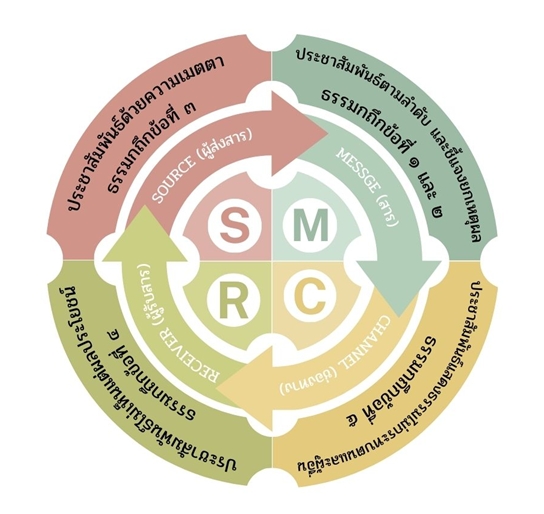
The results of the research found that 1) in the digital age where information spreads quickly, public relations play an important role in creating a good image for an organization and relationships with stakeholders. SMCR Model communication theory, a basic model explaining the public relations process. It is still relevant and can be effectively applied in planning and executing public relations in the digital age. 2) Public relations plays a pivotal role driving social change. As a Buddhist educational institution, it effectively utilizes Buddhist teaching in our public relations efforts to promote social service activities, especially the five Dhammakathika, which are the qualities of a Dhamma teacher, can be excellently applied to public relations work. 3) A framework for disseminating integrated Buddhist public relations for community service at Mahachulalongkornrajavidyalaya University, Pali Buddhaghosa Campus, Nakhon Pathom, based on the SMCR Model of Communication in conjunction with the Five Dhammakathika teaching for social services, as follows; Sender is applied with the 3rdDhammakathika principle, the Message was applied with the 1st and 2ndDhammakathika principle, Channel is applied with the 5thDhammakathika principle. Receiver is applied with the 4thDhammakathika principle. Summary of knowledge gained from research is the SMCR-B Model.
Article Details

This work is licensed under a Creative Commons Attribution-NonCommercial-NoDerivatives 4.0 International License.
Copyright Notice
The content and information in the articles published in Journal of MCU Palisueksabuddhaghosa Review, are regarded as opinions and responsibilities of article author only. It definitely does not mean that the editor must agree or share any responsibility to the author.
Articles, information, content, figure etc. that have been published in the Journal of MCU Palisueksabuddhaghosa Review is considered as the copyright of the Journal. If any individual or organization will to bring any parts of article for promote or to do anything, must be licensed only in official form from the Journal of MCU Palisueksabuddhaghosa Review.
The content and information in the articles published in Journal of MCU Palisueksabuddhaghosa Review, are regarded as opinions and responsibilities of article author only. It definitely does not mean that the editor must agree or share any responsibility to the author.
Articles, information, content, figure etc. that have been published in the Journal of MCU Palisueksabuddhaghosa Review is considered as the copyright of the Journal. If any individual or organization will to bring any parts of article for promote or to do anything, must be licensed only in official form from the Journal of MCU Palisueksabuddhaghosa Review.
References
วิทยาเขตบาฬีศึกษาพุทธโฆส นครปฐม, “ประวัติวิทยาเขต”, [ออนไลน์], แหล่งที่มา : https://pali.mcu.ac.th/?page_id=553. [3 ตุลาคม 2566].
อนุช อาภาภิรม. “เทคโนโลยีกับสวรรค์”, ห้องสมุดสถาบันพระปกเกล้า, [ออนไลน์], แหล่งที่มา : https://kpi-lib.com/library/books/kpibook-9215, [1 ตุลาคม 2566].
