
THE PROCESS OF PROMOTING MEDITATION ACCORDING TO THE TEACHINGS OF PHRA DHAMMAKOSAJARN BUDDHADASA BHIKKHU
Article Sidebar
Main Article Content
Abstract
This research article is a part of the research on “The Way of Practicing Anapanasati by Buddhadasa Bhikkhu According to the Principle of 4 Satipatthana”. The objectives of the study were: (1) to study the way of practicing Ānāpānasati according to the principle of Satipatthana 4 (2) to study the way of practicing Ānāpānasati according to the principles of Buddhadasa Bhikkhu (3) to present the analysis of the way of practicing Ānāpānasati by Buddhadasa Bhikkhu according to the principle of Satipatthana 4. This was qualitative research through documentary investigation.
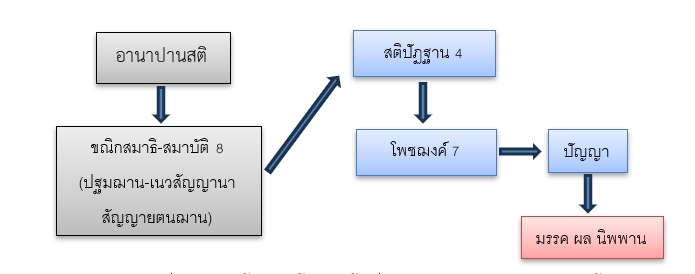
The research results found that the way of practicing Ānāpānasati by Buddhadasa Bhikkhu according to the principle of 4 Satipatthana found is practicing Ānāpānasati based on following the teaching of Satipatthana as the standard practical tradition in Buddhism, namely, keeping the precepts, developing mindfulness, and developing concentration to create wisdom to experience the truth. The starting point of learning is practicing the contemplation of the body in Mahasatipatthana to have continuous mindfulness with sufficient power to see the arising, focusing on the destruction of the continuation of postures called Santati. Experiencing the arising and passing away of form and name consistently occur only of those who are with enough perseverance and strong faculties. The development of Ānāpānasati according to the principles of Buddhadasa Bhikkhu is a process to promote the study of meditation found in Theravada tradition which is a practical method to organize one’s thoughts in daily life, namely studying, working efficiently, developing one’s personality, and at the highest level, to use as a basis for the development of insight development. Meditation according to the teachings of Phra Dhammakosacharn (Buddhadasa Bhikkhu) refers to a practical method reaching to the Jhāna within the 4 Naya: Gaṇanānaya, Anubandhanānaya, Phusanānaya, and Ṭhapanānaya. There are also 4 other methods of Vipassana practice: Sallakkhanānaya, Vivaṭṭanānaya, Parisuddhinaya, and Tesañca Paṭipassanānaya called 16 levels of Ānāpānasati meditation, which will lead to the extinguishing of defilements. The development of insight meditation in Buddhism includes the practice of the principle of right mindfulness, using mindfulness and wisdom to continuously observe the four bases, namely a contemplating mindfulness that is firmly established in observing the body, feeling, the mind, and all phenomena or thought construction. A practitioner with wisdom observing the forms and name in all four bases until clearly experiencing the Four Noble Truths can be freed from all suffering.
Article Details

This work is licensed under a Creative Commons Attribution-NonCommercial-NoDerivatives 4.0 International License.
Copyright Notice
The content and information in the articles published in Journal of MCU Palisueksabuddhaghosa Review, are regarded as opinions and responsibilities of article author only. It definitely does not mean that the editor must agree or share any responsibility to the author.
Articles, information, content, figure etc. that have been published in the Journal of MCU Palisueksabuddhaghosa Review is considered as the copyright of the Journal. If any individual or organization will to bring any parts of article for promote or to do anything, must be licensed only in official form from the Journal of MCU Palisueksabuddhaghosa Review.
The content and information in the articles published in Journal of MCU Palisueksabuddhaghosa Review, are regarded as opinions and responsibilities of article author only. It definitely does not mean that the editor must agree or share any responsibility to the author.
Articles, information, content, figure etc. that have been published in the Journal of MCU Palisueksabuddhaghosa Review is considered as the copyright of the Journal. If any individual or organization will to bring any parts of article for promote or to do anything, must be licensed only in official form from the Journal of MCU Palisueksabuddhaghosa Review.
References
พระไตรปิฎกภาษาไทย ฉบับมหาจุฬาลงกรณราชวิทยาลัย. กรุงเทพมหานคร: โรงพิมพ์มหาจุฬาลงกรณราชวิทยาลัย. 2539.
__________ อรรถกถาภาษาบาลี ฉบับบมหาจุฬาอฏฺกถา. การุงเทพมหานคร: โรงพิมพ์มหาจุฬาลงกรณราชวิทยาลัย. โรงพิมพ์วิญญาณ. 2532-2534.
พระญาณธชเถระ (แลดีสยาดอ). อานาปานทีปนี. แปลโดย พระคันธสาราภิวงศ์ (สมลักษณ์ คนฺธสาโร ป.ธ. 9). กรุงเทพมหานคร: ห้างหุ้นส่วนจำกัด ไทยรายวันการพิมพ์. 2549.
พุทธทาสภิกขุ. วิธีฝกสมาธิวิปสสนา ฉบับสมบูรณ. พิมพ์ครั้งที่ 8. กรุงเทพมหานคร: โอเอ็นจี การพิมพ์ จำกัด. 2545.
พระธรรมธีรราชมหามุนี (โชดก ป.ธ.9). หลักปฏิบัติสมถะและวิปสสนากรรมฐาน. พิมพ์ครั้งที่ 6. กรุงเทพมหานคร: โรงพิมพ์สหธรรมิก. 2546.
พระธรรมโกศาจารย์ (พุทธทาสภิกขุ). อานาปานสติภาวนา. พิมพ์ครั้งที่ 4. กรุงเทพมหานคร: ห้างหุ้นส่วนจำกัด การพิมพ์พระนคร. 2533.
พระโสภณมหาเถระ (มหาสีสยาดอ). มหาสติปัฏฐานสูตร ทางสู่พระนิพพาน. แปลโดย พระคันธสาราภิวงศ์ (สมลักษณ์ คนฺธสาโร ป.ธ. 9). กรุงเทพมหานคร: ห้างหุ้นส่วนจำกัด ไทยรายวันการพิมพ์. 2549.
สมเด็จพระพุทธโฆษาจารย์ (ป.อ. ปยุตฺโต). พุทธธรรม ฉบับปรับขยาย. พิมพ์ครั้งที่ 47. กรุงเทพมหานคร: บริษัท สำนักพิมพ์เพ็ทแอนด์โฮม จำกัด. 2559.
สร้อยสุดา อิ่มอรุณรักษ์. “ผลของการฝึกอานาปานสติภาวนาที่มีตอภาวะสุขภาพจิต”. วิทยานิพนธ์วิทยาศาสตรมหาบัณฑิต สาขาวิทยาคลินิก. บัณฑิตวิทยาลัย: มหาวิทยาลัยมหิดล. 2543.
