
An Analytical Instructional Model for Teaching the Dhammapada via an Online Learning Platform
Article Sidebar
Main Article Content
Abstract
This research paper aimed to: 1) To study the current conditions, curriculum, content, and instructional methods for teaching analytical Pali Dhammapada among Thai monks. 2) To examine the principles of online learning management and to develop a learning process for analytical Pali Dhammapada instruction in accordance with educational reform guidelines. 3) To create an innovative model for online learning of analytical Pali Dhammapada. This research is a qualitative study employing documentary research, field research, and action research. Data were collected from two administrators of monastic education institutes, ten Pali teachers, and ten Pali students.
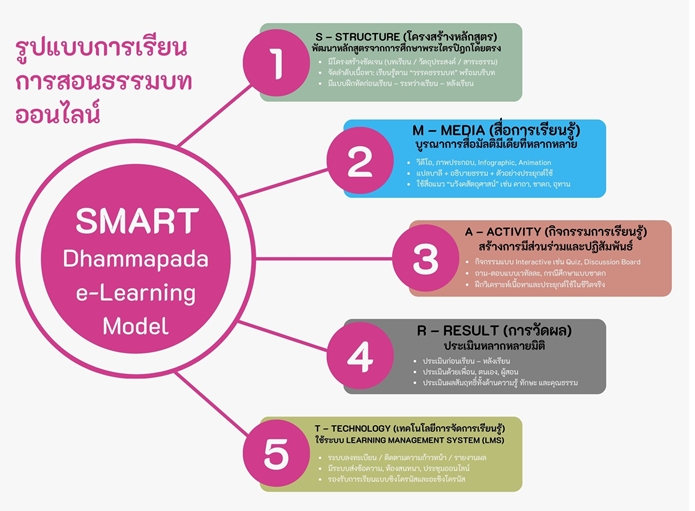
The findings revealed that: 1) The current Dhammapada teaching system in Thai Sangha still employs traditional curriculum focusing on Pali-Thai translation, lacks content integration and practical application, and has an unsystematic evaluation process, resulting in only 10-20% pass rates; 2) The development of online teaching models should integrate multimedia, interactive elements, and efficient learning management systems; 3) The developed learning innovation comprises a comprehensive online learning management system covering content, assessment, and communication aspects, with Dhammapada content organized into six main categories: karma and its results, perfection cultivation, threefold training, cycle of existence, practice for defilement elimination, and nirvana attainment. This research highlights the necessity of modernizing Buddhist scriptural education to enhance its efficiency through the application of technology and learning innovations. Key recommendations include developing a comprehensive online Dhammapada teaching system covering the entire Tipitaka and conducting research to develop integrated applications for complete Tipitaka learning.
Article Details

This work is licensed under a Creative Commons Attribution-NonCommercial-NoDerivatives 4.0 International License.
Copyright Notice
The content and information in the articles published in Journal of MCU Palisueksabuddhaghosa Review, are regarded as opinions and responsibilities of article author only. It definitely does not mean that the editor must agree or share any responsibility to the author.
Articles, information, content, figure etc. that have been published in the Journal of MCU Palisueksabuddhaghosa Review is considered as the copyright of the Journal. If any individual or organization will to bring any parts of article for promote or to do anything, must be licensed only in official form from the Journal of MCU Palisueksabuddhaghosa Review.
The content and information in the articles published in Journal of MCU Palisueksabuddhaghosa Review, are regarded as opinions and responsibilities of article author only. It definitely does not mean that the editor must agree or share any responsibility to the author.
Articles, information, content, figure etc. that have been published in the Journal of MCU Palisueksabuddhaghosa Review is considered as the copyright of the Journal. If any individual or organization will to bring any parts of article for promote or to do anything, must be licensed only in official form from the Journal of MCU Palisueksabuddhaghosa Review.
References
กรมการศาสนา. พระราชบัญญัติการศึกษาพระปริยัติธรรม พ.ศ. 2562. กรุงเทพฯ: โรงพิมพ์การศาสนา. (2562).
ดูรายละเอียดใน [ออนไลน์], แหล่งที่มา https://db.sac.or.th/inscriptions/inscribe/detail/76 [16 กรกฎาคม 2564]
พระมหาสมชาย กนฺตสีโล. การปฏิรูปการศึกษาของคณะสงฆ์ไทยในยุคดิจิทัล. วารสารพุทธศาสตร์ศึกษา, (2563).
มหาจุฬาลงกรณราชวิทยาลัย. แผนยุทธศาสตร์การพัฒนาการศึกษาพระปริยัติธรรม พ.ศ. 2563-2567. กรุงเทพฯ: โรงพิมพ์มหาจุฬาลงกรณราชวิทยาลัย. (2563).
สำนักงานแม่กองบาลีสนามหลวง. (2564). รายงานผลการสอบบาลีสนามหลวง ประจำปี 2564. กรุงเทพฯ: สำนักงานแม่กองบาลีสนามหลวง.
สำนักศาสนาศึกษาวัดเทพลีลา: คู่มือเปิดตำราเรียนบาลี. กรุงเทพฯ: โรงพิมพ์มหาจุฬาลงกรณ์ราชวิทยาลัย, 2545.
