
Kaap Phra Chai Suriya Poem: A Representation of the Governed Citizens based on Buddhist Principles in Sunthorn Phu’s Perspective
Article Sidebar
Main Article Content
Abstract
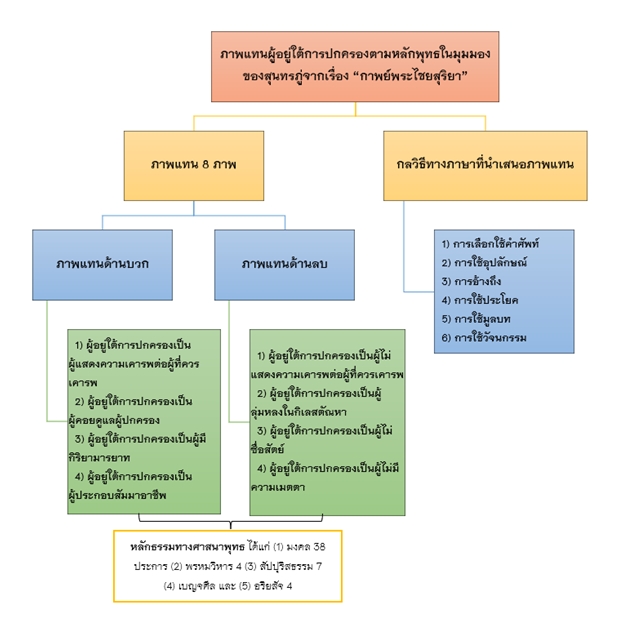
This research article focuses on 3 main objectives: (1) to study the representations of the governed citizen based on Buddhist principles in Sunthorn Phu’s perspective in Kaap Phra Chai Suriya poem, and (2) to examine the linguistic strategies used in conveying these representations based on Buddhist principles in Sunthorn Phu’s perspective in Kaap Phra Chai Suriya Poem. It was qualitative type of research using data collected from online sources, the Vajirayana website, including 119 stanzas of Sunthorn Phu’s “Kaap Phra Chai Suriya” and “Supasit Sorn Stree” analyzed by the frameworks of representation theory and linguistic strategy.
The result showed that 1) Sunthorn Phu presented a total of 8 representations of the governed citizens based on Buddhist principles including 4 positive representations of Govern citizens: Showing respect to the respectable people, being individuals with proper manners, Being practitioners of right livelihood. Conversely, other 4 negative representations also identified the governed citizens: Showing disrespect to the respectable people, being driven by sensual desire, Being dishonest, and Lacking of loving kindness. These representations are in accordance with Buddhist principles including the Thirty-Eight Blessings (Mangala Sutta), the Four Brahmaviharas, the Seven Qualities of a Good Person (Sappurisa-dhamma), the Five Precepts, and the Four Noble Truths. 2) There were 6 linguistic strategies used in conveying these representations based on Buddhist principles in Sunthorn Phu’s perspective including lexical choice, metaphor, allusion, sentence, presupposition and speech acts.
Article Details

This work is licensed under a Creative Commons Attribution-NonCommercial-NoDerivatives 4.0 International License.
Copyright Notice
The content and information in the articles published in Journal of MCU Palisueksabuddhaghosa Review, are regarded as opinions and responsibilities of article author only. It definitely does not mean that the editor must agree or share any responsibility to the author.
Articles, information, content, figure etc. that have been published in the Journal of MCU Palisueksabuddhaghosa Review is considered as the copyright of the Journal. If any individual or organization will to bring any parts of article for promote or to do anything, must be licensed only in official form from the Journal of MCU Palisueksabuddhaghosa Review.
The content and information in the articles published in Journal of MCU Palisueksabuddhaghosa Review, are regarded as opinions and responsibilities of article author only. It definitely does not mean that the editor must agree or share any responsibility to the author.
Articles, information, content, figure etc. that have been published in the Journal of MCU Palisueksabuddhaghosa Review is considered as the copyright of the Journal. If any individual or organization will to bring any parts of article for promote or to do anything, must be licensed only in official form from the Journal of MCU Palisueksabuddhaghosa Review.
References
กาญจนา นาคสกุล. ภาษากับวรรณกรรม. กรุงเทพฯ : โรงพิมพ์จุฬาลงกรณ์มหาวิทยาลัย. 2541.
จันทิมา อังคพณิชกิจ. การวิเคราะห์ข้อความ. กรุงเทพฯ : สำนักพิมพ์มหาวิทยาลัยธรรมศาสตร์. 2561.
จารวีย์ คีรีนิล. การพัฒนาความสามารถด้านการแต่งคำประพันธ์ประเภทกาพย์ของนักเรียนชั้นมัธยมศึกษาปีที่ 1 โดยการจัดการเรียนรู้ด้วยเทคนิคเพื่อนคู่คิด. วิทยานิพนธ์ปริญญาศึกษาศาสตรมหาบัณฑิต สาขาวิชาการสอนภาษาไทย. คณะศึกษาศาสตร์ มหาวิทยาลัยศิลปากร. 2564.
ชัชวดี ศรลัมพ์. ภาษากับความหมาย. พิมพ์ครั้งที่ 3. กรุงเทพฯ : บริษัท จรัญสนิทวงศ์การพิมพ์ จำกัด. 2562.
โชษิตา มณีใส. พินิจกาพย์พระไชยสุริยาของสุนทรภู่. วารสารราชบัณฑิตยสถาน. 38(2). หน้า 60-74. 2555.
ทรงธรรม อินทจักร. แนวคิดพื้นฐานด้านวัจนปฏิบัติศาสตร์. กรุงเทพฯ : มหาวิทยาลัยธรรมศาสตร์, 2550.
ธนบัตร ใจอินทร์. อรรถกถามหาสุบินชาดก: ความสำคัญต่อการสร้างสรรค์วรรณคดีไทย. วิทยานิพนธ์ปริญญาอักษรศาสตรมหาบัณฑิต สาขาวิชาภาษาไทย. คณะอักษรศาสตร์ จุฬาลงกรณ์มหาวิทยาลัย. 2561.
ปริวัฒน์ กุลวิทย์. การสื่อสารด้านสภาพสังคมจากกาพย์พระไชยสุริยา. วารสารศึกษาศาสตร์ มหาวิทยาลัย
ศิลปากร. 16(1), หน้า 209-220. 2561.
พระครูอุทุมพรภัทรธรรม และพระครูสุธีคัมภีรญาณ. ความสัมพันธ์การขัดเกลาทางสังคมกับแนวคิดการขัดเกลาทางสังคมในพระพุทธศาสนา. Journal of Buddhist Education and Research: JBER. 6(2). หน้า 358-369, 2563.
เพียรศิริ วงศ์วิภานนท์. เอกสารการสอนชุดวิชาภาษาไทย 3. กรุงเทพฯ : มหาวิทยาลัยสุโขทัยธรรมาธิราช. 2531.
วชิรญาณ. กาพย์เรื่องพระไชยสุริยา และ สุภาษิตสอนสตรี ของสุนทรภู่. สืบค้นเมื่อ 15 มกราคม 2568 จาก https://shorturl.asia/5WBAz. ม.ป.ป.
วันชนะ ทองคำเภา. ภาพตัวแทนของสมเด็จพระมหาธรรมราชาในวรรณกรรมไทย. วิทยานิพนธ์ปริญญาอักษรศาสตรมหาบัณฑิต สาขาวิชาภาษาไทย. คณะอักษรศาสตร์ จุฬาลงกรณ์มหาวิทยาลัย. 2550.
สมเด็จพระพุทธโฆษาจารย์ (ป.อ. ปยุตฺโต). พจนานุกรมพุทธศาสน์ ฉบับประมวลศัพท์. สืบค้นเมื่อ 19 เมษายน 2568 จาก https://84000.org/tipitaka/dic_dhamma/. 2546.
สายรุ้ง เพียรอนุรักษ์. วรรณกรรมตำราเรียนในสมัยรัชกาลที่ 3: การศึกษาความสัมพันธ์ระหว่างการสร้างวรรณกรรมตำราเรียนและสังคม. วิทยานิพนธ์ปริญญาอักษรศาสตรมหาบัณฑิต สาขาวิชาภาษาไทย. คณะอักษรศาสตร์ มหาวิทยาลัยศิลปากร. 2562.
สำนักงานราชบัณฑิตยสภา. พจนานุกรม ฉบับราชบัณฑิตยสถาน พ.ศ. 2554. สืบค้นเมื่อ 15 มกราคม 2568 จาก https://dictionary.orst.go.th/. 2554.
มหาวิทยาลัยมหาจุฬาลงกรณราชวิทยาลัย. พระไตรปิฎกออนไลน์ ฉบับมหาจุฬาลงกรณราชวิทยาลัย. สืบค้นเมื่อ 22 มิถุนายน 2568 จาก https://tripitaka-online.blogspot.com/, 2559.
Fairclough. N. Language and power. London: Longman, 1989.
Hall. S. Representation: Cultural representations and signifying practices. London: SAGE. 1997.
