
A MODEL OF INTEGRATING BUDDHIST PRINCIPLES TO STRENGTHEN THE PROFESSIONAL DUTIES OF LAY JUDGES IN THE JUVENILE AND FAMILY COURTS, REGION VI
Article Sidebar
Main Article Content
Abstract
The research article aimed to: 1) examine the principles and approaches in the performance of lay judges in the Juvenile and Family Court Region 6; 2) explore the Buddhist doctrines that strengthen collaborative performance among lay judges; and 3) propose a model of integrating Buddhist principles to strengthen the professional duties of lay judges in the Juvenile and Family Courts, Region VI. The study employed qualitative research methodology, combining documents with field work through in-depth interviews. Key informants were purposefully selected, comprising a total of 27 individuals, including both Buddhist monks and lay judges. Data were analyzed using descriptive and interpretive methods.
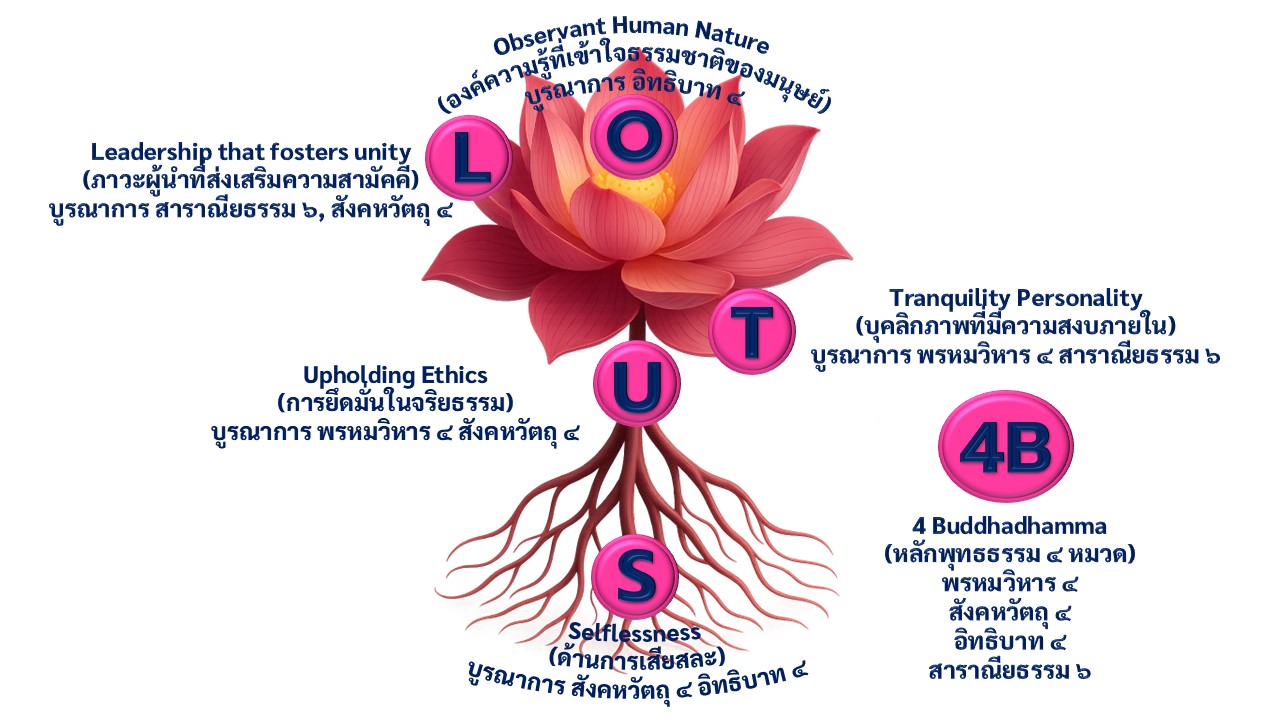
The research findings revealed that five core qualities that characterize the effective performance of lay judges: 1) Leadership that fosters unity, 2) Observant human nature, 3) Tranquil personality, 4) Upholding ethics, and 5) Selflessness. These qualities are reinforced by 4 key Buddhist doctrines: 4 Brahmavihãra which form the foundation of compassionate thinking; 4 Iddhipãda which serve as internal motivation; 4 Sañgahavatthu which guide team relationships; and 6 Sãraṇĩyadhamma which foster a culture of harmony and mutual trust—together embodying a living model of justice for contemporary Thai society. These findings are synthesized into the “LOTUS 4B Model”: L-Leadership that fosters unity; O-Observant human nature; T-Tranquility personality; U-Upholding ethics; and S-Selflessness. 4B refers to the integration of the four aforementioned Buddhist doctrines represented metaphorically as parts of a lotus-petals, stamen, sepals, stem, and roots-each component includes clear indicators measurable both quantitatively and qualitatively. This model embodies the deep power of compassion, wisdom, ethical integrity, inner peace, and selfless service, offering a holistic and sustainable framework for strengthening the juvenile justice system in Thailand.
Article Details

This work is licensed under a Creative Commons Attribution-NonCommercial-NoDerivatives 4.0 International License.
Copyright Notice
The content and information in the articles published in Journal of MCU Palisueksabuddhaghosa Review, are regarded as opinions and responsibilities of article author only. It definitely does not mean that the editor must agree or share any responsibility to the author.
Articles, information, content, figure etc. that have been published in the Journal of MCU Palisueksabuddhaghosa Review is considered as the copyright of the Journal. If any individual or organization will to bring any parts of article for promote or to do anything, must be licensed only in official form from the Journal of MCU Palisueksabuddhaghosa Review.
The content and information in the articles published in Journal of MCU Palisueksabuddhaghosa Review, are regarded as opinions and responsibilities of article author only. It definitely does not mean that the editor must agree or share any responsibility to the author.
Articles, information, content, figure etc. that have been published in the Journal of MCU Palisueksabuddhaghosa Review is considered as the copyright of the Journal. If any individual or organization will to bring any parts of article for promote or to do anything, must be licensed only in official form from the Journal of MCU Palisueksabuddhaghosa Review.
References
คณะผู้พิพากษาสมทบศาลเยาวชนและครอบครัวภาค 6. คู่มือผู้พิพากษาวสทบศาลเยาวชนและครอบครัวภาค 6. (พิษณุโลก: ห้างหุ้นส่วนจำกัดสุรสีห์กราฟฟิค, 2566).
สำนักงานศาลเยาวชนและครอบครัว. คู่มือการปฏิบัติงานของผู้พิพากษาสมทบในศาลเยาวชนและครอบครัว. (กรุงเทพมหานคร: สำนักงานศาลเยาวชนและครอบครัว. 2563).
สำนักงานศาลเยาวชนและครอบครัวกลาง. แนวทางการปฏิบัติงานของผู้พิพากษาสมทบศาลเยาวชนและครอบครัว (กรุงเทพมหานคร: สำนักกิจการผู้พิพากษาสมทบ, 2562).
สำนักงานศาลเยาวชนและครอบครัวภาค 6. รายงานแผนยุทธศาสตร์การบริหารงานและพัฒนาศักยภาพผู้พิพากษาสมทบศาลเยาวชนและครอบครัวภาค 6 ประจำปีงบประมาณ พ.ศ. 2565. (กรุงเทพมหานคร: สำนักงานศาลเยาวชนและครอบครัวภาค 6. 2565).
