
GUIDELINES FOR THE PRACTICING VIPASSANA MEDITATION TO PREPARE THE TERMINALLY ILL PATIENTS THROUGH THE INTEGRATED BUDDHISM
Article Sidebar
Main Article Content
Abstract
This research article aimed to: 1) study the theory about the principles of self-death preparation for late patients in Thai society, 2) study how to practice insight meditation for late patients, and 3) to present the Buddhist integrated insight meditation on the preparation of late-stage patients’ deaths. This is qualitative research done by using field work methodology where in-depth interview of key informants was also made and then the contents analysis was done through the descriptive analysis respectively.
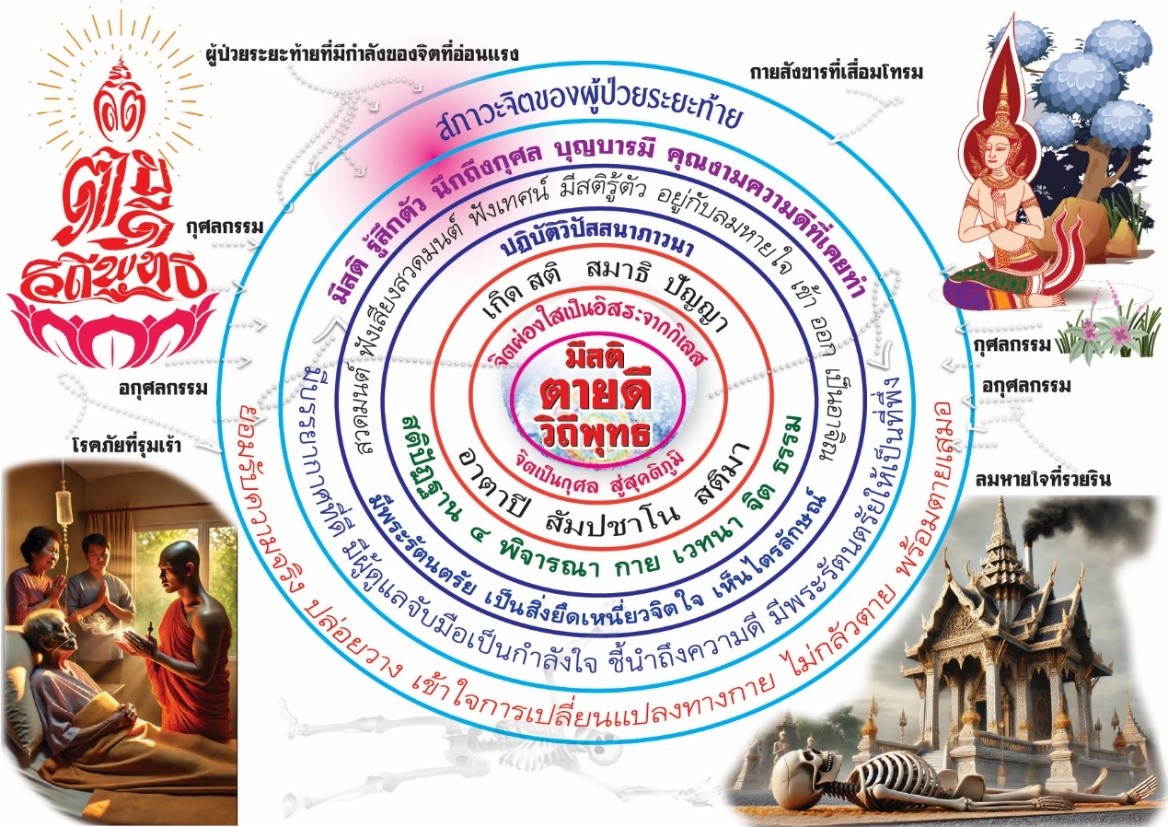
This research investigated the preparation for death among terminally ill patients, yielding 3 key findings; 1) Death preparation involves mind training and continuous mindfulness, especially during the final moments, 2) The principle of “the body is ill, but the mind is not” guides mental training based on the Four Foundations of Mindfulness, aiming for 3 distinct levels: worldly mindfulness, worldly mindfulness integrated with spiritual understanding, and purely spiritual mindfulness. Ānāpānasati was identified as the most effective Vipassana meditation practice for terminally ill patients, 3) Cultivating Ānāpānasati and maintaining mindfulness in all postures leads to the wisdom of understanding life as a natural process. When Anapanasati is fully developed, the mind becomes liberated from defilements, achieving tranquility and complete freedom. The knowledge gained from the research is the model ‘Being mindful, well death through Buddhist way". This model emphasizes meditation practice according to the principles of 4 Satipatthana, characterized by diligence (Atāpi), cclear comprehension (Sampajāno), and mindfulness (Satimā). This continuous mindfulness training helps patients' minds to accept the reality of life, let go of attachments and suffering, understand and accept the transformation of existence, and face death without fear, thus being prepared for a peaceful demise. When the practitioner's final moment is characterized by wholesome mental states, it leads to a mindful and good death, in accordance with the Buddhist path.
Article Details

This work is licensed under a Creative Commons Attribution-NonCommercial-NoDerivatives 4.0 International License.
Copyright Notice
The content and information in the articles published in Journal of MCU Palisueksabuddhaghosa Review, are regarded as opinions and responsibilities of article author only. It definitely does not mean that the editor must agree or share any responsibility to the author.
Articles, information, content, figure etc. that have been published in the Journal of MCU Palisueksabuddhaghosa Review is considered as the copyright of the Journal. If any individual or organization will to bring any parts of article for promote or to do anything, must be licensed only in official form from the Journal of MCU Palisueksabuddhaghosa Review.
The content and information in the articles published in Journal of MCU Palisueksabuddhaghosa Review, are regarded as opinions and responsibilities of article author only. It definitely does not mean that the editor must agree or share any responsibility to the author.
Articles, information, content, figure etc. that have been published in the Journal of MCU Palisueksabuddhaghosa Review is considered as the copyright of the Journal. If any individual or organization will to bring any parts of article for promote or to do anything, must be licensed only in official form from the Journal of MCU Palisueksabuddhaghosa Review.
References
สนุกเพจ. วิปัสสนากรรมฐานทำแล้วจะเกิดผลดีทั้งทางโลกและทางธรรม. [ออนไลน์]. แหล่งที่มา: https://www.sanook.com/horoscope/168443/[22 กันยายน 2567].
TDRI. การเตรียมตัวก่อนวาระสุดท้าย เลือกอยู่หรือไปให้ได้อย่างหวัง. [ออนไลน์]. แหล่งที่มา: https://tdri.or.th/2019/04attitude-toward-palliative-care-in-thailand/[11 เมษายน 2567].
แสนปราชญ์ ปัญญาคโม. ตายดีวิถีพุทธ. (นครราชสีมา: ศูนย์พุทธวิธีดูแลผู้ป่วยระยะท้าย วัดป่าโนนสะอาด. มปพ).
