
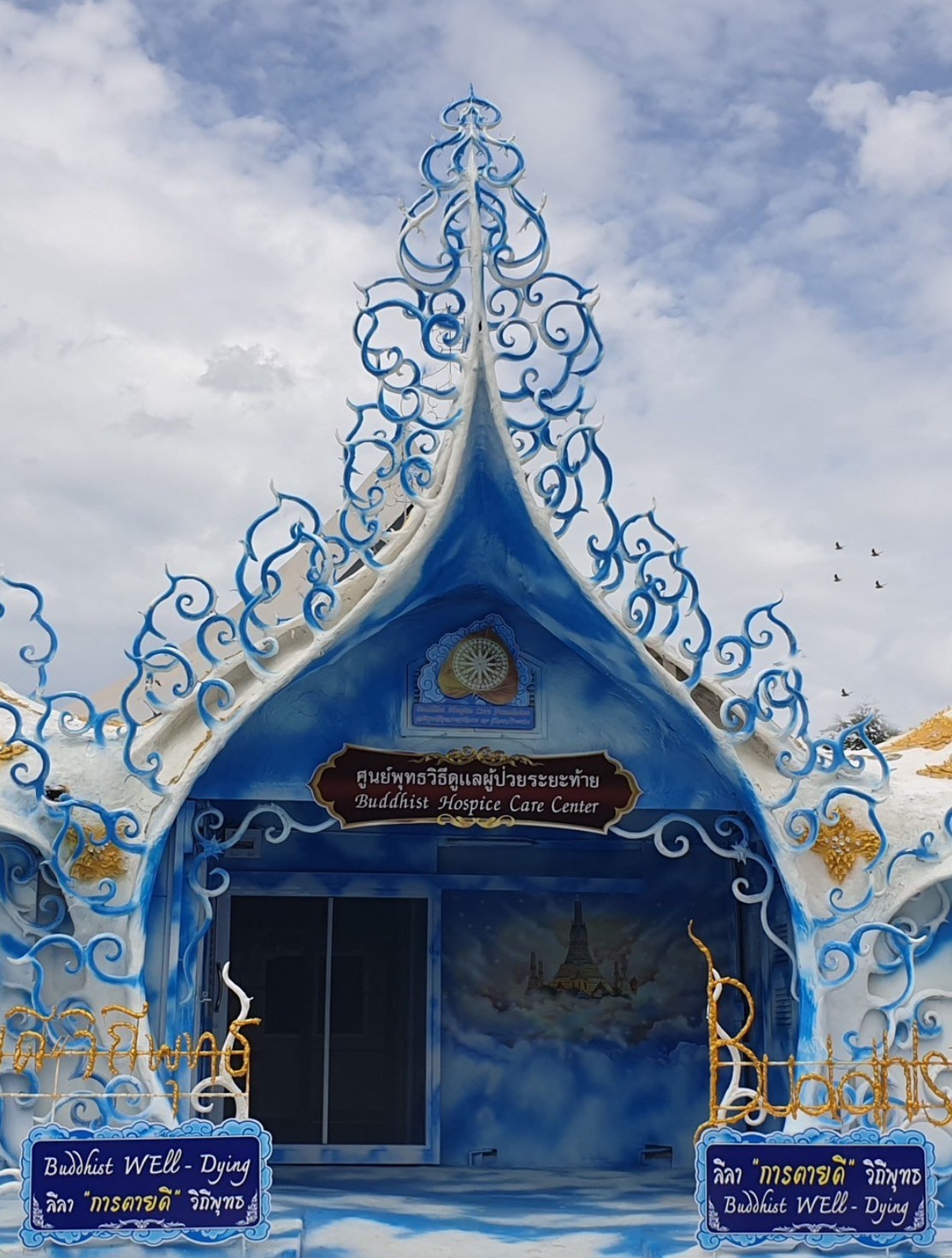
The Buddhist Integrated Enhancement of The Quality of Life for The Terminally Ill at The Buddhist Hospice Care Centre, Wat Pa Non Sa-at in Nakhon Ratchasima Province
Article Sidebar
Main Article Content
Abstract
This research article contains the following objectives: 1) to investigate the concept of end-of-life care at the Buddhist Hospice Care Centre, Wat Pa Non Sa-at in Nakhon Ratchasima Province; 2) to examine the application of Buddhist principles in enhancing the quality of life for terminally ill patients at the Center; and 3) to propose a Buddhist-integrated model for improving the quality of life of end-of-life patients at the Center. It was qualitative research employing documentary research and fieldwork methods. The data collection tools included in-depth interviews with 20 key informants and participation in discussion forums. Data were analyzed using content analysis and presented in a descriptive-analytical format.
The research results revealed that the end-of-life care at the Buddhist Hospice Care Centre is based on the principle of Dhamma leading the world, with a strong emphasis on self-development through daily Dhamma practice 3 sessions per day and insight meditation in accordance with the Four Foundations of Mindfulness or Satipaṭṭhāna. This practice aims to cultivate mindfulness on 3 levels, serving as a foundation for patients to comprehend the nature of reality through the lens of the Three Characteristics. Guided by the concept “the body is ill, but the mind is not,” the Center prioritizes spiritual care and the cultivation of wholesome mental states over physical treatment. Core Buddhist principles employed include the 4 Phāvanā and Satisampajañña, promoting holistic self-development in four dimensions: physical, mental, social, and spiritual. As a result, patients develop a deeper awareness of the nature of life, which reduces fear of death, anxiety, and attachment.
The research proposed the LIVE Model as a framework for enhancing the quality of life of terminally ill patients through an integrated Buddhist approach. The model comprises four key components: L (Learn the Truth) – studying the truth of life through Dhamma practice; I (Integrate Holistic Well-being) – integrating well-being in all four dimensions based on the principles of the Pawana 4; V (Value Spiritual Development) – cultivating spiritual development through the role of a “Great Teacher” who offers Dhamma as a gift; and E (Enlighten to Let Go) – attaining wisdom and letting go, enabling patients to “be mindful, live well through the Buddhist way.” This model represents an innovative Buddhist-integrated approach that supports patients in facing aging, illness, and death without suffering, living meaningfully in the present, and departing with dignity in accordance with Buddhist wisdom.
Article Details

This work is licensed under a Creative Commons Attribution-NonCommercial-NoDerivatives 4.0 International License.
Copyright Notice
The content and information in the articles published in Journal of MCU Palisueksabuddhaghosa Review, are regarded as opinions and responsibilities of article author only. It definitely does not mean that the editor must agree or share any responsibility to the author.
Articles, information, content, figure etc. that have been published in the Journal of MCU Palisueksabuddhaghosa Review is considered as the copyright of the Journal. If any individual or organization will to bring any parts of article for promote or to do anything, must be licensed only in official form from the Journal of MCU Palisueksabuddhaghosa Review.
The content and information in the articles published in Journal of MCU Palisueksabuddhaghosa Review, are regarded as opinions and responsibilities of article author only. It definitely does not mean that the editor must agree or share any responsibility to the author.
Articles, information, content, figure etc. that have been published in the Journal of MCU Palisueksabuddhaghosa Review is considered as the copyright of the Journal. If any individual or organization will to bring any parts of article for promote or to do anything, must be licensed only in official form from the Journal of MCU Palisueksabuddhaghosa Review.
References
กรมกิจการผู้สูงอายุ กระทรวงการพัฒนาสังคมและความมั่นคงของมนุษย์. สถิติผู้สูงอายุ กันยายน 2567: [ออนไลน์]. แหล่งที่มา: https://www.dop.go.th/th/statistics_page?cat=1&id=2559 [29 พฤศจิกายน 2567].
กองยุทธศาสตร์และแผนงาน สำนักงานปลัดกระทรวงสาธารณสุข. สถิติสาธารณสุข 2566: [ออนไลน์]. แหล่งที่มา: https://spd.moph.go.th/public-health-statistics [4 กุมภาพันธ์ 2567].
พระแสนปราชญ์ ปัญญาคโม. ตายดีวิถีพุทธ. (นครราชสีมา: ศูนย์พุทธวิธีดูแลผู้ป่วยระยะท้าย วัดป่าโนนสะอาด จ.นครราสีมา). 2567.
สำนักงานคณะกรรมการสุขภาพแห่งชาติ. พระราชบัญญัติสุขภาพแห่งชาติ พ.ศ. 2550. (กรุงเทพฯ: สำนักงานคณะกรรมการสุขภาพแห่งชาติ. 2550). มาตรา 12.
แสวง บุญเฉลิมวิภาส. “การรักษาพยาบาลผู้ป่วยวาระสุดท้าย : ความจริงทางการแพทย์กับขอบเขตทางกฎหมาย”. วารสารกฎหมายสุขภาพและสาธารณสุข. ปีที่ 1 ฉบับที่ 3 (กันยายน-ธันวาคม 2558).
World Health Organization. Palliative Care. [Online]. Source: https://www.who.int/ news-room/fact-sheets/detail/palliative-care [February 4. 2024].
