
The Development Of Buddhist-Oriented Creative Ctivities To Promote Sustainability Of Temples And Communities Along Phra Khanong Canal
Article Sidebar
Main Article Content
Abstract
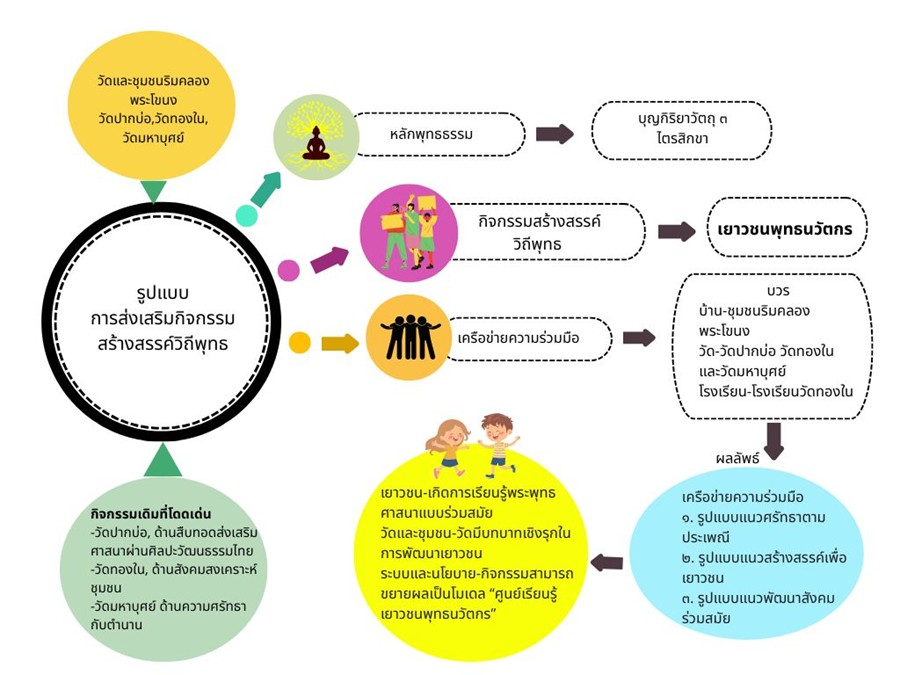
This research aimed at 1) to study the context of the temples and the model of promoting Buddhist activities in temples along Phra Khanong Canal, 2) to develop creative Buddhist activities in temples and communities along Phra Khanong Canal, and 3) to propose a model of promoting creative Buddhist activities in temples and communities along Phra Khanong Canal. This research was qualitative research using in-depth interviews and descriptive data analysis. The research results found that 1) the context of the temples and the model of promoting Buddhist activities in temples along Phra Khanong Canal found that temples along Phra Khanong Canal, Wat Pak Bo, Wat Thong Nai, and Wat Mahabut have distinctive characteristics that clearly reflect beliefs, faith, and people’s participation in Buddhism, 2) it was found that the development of creative Buddhist activities consisted of 1) studying and analyzing the community context, 2) holding joint meetings to create activities, “Buddhist Innovative Youth” 3.) Experimenting with the activity format in the target area 4.) Summarizing the results and building on the activities 3) Found that the format for promoting creative Buddhist activities at temples and communities along the Phra Khanong Canal can be summarized into 3 formats: 1. Traditional faith format 2. Creative for youth format 3. Contemporary social development format Knowledge gained from research The format for promoting creative Buddhist activities comes from 3 components: Buddhist principles, including the 3 meritorious deeds and Trisikkha; Creative Buddhist activities, including (1.) Novice monk ordination activity at Wat Pak Bo; (2.) “Buddhist Innovative Youth” activity at Wat Thong Nai; (3.) Knowledge and morality development activity at Wat Mahabut; 3. Cooperation network; Cooperation network, especially BWOR (home, temple, government office).
Keywords: The Development, Buddhist-Oriented Creative Ctivities To Promote Sustainability, Temples And Communities Along Phra Khanong Canal
Article Details

This work is licensed under a Creative Commons Attribution-NonCommercial-NoDerivatives 4.0 International License.
Copyright Notice
The content and information in the articles published in Journal of MCU Palisueksabuddhaghosa Review, are regarded as opinions and responsibilities of article author only. It definitely does not mean that the editor must agree or share any responsibility to the author.
Articles, information, content, figure etc. that have been published in the Journal of MCU Palisueksabuddhaghosa Review is considered as the copyright of the Journal. If any individual or organization will to bring any parts of article for promote or to do anything, must be licensed only in official form from the Journal of MCU Palisueksabuddhaghosa Review.
The content and information in the articles published in Journal of MCU Palisueksabuddhaghosa Review, are regarded as opinions and responsibilities of article author only. It definitely does not mean that the editor must agree or share any responsibility to the author.
Articles, information, content, figure etc. that have been published in the Journal of MCU Palisueksabuddhaghosa Review is considered as the copyright of the Journal. If any individual or organization will to bring any parts of article for promote or to do anything, must be licensed only in official form from the Journal of MCU Palisueksabuddhaghosa Review.
References
ปรธภร ปุระกัน. “รูปแบบการส่งเสริมบทบาทของผู้สูงอายุในกิจกรรมทางพระพุทธศาสนาในจังหวัดชัยภูมิ”. วารสารสังคมศาสตร์และมานุษยวิทยาเชิงพุทธ. ปีที่ 6 ฉบับที่ 2 กุมภาพันธ์ 2564.
พระราชสุตาภรณ์ และคณะ. “การบูรณาการพื้นที่นวัตกรรมการเรียนรู้วิถีพุทธ”. วารสารสันติศึกษา
ปริทรรศน์ มจร. ปีที่ 10 ฉบับที่ 3 พฤษภาคม 2565.
สิน งามประโคน. “การพัฒนาองค์ความรู้พื้นที่นวัตกรรมการเรียนรู้วิถีพุทธ”. วารสาร มจร สังคมศาสตร์ปริทรรศน์ . ปีที่ 13 ฉบับที่ 4 กรกฎาคม - สิงหาคม 2567.
สำนักงานสภาพัฒนาการเศรษฐกิจและสังคมแห่งชาติ. แผนพัฒนาเศรษฐกิจและสังคมแห่งชาติ ฉบับที่ 11 (พ.ศ. 2555-2559). สำนักงานสภาพัฒนาการเศรษฐกิจและสังคมแห่งชาติ: สำนักนายกรัฐมนตรี, 2555.
อนันต์ คติยะจันทร. การอนุรักษ์ชุมชนกับวิถีชีวิตชุมชนและสิ่งแวดล้อมทางวัฒนธรรมของชุมชนริมปากแม่น้ำห้วยหลวง จังหวัดหนองคาย. วารสารปัญญาภิวัฒน์ ปีที่ 12 ฉบับที่ 1 ประจำเดือนมกราคม – เมษายน 2563.
