
Tipitaka Pali Aphidhana Samsa – Sannahayamase Transliteration, Translation and Analysis
Article Sidebar
Main Article Content
Abstract
The objectives of this research are threefold: 1) to transliterate the Tipiṭaka Pāli Abhidhāna from Burmese script into Thai Pāli script, covering the section from saṃsa–sannāhayāmase; 2) to translate the Tipiṭaka Pāli Abhidhāna within the same range; and 3) to study and analyze the Tipiṭaka Pāli Abhidhāna in terms of its historical background, phonology, and educational value. This study employed a qualitative documentary research method. The researcher used the original Burmese-script manuscript of the Tipiṭaka Pāli Abhidhāna, Volume 21, covering saṃsa–sannāhayāmase, and transliterated it into Thai Pāli script. The process involved analyzing and classifying entries along with their exemplars, translating, compiling, and presenting the results to academic advisors and experts for verification, revision, and improvement.
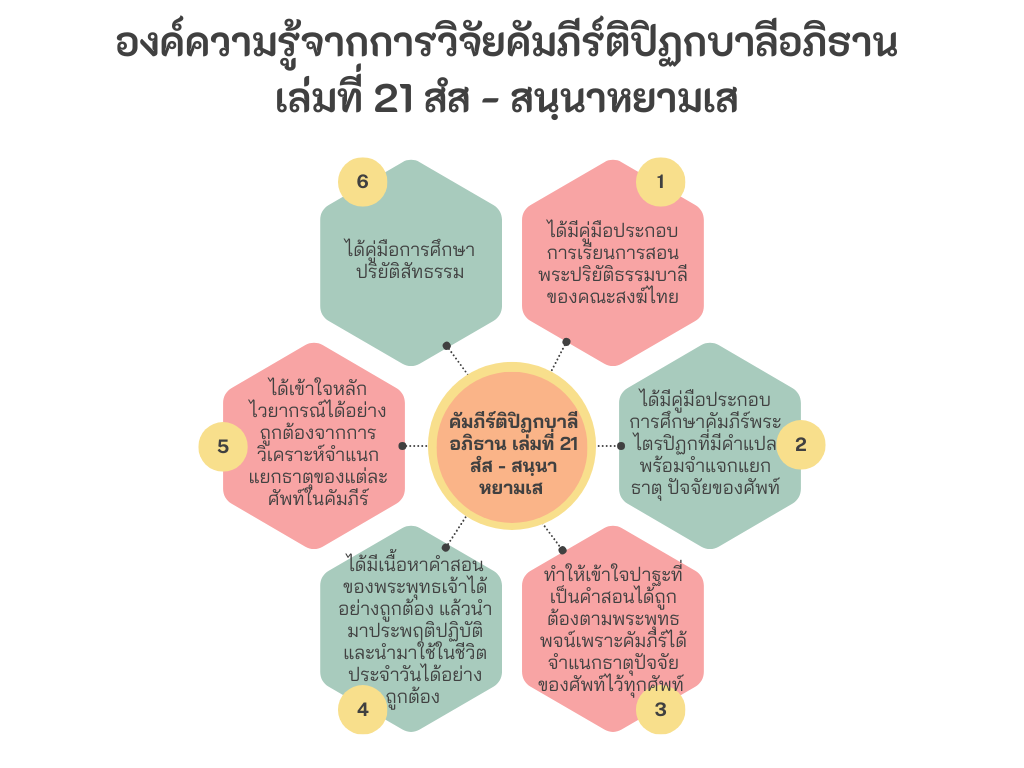
The findings are as follows: 1) The researcher transliterated the Tipiṭaka Pāli Abhidhāna, Sixth Council Burmese Edition, Volume 21, compiled by Shin Min Sayadaw and a group of monks, from Burmese script into Thai Pāli script. The selected section includes the letter “sa,” beginning from saṃsa to sannāhayāmase, comprising 7,885 terms with examples drawn from the Tipiṭaka, Aṭṭhakathā, Ṭīkā, Anuṭīkā, and other grammatical treatises. Each entry identifies its word class (e.g., noun, verb, indeclinable), analyzes its root according to grammatical principles, and groups synonymous or related terms together, reflecting a method of compilation aimed at linguistic and semantic completeness. 2) After transliteration, the text was translated while preserving meanings consistent with or close to the headword’s definition, ensuring the work remained aligned with its purpose. Translation was conducted in three dimensions: content, by rendering according to etymology, root, or meaning; language and style, by translating interpretively rather than literally, clarifying the word type; and semantic relationship, by preserving consistent meanings of repeated or synonymous terms across the Tipiṭaka and related commentarial works. 3) The Tipiṭaka Pāli Abhidhāna traces its development back to 1769 CE (B.E. 2312), composed by Burmese monks based on grammatical traditions, and evolved into several editions, with Volume 21 classified under vohāra, samānattthakosa, and anekatthakosa types. The researcher analyzed selected terms under six grammatical categories—sandhi, nāma, samāsa, taddhita, ākhyāta, and kittaka—five examples each. The educational value of the text is twofold: as a lexicographical source, offering profound understanding of etymology and meaning essential for the study of the Tipiṭaka and its commentaries; and for Pāli studies, in three aspects: (1) grammatical analysis, aiding comprehension of canonical terms; (2) metrics and prosody, showing how terms fit into metrical patterns of heavy and light syllables; and (3) scriptural study, serving as a reference tool comparable with other exegetical works such as the Abhidhammatthavibhāvinī and Aṭṭhayojanā, thereby enhancing interpretation and understanding across texts.
Article Details

This work is licensed under a Creative Commons Attribution-NonCommercial-NoDerivatives 4.0 International License.
Copyright Notice
The content and information in the articles published in Journal of MCU Palisueksabuddhaghosa Review, are regarded as opinions and responsibilities of article author only. It definitely does not mean that the editor must agree or share any responsibility to the author.
Articles, information, content, figure etc. that have been published in the Journal of MCU Palisueksabuddhaghosa Review is considered as the copyright of the Journal. If any individual or organization will to bring any parts of article for promote or to do anything, must be licensed only in official form from the Journal of MCU Palisueksabuddhaghosa Review.
The content and information in the articles published in Journal of MCU Palisueksabuddhaghosa Review, are regarded as opinions and responsibilities of article author only. It definitely does not mean that the editor must agree or share any responsibility to the author.
Articles, information, content, figure etc. that have been published in the Journal of MCU Palisueksabuddhaghosa Review is considered as the copyright of the Journal. If any individual or organization will to bring any parts of article for promote or to do anything, must be licensed only in official form from the Journal of MCU Palisueksabuddhaghosa Review.
References
ดารารัตน์ อินทร์ประสิทธิ์. การใช้พจนานุกรมบาลี–ไทยในการแปลพระไตรปิฎก. วารสารมนุษยศาสตร์. มหาวิทยาลัยเชียงใหม่, 2563.
ธีรพล ศรีสุวรรณ. การพัฒนาพจนานุกรมบาลี–ไทยเชิงวิชาการ. วารสารวิชาการศิลปศาสตร์. มหาวิทยาลัยมหิดล, 2564, หน้า 87.
พระครูปลัดสุวัฒนพรหมคุณ. การใช้คัมภีร์อภิธานในการเรียนการสอนบาลีในคณะสงฆ์. วิทยานิพนธ์พุทธศาสตรมหาบัณฑิต. มหาวิทยาลัยมหาจุฬาลงกรณราชวิทยาลัย, 2562. หน้า 115.
พระครูอมรวิสุทธิ์. การพัฒนาคู่มือการแปลบาลีสำหรับคณะสงฆ์. วารสารพุทธศาสน์ศึกษา. มหาวิทยาลัยมหามกุฏราชวิทยาลัย, 2565.
พระมหาสุวิทย์ ญาณกิตฺโต. การแปลบาลีเชิงอรรถในอรรถกถาธรรมบท. วิทยานิพนธ์พุทธศาสตรมหาบัณฑิต. มหาวิทยาลัยมหาจุฬาลงกรณราชวิทยาลัย, 2561.
มหาจุฬาลงกรณราชวิทยาลัย. พระไตรปิฎกภาษาบาลี ฉบับมหาจุฬาเตปิฏกํ. กรุงเทพมหานคร: โรงพิมพ์มหาจุฬาลงกรณราชวิทยาลัย, 2500.
เวทย์ บรรณกรกุล. “ศึกษาวิเคราะห์คันถารัมภะในคัมภีร์ธัมมปทัฏฐกถา”. สารนิพนธ์พุทธศาสตรดุษฎีบัณฑิต. บัณฑิตวิทยาลัย: มหาวิทยาลัยมหาจุฬาลงกรณราชวิทยาลัย, 2559.
สมเด็จพระพุทธชินวงศ์ สมศักดิ์ อุปสมเถระ และคณะ. สัททานุกรมพระไตรปิฎกเชิงวิจัย ฉบับบาลี - ไทย เล่ม 1 (อ - องฺโคฬาริกตา). จัดพิมพ์โดยศูนย์เผยแผ่พระพุทธศาสนาแห่งชาติ สำนักงานพระพุทธศาสนาแห่งชาติ. กรุงเทพมหานคร: หจก.ประยูรสาส์นไทย การพิมพ์, 2556.
อุทิส ศิริวรรณ ศ. ดร. และคณะ. พจนานุกรมพระไตรปิฎกบาลีเถรวาท เล่ม 1-24. กรุงเทพมหานคร: บจก.ปัญญมิตร การพิมพ์, 2565.
