
A STUDY OF VIPSSANÃ MADITATION TEACHING MAETHOD OF PHRAKRU PHAWANAWISUTTHIKHUN WI.
Article Sidebar
Main Article Content
Abstract
The objectives of this research are threefold: 1) To study the methods of teaching Vipassanā meditation in the Theravāda Buddhist scriptures. 2)To study the methods of teaching Vipassanā meditation by Phra Khru Phawanavisuddhikhun, Vi. 3)To analyze the methods of teaching Vipassanā meditation by Phra Khru Phawanavisuddhikhun, Vi. The data were collected from the Tipiṭaka, Commentaries, Sub-commentaries, Theravāda Buddhist texts, manuals, books, documents, CD-ROMs, related research works, as well as through observation of the teaching and interviews with Phra Khru Phawanavisuddhikhun, Vi. The information was then analyzed, compiled, and described in a narrative form.
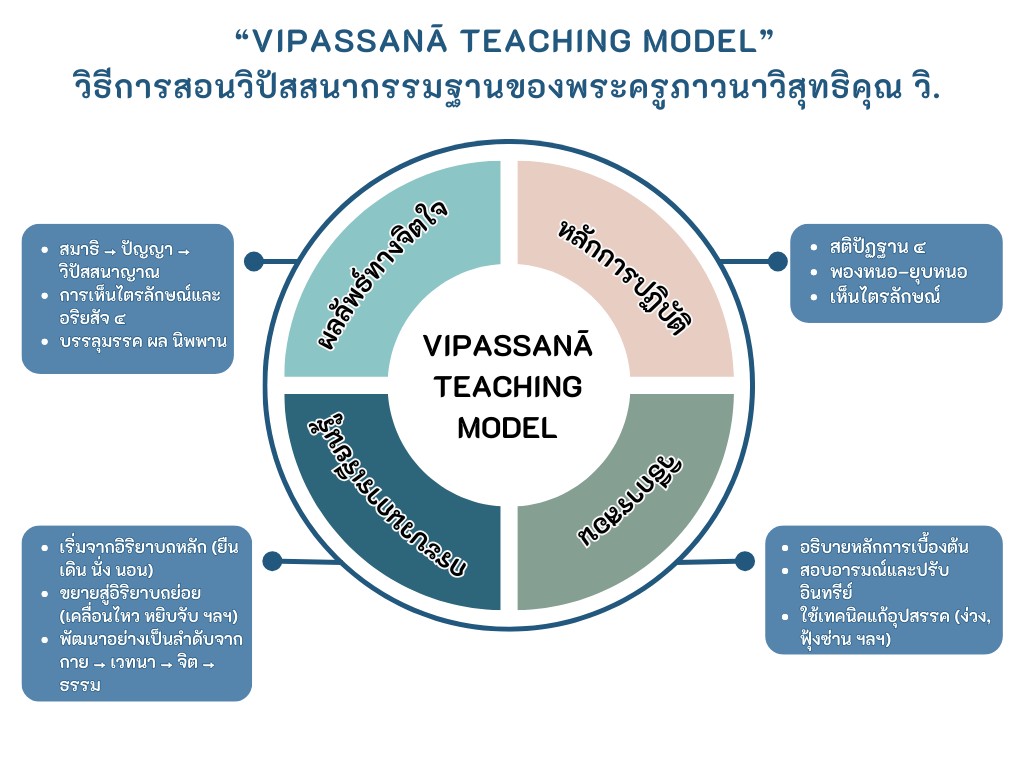
The research findings reveal that the practice of Vipassanā meditation as found in the Theravāda Buddhist scriptures is based on the principle of the Four Foundations of Mindfulness (Satipaṭṭhāna 4), namely contemplation of body, feelings, mind, and dhammas, leading to the realization of the Three Characteristics (anicca, dukkha, anattā), the arising and passing away of name-and-form, and the Four Noble Truths. This single method leads to the Noble Eightfold Path, the arising of Vipassanā-ñāṇa (insight knowledge), and ultimately to the attainment of Path, Fruition, and Nibbāna—the cessation of all suffering, which is the supreme goal of Buddhism. The teaching method of Vipassanā meditation by Phra Khru Phawanavisuddhikhun, Vi. follows the Four Foundations of Mindfulness according to the lineage of noble teachers, emphasizing the method of noting the breath and bodily postures as taught by the Venerable Mahāsi Sayadaw (Sobhana Mahāthera), known as the “rising–falling” (paung–yup) technique. He teaches practitioners to recognize the essentials of practice: noting body, feelings, mind, and dhammas; identifying primary and secondary objects; maintaining mindfulness of present-moment experiences in walking meditation, sitting, standing, turning, and minor bodily postures. The teaching also includes reporting and checking meditation experiences to balance the faculties and resolve practitioners’ difficulties, together with further explanations on principles of practice aligned with the Satipaṭṭhāna method. Additionally, he introduces specific techniques of accurate and suitable noting to support the development of concentration and insight, leading to the Noble Eightfold Path. The teaching method of Phra Khru Phawanavisuddhikhun, Vi. is consistent with the Theravāda Buddhist scriptures in all respects. The only difference lies in the elaboration of details and some practical techniques of Vipassanā development, aimed at helping practitioners gain a clearer understanding and achieve tangible experiential results. The Knowledge Framework Developed as the Vipassana Teaching Model.
Article Details

This work is licensed under a Creative Commons Attribution-NonCommercial-NoDerivatives 4.0 International License.
Copyright Notice
The content and information in the articles published in Journal of MCU Palisueksabuddhaghosa Review, are regarded as opinions and responsibilities of article author only. It definitely does not mean that the editor must agree or share any responsibility to the author.
Articles, information, content, figure etc. that have been published in the Journal of MCU Palisueksabuddhaghosa Review is considered as the copyright of the Journal. If any individual or organization will to bring any parts of article for promote or to do anything, must be licensed only in official form from the Journal of MCU Palisueksabuddhaghosa Review.
The content and information in the articles published in Journal of MCU Palisueksabuddhaghosa Review, are regarded as opinions and responsibilities of article author only. It definitely does not mean that the editor must agree or share any responsibility to the author.
Articles, information, content, figure etc. that have been published in the Journal of MCU Palisueksabuddhaghosa Review is considered as the copyright of the Journal. If any individual or organization will to bring any parts of article for promote or to do anything, must be licensed only in official form from the Journal of MCU Palisueksabuddhaghosa Review.
References
พระธรรมธีรราชมหามุนี (โชดก ญฺาณสิทฺธิ), คำบรรยาย วิปัสสนากรรมฐาน, (กรุงเทพมหานคร: บริษัท ประยูรวงศ์พริ้นท์ติ้ง จำกัด, 2550).
พระพุทธโฆษาจารย์. วิสุทธิมรรค. แปลโดย สมเด็จพระมหาวีรวงศ์. กรุงเทพฯ: มหามกุฏราชวิทยาลัย, 2542.
พระโสภณมหาเถระ (มหาสีสยาดอ), มหาสติปัฏฐานสูตรทางสู่นิพพาน, พระคันธสาราภิวงศ์ แปลและเรียบเรียง, พิมพ์ครั้งที่ 2, (กรุงเทพมหานคร: ห้างหุ้นส่วนจำกัด ไทยรายวันการพิมพ์, 2549).
พุทธทาสภิกขุ. คู่มือมนุษย์. กรุงเทพฯ: ธรรมสภา, 2535.
มหาจุฬาลงกรณราชวิทยาลัย. พระไตรปิฎกภาษาไทย ฉบับมหาจุฬาลงกรณราชวิทยาลัย. กรุงเทพมหานคร: โรงพิมพ์มหาจุฬาลงกรณราชวิทยาลัย, 2539.
สมเด็จพระมหาสมณเจ้า กรมพระปรมนุชิตชิโนรส, ปฐมสมโพธิกถา, (กรุงเทพมหานคร: กรมศิลปากร, 2539).
Mahāsi Sayadaw. Practical Insight Meditation. Rangoon: Buddha Sasana Nuggaha Organization, 1994.
