
Development of a Suttavipassana model for stress management among working adults in Nonthaburi Province
Article Sidebar
Main Article Content
Abstract
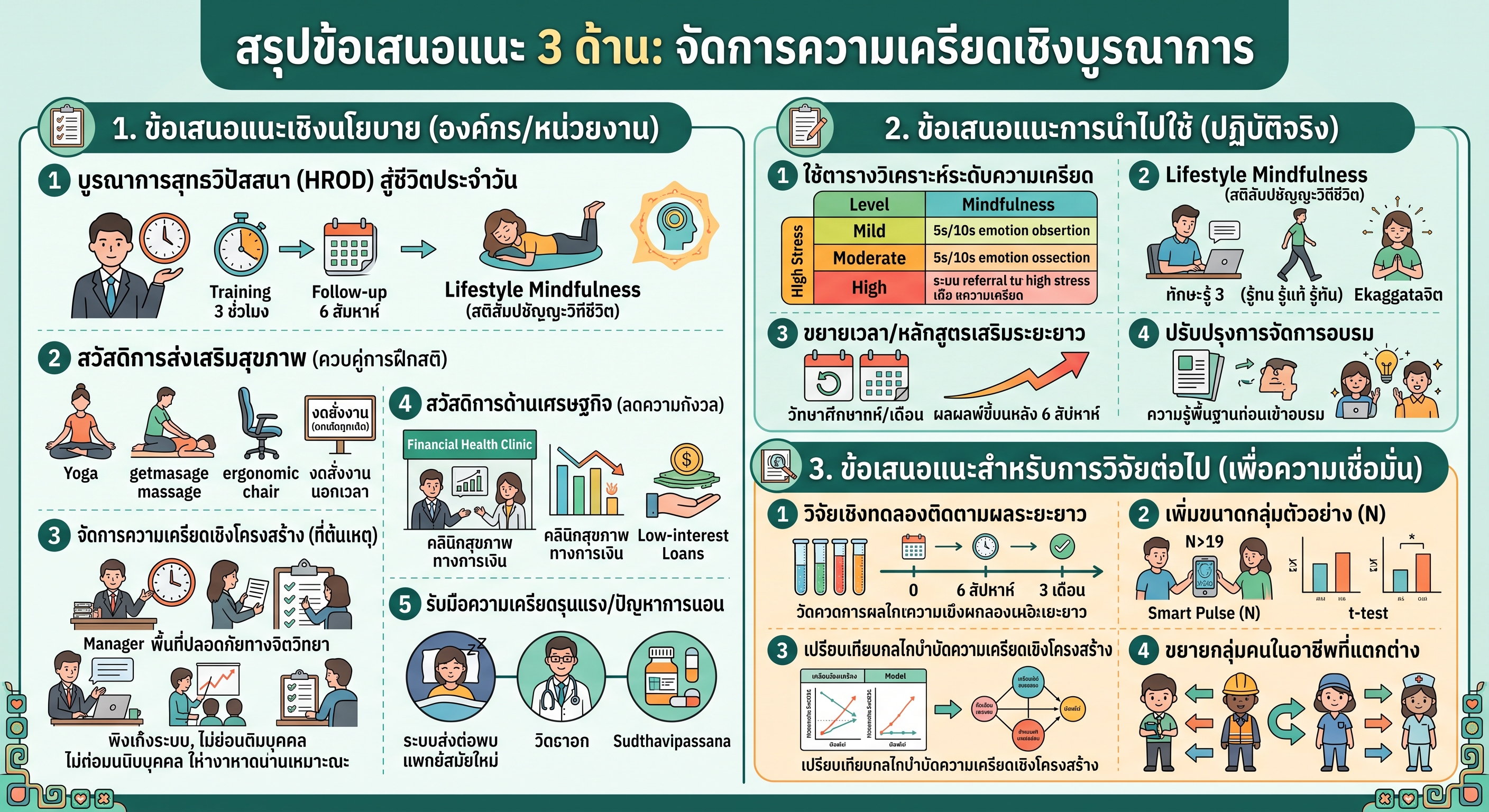
This research article aims to: (1) examine the problems related to stress management among working-age adults, (2) develop an effective Sutthavipassana model to support stress management for working-age adults, and (3) present the outcomes of developing the Sutthavipassana model for enhancing stress management in this population. The study employed a research and development (R&D) design with a mixed-methods approach, incorporating curriculum development and validation, a short-term intervention trial of three hours, and subsequent evaluation. The sample consisted of 10 participants. Research instruments included the Stress Assessment Scale (SPST-20 and ST-5) and physiological stress measurement using Smart Pulse (Heart Rate Variability: HRV).
The findings revealed that the Suddhavipassana curriculum model was highly effective in reducing self-reported stress. Mean scores on the SPST-20 decreased significantly from a high level (x̄ = 2.36) to a moderate level (x̄ = 2.18), with statistical significance at p = .001 (t = 3.65, df = 19). Similarly, scores on the ST-5 also showed a statistically significant reduction at p = .034 (t = 3.16, df = 4). These results align with the principles of Suddhavipassana practice, which employs mindfulness and awareness of arising emotional states and stress as manifestations of impermanence (arising–ceasing) to reduce mental hindrances such as intrusive thoughts. However, physiological stress measurements demonstrated only an overall downward trend (from 61.1% to 56.4%), with physical stress showing the most notable reduction (from 60.4% to 52.3%). These changes, nevertheless, did not reach statistical significance. Moreover, structural stress arising from external factors—such as unmet goals and financial problems—remained relatively high after the training. Overall, participants expressed a high level of satisfaction (x̄ = 4.06), particularly with respect to the applicability of the acquired knowledge. The study recommends conducting longitudinal follow-up research (at least six weeks) to examine physiological outcomes more comprehensively. Additionally, organizations are encouraged to integrate this curriculum into human resource management strategies to foster sustained workplace performance and daily life well-being.
Article Details

This work is licensed under a Creative Commons Attribution-NonCommercial-NoDerivatives 4.0 International License.
Copyright Notice
The content and information in the articles published in Journal of MCU Palisueksabuddhaghosa Review, are regarded as opinions and responsibilities of article author only. It definitely does not mean that the editor must agree or share any responsibility to the author.
Articles, information, content, figure etc. that have been published in the Journal of MCU Palisueksabuddhaghosa Review is considered as the copyright of the Journal. If any individual or organization will to bring any parts of article for promote or to do anything, must be licensed only in official form from the Journal of MCU Palisueksabuddhaghosa Review.
The content and information in the articles published in Journal of MCU Palisueksabuddhaghosa Review, are regarded as opinions and responsibilities of article author only. It definitely does not mean that the editor must agree or share any responsibility to the author.
Articles, information, content, figure etc. that have been published in the Journal of MCU Palisueksabuddhaghosa Review is considered as the copyright of the Journal. If any individual or organization will to bring any parts of article for promote or to do anything, must be licensed only in official form from the Journal of MCU Palisueksabuddhaghosa Review.
References
มหาจุฬาลงกรณราชวิทยาลัย พระไตรปิฎกภาษาบาลี ฉบับมหาจุฬาเตปิฎกํ 2511 กรุงเทพมหานคร : โรงพิมพ์รุ่งเรืองธรรม, 2516.
_______. พระไตรปิฎกภาษาไทย ฉบับมหาจุฬาลงกรณราชวิทยาลัย. กรุงเทพมหานคร : โรงพิมพ์มหาจุฬาลงกรณราชวิทยาลัย, 2539.
กิดานันท์ ชำนาญเวช, “ความเครียดทัศนะในแนวคิดพุทธจิตวิทยา”, ครุจันทรสาร, ปี่ที่ 11 ฉบับที่ 1 มกราคม-มิถุนายน.2551.
เทอดศักดิ์ เดชคง. วิถีแห่งการคลายเครียด. พิมพ์ครั้งที่ 2. กรุงเทพมหานคร: มติชน, 2539.
พระโสภณมหาเถระ (มหาสีสยาดอ). รจนา วิปัสสนานัย เล่ม 1. พระพรหมโมลี (สมศักดิ์ อุปสมมหาเถระ) ป.ธ.9, M.A, Ph.D. ผู้ตรวจชำระ, พระคันธสาราภิวงศ์ แปลและเรียบเรียง. (นครปฐม: ห้างหุ้นส่วนจำกัด ซีเอไอ เซ็นเตอร์ จำกัด, 2548), หน้า 63.
พระโสภณมหาเถระ (มหาสีสยาดอ), วิปัสสนาชุนี ฉบับสมบูรณ์, รจนา. จำรูญ ธรรมดา แปล พิมพ์ครั้งที่ 3, (จังหวัดนครปฐม: พิมพ์ที่ สาละพิมการ, 2562), หน้า 60-62.
พระสมุห์วัลลภ วลฺลโภ (เจสระ), ได้ศึกษาวิจัยเรื่อง “การพัฒนาจิต, ความยึดติด”, วารสารพุทธจิตวิทยา ปีที่ 1 ฉบับที่ 2 (กรกฎาคม-ธันวาคม,2559).
พระครูปลัดสุนทร สุนฺทโร, “ ศึกษาหลักปฏิบัติวิปัสสนาภาวนาแบบพอง-ยุบตามแนวปฏิบัติของพระโสภณมหาเถระ”, วิทยานิพนธ์ปริญญาพุทธศาสตรมหาบัณฑิต.บัณฑิตวิทยาลัย: มหาวิทยาลัยมหาจุฬาลงกรณราชวิทยาลัย, 2555.
ยงยุทธ วงศ์ภิรมย์ศานติ์ และคณะ, คลายความเครียดด้วยตัวเอง. กรุงเทพมหานคร: กองสุขภาพจิตสังคม โรงพิมพ์องค์การสงเคราะห์ทหารผ่านศึก, 2548.
ลักขณา สริวัฒน์. จิตวิทยาในชีวิตประจำวัน. กรุงเทพมหานคร: โอ เอส พริ้นติงเฮาส์. 2544.
อุบล เลี้ยววาริณ, “การฝึกอบรมตามแนวพุทธเพื่อพัฒนาสุขภาพจิต”, วารสารพัฒนาบริหารศาสตร์, ปี่ที่ 34 ฉบับที่ 2 (เมษายน.-มิถุนายน.2542)
Eric S. Parilla. (2012). Level of Stress Experienced by NWU Employees: Towards Developing a Stress Management. Asian Journal of Management Research, 2(2), 779.
