
ANALYSIS OF THE ATTAINMENT OF DHAMMA BY PHRA UBONWANNA THERI
Article Sidebar
Main Article Content
Abstract
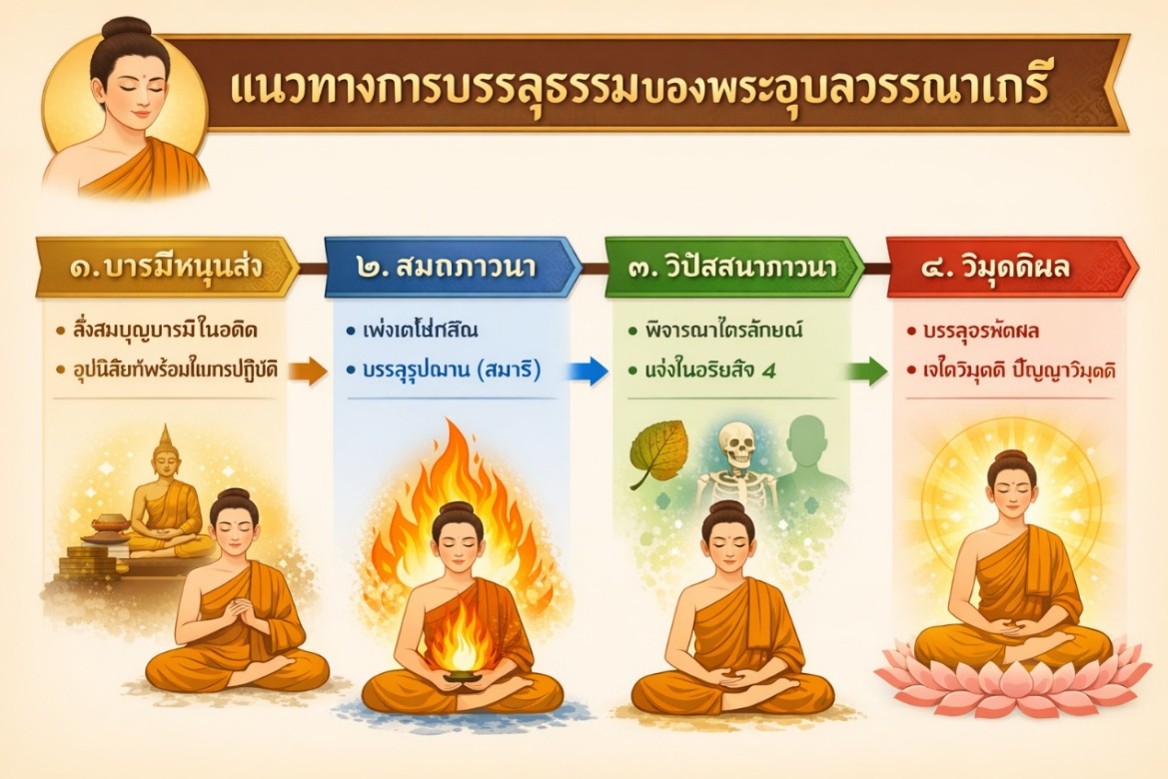
This research has two objectives: (1) to study the life history and the accumulation of spiritual perfections (pāramī) of Venerable Uppalavaṇṇā Therī, and (2) to study the attainment of enlightenment of Venerable Uppalavaṇṇā Therī. This study is a documentary research. The researcher defines the scope of the study into two aspects: the documentary scope, which determines the sources of documents used in this research, and the scope of study, which specifies the content areas and issues to be examined.
The findings reveal that (1) Venerable Uppalavaṇṇā Therī was the chief female disciple on the left side of the Buddha and was honored as the foremost among bhikkhunīs endowed with psychic powers. This distinction resulted from her long-standing accumulation of spiritual perfections in generosity (dāna), morality (sīla), and mental development (bhāvanā), which led to strong spiritual faculties. In her final existence, she was born as a woman of extraordinary beauty, which was the result of past merit. Such beauty became a supporting condition that led her to develop disenchantment with saṃsāra, prompting her to renounce worldly life and enter the Buddhist monastic order. (2) The enlightenment of Venerable Uppalavaṇṇā Therī was achieved through a systematic practice of Dhamma. She began with the development of tranquility meditation (samatha-bhāvanā) using the fire kasiṇa (tejo-kasiṇa) as a meditation object, which led her mind to become firmly concentrated and attain the jhānas. She then used this concentration as a foundation for insight meditation (vipassanā-bhāvanā), contemplating mental and physical phenomena according to the Three Characteristics—impermanence, suffering, and non-self—until wisdom arose, enabling her to realize the Four Noble Truths and attain arahantship. The body of knowledge derived from this research demonstrates that the path to enlightenment of Venerable Uppalavaṇṇā Therī is a systematic process consistent with the Threefold Training—morality, concentration, and wisdom—and serves as an exemplary model of Buddhist practice aimed at genuine liberation in Theravāda Buddhism.
Article Details

This work is licensed under a Creative Commons Attribution-NonCommercial-NoDerivatives 4.0 International License.
Copyright Notice
The content and information in the articles published in Journal of MCU Palisueksabuddhaghosa Review, are regarded as opinions and responsibilities of article author only. It definitely does not mean that the editor must agree or share any responsibility to the author.
Articles, information, content, figure etc. that have been published in the Journal of MCU Palisueksabuddhaghosa Review is considered as the copyright of the Journal. If any individual or organization will to bring any parts of article for promote or to do anything, must be licensed only in official form from the Journal of MCU Palisueksabuddhaghosa Review.
The content and information in the articles published in Journal of MCU Palisueksabuddhaghosa Review, are regarded as opinions and responsibilities of article author only. It definitely does not mean that the editor must agree or share any responsibility to the author.
Articles, information, content, figure etc. that have been published in the Journal of MCU Palisueksabuddhaghosa Review is considered as the copyright of the Journal. If any individual or organization will to bring any parts of article for promote or to do anything, must be licensed only in official form from the Journal of MCU Palisueksabuddhaghosa Review.
References
พระไตรปิฎกภาษาไทย อรรถกถาภาษาบาลี ฉบับบมหาจุฬาอฏฺกถา. การุงเทพมหานคร: โรงพิมพ์มหาจุฬาลงกรณราชวิทยาลัย, โรงพิมพ์วิญญาณ, 2532-2534.
พระไตรปิฎกภาษาไทย ฉบับมหาจุฬาลงกรณราชวิทยาลัย. กรุงเทพมหานคร: โรงพิมพ์มหาจุฬาลงกรณราชวิทยาลัย, 2539.
พระมหาโสฬส ชนุตฺตโม (พรมมา), “ความมีอยู่ของความชั่วในพุทธปรัชญาเถรวาท”, วารสาร มจร ปรัชญาปริทรรศน์ ปีที่ 2 ฉบับที่ 1 : (มกราคม - มิถุนายน 2562), หน้า 12-13.
สมเด็จพระพุทธชินวงศ์ (สมศักดิ์ อุปสมมหาเถระ ป.ธ.9), อริย วังสปฏิปทา, (กรุงเทพมหานคร: หจก.ประยูรสาส์นไทย การพิมพ์, 2554).
