
Establishing a learning network for the history of Buddhism as reflected in Lan Xang inscriptions in Nong Khai Province
Article Sidebar
Main Article Content
Abstract
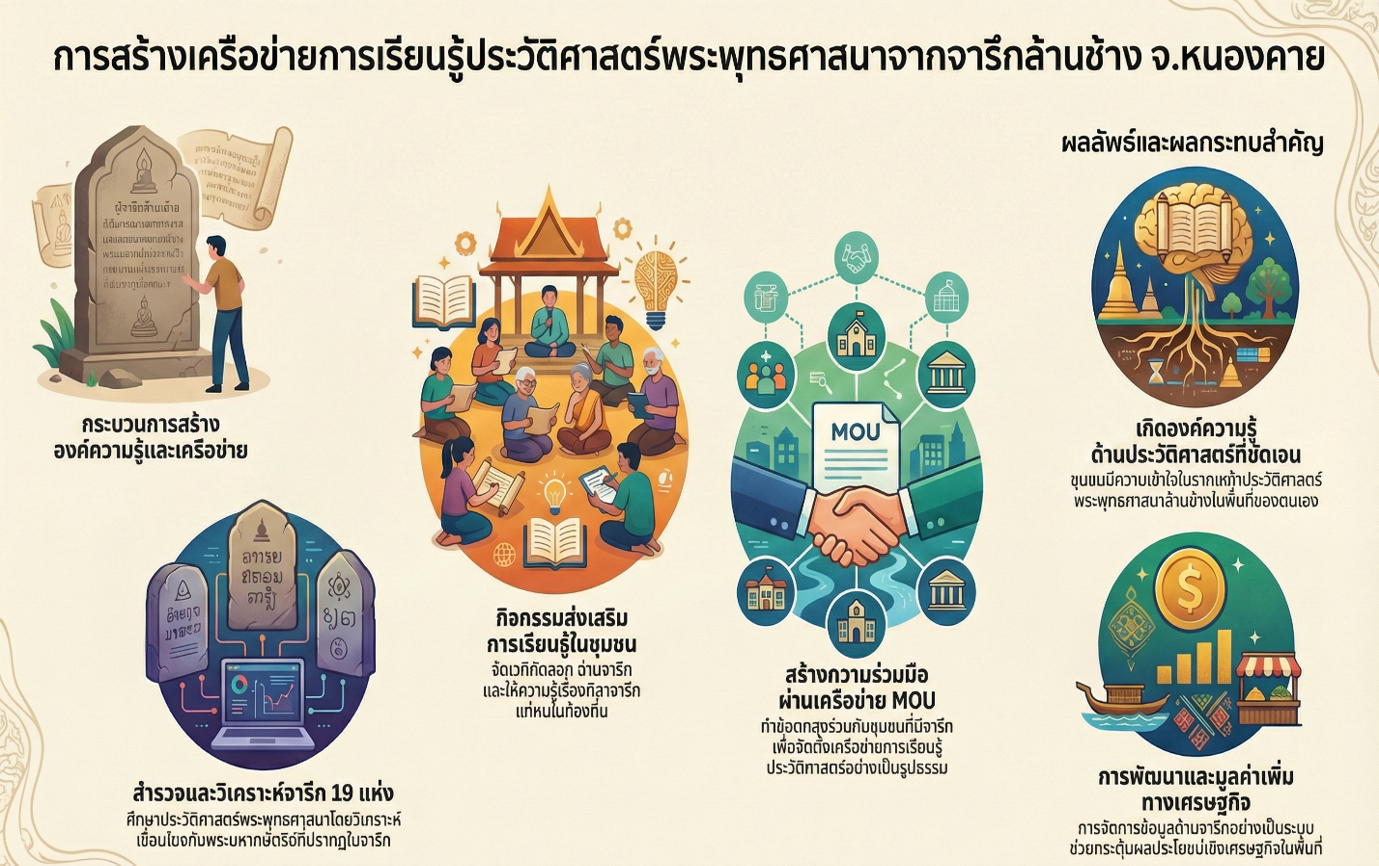
The research project, "A Study of the Creation of a Learning Network for the History of Buddhism in Lan Xang Inscriptions in Nong Khai Province," has three objectives:(1) To conduct a survey and analysis of the history of Buddhism as found in the Lan Xang inscriptions in Nong Khai Province.(2) To organize activities to promote learning about the history of Buddhism as found in the Lan Chang inscriptions in Nong Khai Province (3) To create a network for learning about the history of Buddhism as found in the Lan Chang inscriptions in Nong Khai Province.
The research results found that (1) the field survey of Lan Xang inscriptions in Nong Khai Province was conducted in 5 districts in total, with 19 locations divided into:(1) 5 in Muang Nong Khai District, (2) 5 in Tha Bo District, (3) 7 in Phon Phisai District, (4) 1 in Si Chiang Mai District, and (5) 1 in Sangkhom District. Of the 19 inscriptions, the oldest is the inscription at Wat Luang, 1957 BE.The youngest inscription is the one from the Phra Kaew Temple, dating back to 2355 BE (1812 CE) during the reign of King Anuwong. If we divide the reigns according to the BE (Buddhist Era), we would get a total of 11 monarchs.The research team used the number of monarchs as a basis for analyzing the history of Buddhism in Lan Xang inscriptions.(2) The research team organized two learning activities: (1) the activity of copying and reading inscriptions, the activity of gaining knowledge.(2) The activity of providing knowledge about the history of Buddhism in Lan Xang inscriptions resulted in interest and participants gained knowledge.(3) The research team has established a learning network on the history of Buddhism in two dimensions: (1) organizing group meetings for learning, and (2) making an MOU agreement to support the work of the network.
Article Details

This work is licensed under a Creative Commons Attribution-NonCommercial-NoDerivatives 4.0 International License.
Copyright Notice
The content and information in the articles published in Journal of MCU Palisueksabuddhaghosa Review, are regarded as opinions and responsibilities of article author only. It definitely does not mean that the editor must agree or share any responsibility to the author.
Articles, information, content, figure etc. that have been published in the Journal of MCU Palisueksabuddhaghosa Review is considered as the copyright of the Journal. If any individual or organization will to bring any parts of article for promote or to do anything, must be licensed only in official form from the Journal of MCU Palisueksabuddhaghosa Review.
The content and information in the articles published in Journal of MCU Palisueksabuddhaghosa Review, are regarded as opinions and responsibilities of article author only. It definitely does not mean that the editor must agree or share any responsibility to the author.
Articles, information, content, figure etc. that have been published in the Journal of MCU Palisueksabuddhaghosa Review is considered as the copyright of the Journal. If any individual or organization will to bring any parts of article for promote or to do anything, must be licensed only in official form from the Journal of MCU Palisueksabuddhaghosa Review.
References
กรมศิลปากร. (2547). จารึกในประเทศไทย เล่มที่ 7: ภาคตะวันออกเฉียงเหนือ. กรุงเทพฯ: กรมศิลปากร.
กรมศิลปากร. (2551). ประวัติศาสตร์ล้านช้าง. กรุงเทพฯ: กรมศิลปากร.
กรมศิลปากร. (2560). โบราณคดีภาคตะวันออกเฉียงเหนือ. กรุงเทพฯ: กรมศิลปากร.
ธวัช ปุณโณทก. (2530). อักษรไทยโบราณ: อักษรลาวและอักษรไทยน้อย. กรุงเทพฯ: โอเดียนสโตร์.
ธวัช ปุณโณทก. (2540). จารึกล้านช้าง. กรุงเทพฯ: มติชน.
นิธิ เอียวศรีวงศ์. (2547). การเมืองไทยสมัยพระเจ้ากรุงธนบุรี. กรุงเทพฯ: มติชน.
(ใช้ประกอบบริบทประวัติศาสตร์ช่วงปลายล้านช้างและความสัมพันธ์กับสยาม)
พิเศษ เจียจันทร์พงษ์. (2544). ล้านช้าง: ประวัติศาสตร์และศิลปะ. กรุงเทพฯ: เมืองโบราณ.
ศูนย์มานุษยวิทยาสิรินธร (องค์การมหาชน). (2565). ฐานข้อมูลจารึกในประเทศไทย. สืบค้นจาก
https://db.sac.or.th/inscriptions
สถาบันวิจัยภาษาและวัฒนธรรมเอเชีย มหาวิทยาลัยมหิดล. (2550). วัฒนธรรมลุ่มน้ำโขง. กรุงเทพฯ: มหาวิทยาลัยมหิดล.
สำนักงานราชบัณฑิตยสภา. (2556). สารานุกรมประวัติศาสตร์ไทย ฉบับราชบัณฑิตยสภา. กรุงเทพฯ: ราชบัณฑิตยสภา.
สำนักโบราณคดี กรมศิลปากร. (2554). แหล่งโบราณคดีสำคัญในภาคตะวันออกเฉียงเหนือ. กรุงเทพฯ: กรมศิลปากร.
สุจิตต์ วงษ์เทศ. (2546). ลาว-ล้านช้าง: ประวัติศาสตร์ สังคม และวัฒนธรรม. กรุงเทพฯ: มติชน.
หอสมุดแห่งชาติ. (2542). ตำนานอุรังคธาตุ. กรุงเทพฯ: กรมศิลปากร.
