
Development of Augmented Reality (AR) Learning Media for Dhammapada
Article Sidebar
Main Article Content
Abstract
This research had three main objectives: (1) to study the use of Augmented Reality (AR) Dhammapada instructional media, (2) to design and develop AR-based Dhammapada learning media, and (3) to evaluate learners’ learning effectiveness. The study employed a qualitative research methodology, utilizing documentary research and practical implementation. The collected data were analyzed and synthesized to design and develop an innovative instructional media in accordance with the stated objectives.
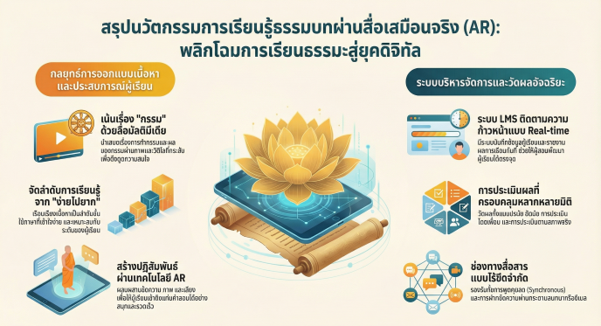
The research findings revealed that: 1)AR-based Dhammapada instructional media involves transforming the Dhammapada—teachings of the Buddha presented in Pali verses with Thai translations—into learning materials through augmented reality technology. This innovation generated four key benefits: (1) the Dhamma content became modernized and relevant, (2) the lessons became vivid and effectively connected learners with contextual events, (3) it created impressive and meaningful learning experiences, and (4) it enabled learners to access the content anytime and anywhere. 2) The design and development of the AR Dhammapada media integrated Bloom’s learning theory, covering the three domains: cognitive, affective, and psychomotor, together with the concepts of Active Learning and the CIPPA instructional model. This integration resulted in high-quality instructional media aligned with 21st-century learning processes. The developed media demonstrated appropriateness in terms of content, design, presentation, and interaction. Augmented Reality technology served as a key tool in fostering experiential learning, enabling learners not only to receive information but also to interact with the content, practice critical thinking and analysis, and systematically reflect on the moral values embedded in the Dhammapada. 3) The evaluation of learners’ learning effectiveness, based on a satisfaction questionnaire, indicated that learners’ overall satisfaction with the AR Dhammapada instructional media was at the highest level, with a mean score of 4.90 and a standard deviation of 0.30. This demonstrates that the developed media effectively enhanced learning outcomes and generated new knowledge in the form of an innovative AR-based learning model—transforming Dhamma education into the digital age.
Article Details

This work is licensed under a Creative Commons Attribution-NonCommercial-NoDerivatives 4.0 International License.
Copyright Notice
The content and information in the articles published in Journal of MCU Palisueksabuddhaghosa Review, are regarded as opinions and responsibilities of article author only. It definitely does not mean that the editor must agree or share any responsibility to the author.
Articles, information, content, figure etc. that have been published in the Journal of MCU Palisueksabuddhaghosa Review is considered as the copyright of the Journal. If any individual or organization will to bring any parts of article for promote or to do anything, must be licensed only in official form from the Journal of MCU Palisueksabuddhaghosa Review.
The content and information in the articles published in Journal of MCU Palisueksabuddhaghosa Review, are regarded as opinions and responsibilities of article author only. It definitely does not mean that the editor must agree or share any responsibility to the author.
Articles, information, content, figure etc. that have been published in the Journal of MCU Palisueksabuddhaghosa Review is considered as the copyright of the Journal. If any individual or organization will to bring any parts of article for promote or to do anything, must be licensed only in official form from the Journal of MCU Palisueksabuddhaghosa Review.
References
ทิศนา แขมมณี, ศาสตร์การสอน: องค์ความรู้เพื่อการจัดกระบวนการเรียนรู้ที่มีประสิทธิภาพ, พิมพ์ครั้งที่ 14 (กรุงเทพฯ: สำนักพิมพ์แห่งจุฬาลงกรณ์มหาวิทยาลัย, 2554).
ธนพล สมัครการ และคณะ. (2023). การประเมินคุณภาพสื่อการเรียนรู้ AR: กรณีศึกษาการเรียนการสอนในระดับอุดมศึกษา. วารสารเทคโนโลยีการศึกษา, 16(2), 89-104.
พระครูศรีปัญญาวิกรม, “รูปแบบการเรียนการสอนบาลีศึกษาในสังคมไทย”, Vol.4 No.2 July – December 2015 Academic Journal of Mahamakut Buddhist University Roi Et Campus, p 86.
พระมหาวิชาญ สุวิชาโน. รูปแบบการจัดการเรียนการสอนธรรมะด้วยเทคโนโลยีสมัยใหม่. วารสารพุทธศาสตร์ศึกษา, 15(1), (2024). หน้า 78-94.
รัตนา พลอยสวัสดิ์. การประเมินผลสื่อการเรียนรู้ AR: แนวทางและเครื่องมือ. วารสารวิจัยทางการศึกษา, 18 (1), (2024). หน้า 34-48.
วิมล สุขสวัสดิ์ และคณะ. การพัฒนาระบบสื่อการเรียนรู้ดิจิทัลอย่างยั่งยืน. วารสารเทคโนโลยีการศึกษา, 16(3), (2023). หน้า 145-162.
วิศรุต พัฒนพงษ์. แนวทางการพัฒนาแอปพลิเคชัน AR ที่มีประสิทธิภาพและความปลอดภัยสูง. วารสารวิทยาการคอมพิวเตอร์และเทคโนโลยีสารสนเทศ, 20(1), (2024). 12-25.
สมศักดิ์ จันทร์แก้ว และคณะ. (2022). การประยุกต์ใช้เทคโนโลยี AR ในการพัฒนาสื่อการเรียนรู้แบบมีปฏิสัมพันธ์. วารสารเทคโนโลยีการศึกษา, 15(1), 78-95.
หลักสูตรธรรมศึกษา ชั้นตรี ฉบับปรับปรุง พุทธศักราช 2557, คณะสงฆ์และรัฐบาล จัดพิมพ์, ครั้งที่ 1 จำนวน 500,000 เล่ม, โรงพิมพ์มหามกุฎราชวิทยาลัย, นครปฐม 2558. หน้า 9-195., และ ดูรายละเอียดใน แหล่งที่มา ออนไลน์ https://www.gongtham.net/web/news.php [สืบค้น 28 กรกฎาคม 2566]
Bloom, B. S., Engelhart, M. D., Furst, E. J., Hill, W. H., and Krathwohl, D. R., Taxonomy of educational objectives: The classification of educational goals. Handbook I: Cognitive domain (New York: David McKay Company, 1956).
Bonwell, C. C., and Eison, J. A., Active Learning: Creating Excitement in the Classroom. ASHE-ERIC Higher Education Report No. 1 (Washington, D.C.: The George Washington University, School of Education and Human Development, 1991).
Santiago, S. B., and Banner, P. H., "Augmented Reality in Education: A Meta-Review and Cross-Media Analysis," Personal and Ubiquitous Computing 18, no. 6 (2014): 1533-1543.
