
Leadership Leadership in the Digital Age of School Administrators Under the Chiang Rai Primary Educational Service Area Office 2
Article Sidebar
Main Article Content
Abstract
This research aimed to: 1) study the digital leadership component of school administrators under the Chiang Rai Primary Educational Service Area Office 2. 2) study the digital leadership condition of school administrators and 3) study the digital leadership development guidelines of school administrators. This research was a mixed-methods research. The population consisted of school administrators and teachers, for a total of 1,561 people. The tools used were digital leadership component data records, questionnaires, and interviews. The data were analyzed by the percentage, mean, standard deviation, and content analysis.
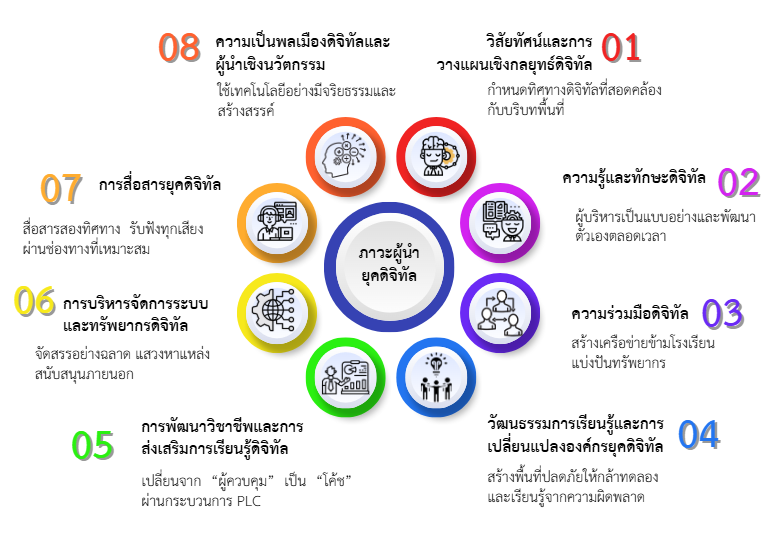
The results revealed that 1) the digital leadership component of school administrators consisted of 8 areas: 1) vision and digital strategic planning; 2) digital knowledge and skills; 3) digital collaboration; 4) digital learning culture and digital transformation; 5) professional development and digital learning promotion; 6) system and digital resources management; 7) digital communication; and 8) digital citizenship and innovative leadership, 2) the overall digital leadership of school administrators was at a high level, with the highest averages being in terms of vision and digital strategic planning, while in terms of culture learning, and organizational transformation in the digital age had the lowest averages, but remained at a high level as well. 3) The digital leadership development guidelines were that; school administrators should focus on strengthening their digital strategic vision continuously, develop digital knowledge and skills, promote a culture of mutual learning, systematically manage resources and information systems, as well as cultivate digital citizenship and innovate in accordance with the context of the need limit for digital resources and infrastructure.
Article Details

This work is licensed under a Creative Commons Attribution-NonCommercial-NoDerivatives 4.0 International License.
Copyright Notice
The content and information in the articles published in Journal of MCU Palisueksabuddhaghosa Review, are regarded as opinions and responsibilities of article author only. It definitely does not mean that the editor must agree or share any responsibility to the author.
Articles, information, content, figure etc. that have been published in the Journal of MCU Palisueksabuddhaghosa Review is considered as the copyright of the Journal. If any individual or organization will to bring any parts of article for promote or to do anything, must be licensed only in official form from the Journal of MCU Palisueksabuddhaghosa Review.
References
Acebuche, M. T. S. (2024). Transformational leadership in the digital age: Challenges and opportunities for educational institutions. International Journal of Educational Management, 38(2), 145–162.
Bandura, A. (1977). Social learning theory. Prentice Hall.
Bryson, J. M. (2024). Strategic planning and digital transformation in public organizations. Public Administration Review, 84(1), 23–45.
Cooper, S. (2021). Digital leadership in education: Building a culture of innovation. Educational Technology & Society, 24(3), 112–125.
Gerald, D. (2020). Digital leadership competencies in educational settings: A systematic review. Journal of Educational Administration, 58(4), 445–467.
Hamzah, M. I., Yakop, F., & Nordin, N. M. (2021). The role of digital leadership in transforming educational institutions during COVID-19 pandemic. Education and Information Technologies, 26(6), 7363–7385.