
The Structural Crisis of the Thai Sangha: Declining Monks, Increasing Temples, and a Buddhist-Philosophical Analysis
Article Sidebar
Main Article Content
Abstract
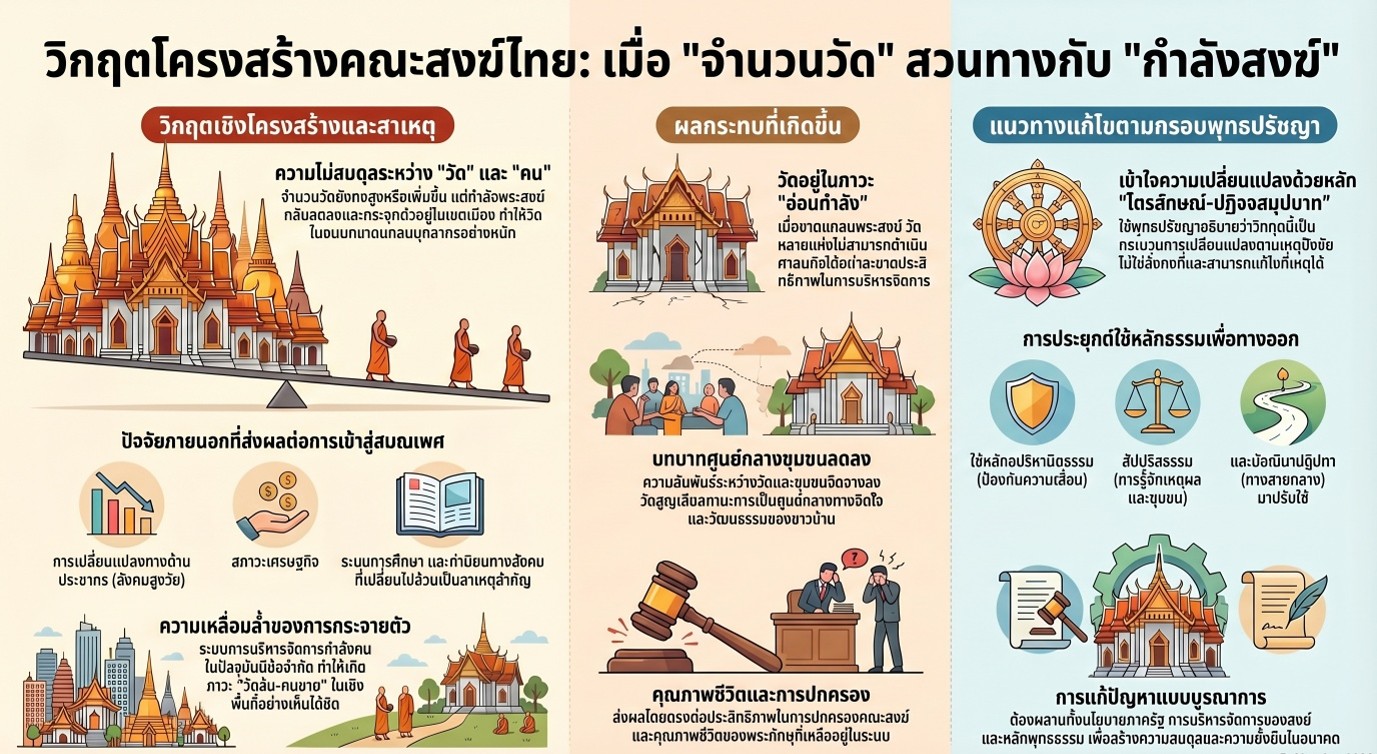
This article aims to: 1) examine changes in the number of Buddhist monks and temples in Thailand; 2) analyze the impacts of the structural imbalance between the number of monks and temples on the Sangha and local communities; and 3) synthesize a Buddhist philosophical framework for explaining and proposing responses to the structural crisis of the Thai Sangha. The study employs qualitative documentary research based on statistical data from the National Office of Buddhism together with academic literature in Buddhist studies, sociology of religion, and Buddhist philosophy. The findings show that the condition of “declining monks and increasing temples” reflects a structural imbalance within the Thai Sangha in three major dimensions: manpower, spatial distribution of monks, and the role of temples as community institutions. Key contributing factors include changing ordination values, the expansion of modern education, migration to urban areas, and limitations in Sangha administration. Interpreted through Buddhist philosophy—particularly Dhamma-Vinaya, Aparihaniyadhamma, Sangha harmony, the Threefold Training, and dependent origination—the stability of Buddhism depends not primarily on the number of temples, but on the quality of the Sangha, continuity of education and practice, and the ability of temples to sustain communities. The article argues that addressing the structural crisis of the Thai Sangha requires systemic management, reform of monastic education, and revitalization of temples as effective spiritual and social centers.
Article Details

This work is licensed under a Creative Commons Attribution-NonCommercial-NoDerivatives 4.0 International License.
Copyright Notice
The content and information in the articles published in Journal of MCU Palisueksabuddhaghosa Review, are regarded as opinions and responsibilities of article author only. It definitely does not mean that the editor must agree or share any responsibility to the author.
Articles, information, content, figure etc. that have been published in the Journal of MCU Palisueksabuddhaghosa Review is considered as the copyright of the Journal. If any individual or organization will to bring any parts of article for promote or to do anything, must be licensed only in official form from the Journal of MCU Palisueksabuddhaghosa Review.
The content and information in the articles published in Journal of MCU Palisueksabuddhaghosa Review, are regarded as opinions and responsibilities of article author only. It definitely does not mean that the editor must agree or share any responsibility to the author.
Articles, information, content, figure etc. that have been published in the Journal of MCU Palisueksabuddhaghosa Review is considered as the copyright of the Journal. If any individual or organization will to bring any parts of article for promote or to do anything, must be licensed only in official form from the Journal of MCU Palisueksabuddhaghosa Review.
References
พระพรหมคุณาภรณ์ (ป.อ. ปยุตฺโต). พุทธธรรม (กรุงเทพฯ: มหาจุฬาลงกรณราชวิทยาลัย. 2016).
พระพุทธโฆสาจารย์. วิสุทธิมรรค. แปลโดยสมเด็จพระพุฒาจารย์ (อาจ อาสภมหาเถร). พิมพ์ครั้งที่ 10 (กรุงเทพมหานคร: ธนาเพรส. 2554).
พระมหาวิเชียร วชิรธมฺโม และคณะ. “บทบาทของพระสงฆ์กับการพัฒนาสังคมไทยยุคปัจจุบัน.” วารสารมหาจุฬาตานีปริทรรศน์ มหาวิทยาลัยมหาจุฬาลงกรณราชวิทยาลัย. ปีที่ 3 ฉบับที่ 6 (กรกฎาคม–ธันวาคม 2564): 42–49.
พระมหาวิเชียร วชิรธมฺโม. “บทบาทของพระสงฆ์กับการพัฒนาสังคมไทยยุคปัจจุบัน.” (2565).
พระสมุห์ธณัฐพล ธมฺมสโร (ผลาเลิศ) และพระแมนรัตน์ จตฺตมโล (พิทักษ์ทรัพย์). “วิกฤติการณ์ศรัทธาของประชาชนที่มีต่อพระสงฆ์ไทยและแนวทางการสร้างศรัทธาของพระสงฆ์ในยุคโซเชียล.” วารสารพุทธนวัตกรรมและการจัดการ, ปีที่ 6 ฉบับที่ 1 (มกราคม–กุมภาพันธ์ 2566): 191–198.
พระสุภาพ สุภาโว (บัวบรรจง), “บทบาทของพระสงฆ์ในการพัฒนาชุมชนในเขตพื้นที่ตำบลยางค้อม อำเภอพิปูน จังหวัดนครศรีธรรมราช,” วารสารมหาจุฬานาครทรรศน์, ปีที่ 5 ฉบับที่ 3 (กันยายน–ธันวาคม 2561): 655–671.
ภาณุมาศ ภาณุปาโณ. “วิเคราะห์การบริหารกิจการคณะสงฆ์ไทยตามพระราชบัญญัติคณะสงฆ์ พ.ศ. 2505.” Journal of Roi Kaensarn Academi 9. no. 12 (2567): 1562–1574.
มหาจุฬาลงกรณราชวิทยาลัย. พระไตรปิฎกภาษาไทย ฉบับมหาจุฬาลงกรณราชวิทยาลัย. กรุงเทพมหานคร: โรงพิมพ์มหาจุฬาลงกรณราชวิทยาลัย. 2539.
สมคิด แสงกล้า. “นโยบายและการบริหารจัดการของคณะสงฆ์ภายใต้สถานการณ์การลดจำนวนพระภิกษุสงฆ์ในปัจจุบัน” (การค้นคว้าอิสระปริญญามหาบัณฑิต. มหาวิทยาลัยธรรมศาสตร์. 2564). หน้า 35–42.
สมคิด แสงกล้า. “นโยบายและการบริหารจัดการของคณะสงฆ์ภายใต้สถานการณ์การลดจำนวนพระภิกษุสงฆ์ในปัจจุบัน.” (2560).
สำนักงานพระพุทธศาสนาแห่งชาติ. รายงานประจำปี 2566 และฐานข้อมูลสถิติพระภิกษุ-สามเณร/ทะเบียนวัด (กรุงเทพมหานคร: สำนักงานพระพุทธศาสนาแห่งชาติ. 2566).
สำนักงานพระพุทธศาสนาแห่งชาติ. รายงานประจำปี 2566 และฐานข้อมูลสถิติพระภิกษุ-สามเณร/ทะเบียนวัด (กรุงเทพมหานคร: สำนักงานพระพุทธศาสนาแห่งชาติ. 2566).
อินถา ศิริวรรณ. “กลยุทธ์การบริหารจัดการศึกษาของคณะสงฆ์ไทย.” Journal of Modern Learning Development. ปีที่ 5 ฉบับที่ 3 (พฤษภาคม–มิถุนายน 2020): 1–15.
Agenda. “วัดไทยมีพระมากแค่ไหนในแต่ละจังหวัด?”. 2 มิถุนายน 2566.
C. Boonnoon. “Declining Number of Buddhist Monks and Its Impact on the Rural Community in Contemporary Thailand.” The Chulalongkorn Journal of Buddhist Studies 7 (2013): 1–30.
