
An Analytical Study of the Relationship between Mindfulness and Clear Comprehension and the Practice of Vipassanā Meditation Based on the Four Foundations of Mindfulness
Article Sidebar
Main Article Content
Abstract
This research aims to: (1) examine the concepts of mindfulness (sati). clear comprehension (sampajañña). and the Four Foundations of Mindfulness (satipaṭṭhāna) in Buddhist canonical texts; (2) study the roles and relationships between mindfulness and clear comprehension in Vipassanā meditation according to the Four Foundations of Mindfulness; and (3) analytically explain the roles and interrelationships between mindfulness. clear comprehension. and Vipassanā practice within this framework. This documentary research draws primarily on Theravāda Buddhist scriptures and related sources.
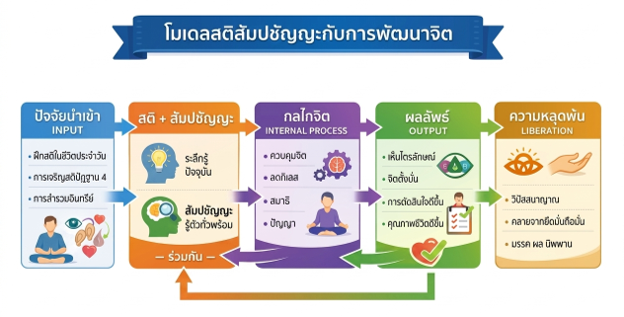
The research findings indicate that the concepts of mindfulness (sati) and clear comprehension (sampajañña). together with the framework of the Four Foundations of Mindfulness. are systematically and coherently presented within the Theravāda Buddhist scriptures. Mindfulness functions as the faculty of recollective awareness. serving to regulate the mind and prevent it from drifting along with mental objects. Clear comprehension. on the other hand. operates as a comprehensive awareness accompanied by wisdom. enabling discernment of purpose. appropriateness. and non-delusion regarding phenomena. These two mental factors operate within the framework of the Four Foundations of Mindfulness. which provide a structured training encompassing body. feelings. mind. and mental objects (dhammas). thereby facilitating a continuous and systematic development of the mind. Mindfulness and clear comprehension play a crucial role in the practice of vipassanā meditation as mechanisms for mental regulation and for maintaining the quality of meditative practice. Specifically. mindfulness is responsible for recognizing present-moment objects. while clear comprehension ensures that such recognition accords with reality. The relationship between mindfulness. clear comprehension. and the Four Foundations of Mindfulness is causal and interdependent. Continuous cultivation of the Four Foundations strengthens and refines mindfulness and clear comprehension. Conversely. well-established mindfulness and clear comprehension support the correct and goal-oriented practice of the Four Foundations. preventing deviation from the objectives of insight meditation. Mindfulness and clear comprehension thus function as essential systemic mechanisms in regulating the cognition of phenomena. Mindfulness performs the role of awareness. while clear comprehension governs accurate understanding and evaluative monitoring. Their mutually supportive interaction ensures that practice remains continuous. accurate. and profound. enabling an integrated contemplation of the four domains: body. feelings. mind. and dhammas. Furthermore. they constitute key conditions leading to the progressive emergence of insight knowledges (vipassanā-ñāṇa). beginning from the knowledge of the delimitation of mind and matter (nāma-rūpa-pariccheda-ñāṇa) up to path knowledge (magga-ñāṇa). which represents the highest wisdom. Ultimately. this process culminates in the attainment of the true goal of vipassanā practice
Article Details

This work is licensed under a Creative Commons Attribution-NonCommercial-NoDerivatives 4.0 International License.
Copyright Notice
The content and information in the articles published in Journal of MCU Palisueksabuddhaghosa Review, are regarded as opinions and responsibilities of article author only. It definitely does not mean that the editor must agree or share any responsibility to the author.
Articles, information, content, figure etc. that have been published in the Journal of MCU Palisueksabuddhaghosa Review is considered as the copyright of the Journal. If any individual or organization will to bring any parts of article for promote or to do anything, must be licensed only in official form from the Journal of MCU Palisueksabuddhaghosa Review.
The content and information in the articles published in Journal of MCU Palisueksabuddhaghosa Review, are regarded as opinions and responsibilities of article author only. It definitely does not mean that the editor must agree or share any responsibility to the author.
Articles, information, content, figure etc. that have been published in the Journal of MCU Palisueksabuddhaghosa Review is considered as the copyright of the Journal. If any individual or organization will to bring any parts of article for promote or to do anything, must be licensed only in official form from the Journal of MCU Palisueksabuddhaghosa Review.
References
พระไตรปิฎกภาษาไทย อรรถกถาภาษาบาลี ฉบับบมหาจุฬาอฏฺกถา. การุงเทพมหานคร: โรงพิมพ์มหาจุฬาลงกรณราชวิทยาลัย. โรงพิมพ์วิญญาณ. 2532-2534.
พระไตรปิฎกภาษาไทย ฉบับมหาจุฬาลงกรณราชวิทยาลัย. กรุงเทพมหานคร: โรงพิมพ์มหาจุฬาลงกรณราชวิทยาลัย. 2539.
พระครูโกศลชัยพัฒน์ สิริเตโช. “ศึกษาสัมปชัญญะในการปฏิบัติวิปัสสนาภาวนาในจิตตานุปัสสนาสติปัฏฐาน”. สารนิพนธพุทธศาสตรมหาบัณฑิต สาขาวิชาวิปัสสนาภาวนา. (บัณฑิตวิทยาลัย: มหาวิทยาลัยมหาจุฬาลงกรณราชวิทยาลัย. 2561).
พระพรหมคุณาภรณ์ (ป.อ.ปยุตฺโต). พุทธธรรม ฉบับปรับขยาย. พิมพ์ครั้งที่ 32. (กรุงเทพมหานคร: โรงพิมพ์ สำนักพิมพ์ผลิธัมม์ ในเครือบริษัทสำนักพิมพ์เพ็ทแอนท์โฮม. 2555).
พระพรหมคุณาภรณ์ (ป.อ. ปยุตฺโต). พจนานุกรมพุทธศาสตร์ ฉบับประมวลธรรม. พิมพ์ครั้งที่ 16. (กรุงเทพมหานคร: บริษัท เอส. อาร์. พริ้นติ้ง แมส โปรดักส์ จำกัด. 2551).
พระพรหมคุณาภรณ์ (ป.อ. ปยุตฺโต). พจนานุกรมพุทธศาสตร์ ฉบับประมวลศัพท์. พิมพ์ครั้งที่ 11. (กรุงเทพมหานคร: บริษัท เอส. อาร์. พริ้นติ้ง แมส โปรดักส์ จำกัด. 2551).
