
AN ANALYTICAL STUDY OF MINDFULNESS OF BREATHING (ĀNĀPĀNASSATI) IN THE DEVELOPMENT OF INSIGHT MEDITATION BASED ON THE FOUR FOUNDATIONS OF MINDFULNESS
Article Sidebar
Main Article Content
Abstract
This research article aimed to: (1) study mindfulness of breathing (Ānāpānasati) in accordance with the Four Foundations of Mindfulness (Satipaṭṭhāna) as presented in the Buddhist scriptures. and (2) analyze the development of mindfulness of breathing as a process for elevating the mind to insight meditation (Vipassanā) based on the Four Foundations of Mindfulness. This study employed a documentary research methodology. drawing upon the Tipiṭaka. commentaries. and related academic documents.
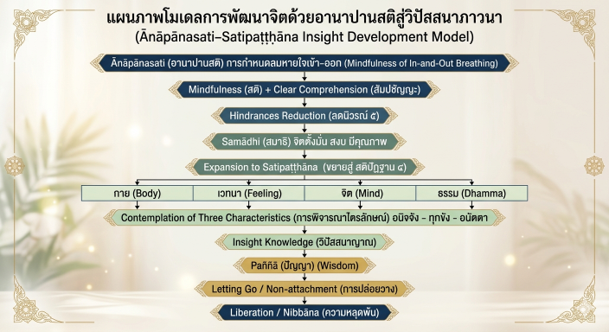
The findings revealed that mindfulness of breathing. within the framework of the Four Foundations of Mindfulness. is classified under contemplation of the body (kāyānupassanā). It emphasizes continuous awareness of inhalation and exhalation accompanied by mindfulness and clear comprehension. This practice represents a systematic process of mental development. beginning with the stabilization of the mind. the reduction of the five hindrances. and the establishment of concentration as a foundation. Subsequently. it can be extended to the contemplation of feelings. mind. and mental objects in a structured manner. leading to an understanding of phenomena as they truly are. which serves as a fundamental basis for the cultivation of insight meditation. Furthermore. the development of mindfulness of breathing for elevating the mind to insight meditation was found to be a systematic process integrating tranquillity meditation (samatha) and insight meditation (vipassanā). Beginning with the observation of the breath to cultivate calmness and concentration. the stabilized mind can then progressively develop into the contemplation of the Four Foundations of Mindfulness. This enables the practitioner to perceive the arising. persistence. and cessation of phenomena in accordance with the Three Characteristics (anicca. dukkha. and anattā). Such realization leads to the development of insight knowledge. wisdom. and ultimately. the process of letting go. The study also resulted in a body of knowledge synthesized into a conceptual model illustrating the development of the mind through mindfulness of breathing toward insight meditation.
Article Details

This work is licensed under a Creative Commons Attribution-NonCommercial-NoDerivatives 4.0 International License.
Copyright Notice
The content and information in the articles published in Journal of MCU Palisueksabuddhaghosa Review, are regarded as opinions and responsibilities of article author only. It definitely does not mean that the editor must agree or share any responsibility to the author.
Articles, information, content, figure etc. that have been published in the Journal of MCU Palisueksabuddhaghosa Review is considered as the copyright of the Journal. If any individual or organization will to bring any parts of article for promote or to do anything, must be licensed only in official form from the Journal of MCU Palisueksabuddhaghosa Review.
The content and information in the articles published in Journal of MCU Palisueksabuddhaghosa Review, are regarded as opinions and responsibilities of article author only. It definitely does not mean that the editor must agree or share any responsibility to the author.
Articles, information, content, figure etc. that have been published in the Journal of MCU Palisueksabuddhaghosa Review is considered as the copyright of the Journal. If any individual or organization will to bring any parts of article for promote or to do anything, must be licensed only in official form from the Journal of MCU Palisueksabuddhaghosa Review.
References
พระธรรมปิฎก (ป.อ. ปยุตฺโต). การพัฒนาจิตตามหลักพระพุทธศาสนา. กรุงเทพมหานคร: มหาจุฬาลงกรณราชวิทยาลัย. (2546).
พระพรหมคุณาภรณ์ (ป.อ. ปยุตฺโต). แนวทางการปฏิบัติวิปัสสนาตามหลักพระพุทธศาสนา. (กรุงเทพมหานคร: มหาจุฬาลงกรณราชวิทยาลัย. 2558).
พระพรหมคุณาภรณ์ (ป.อ. ปยุตฺโต). พุทธธรรม (ฉบับปรับปรุงและขยายความ). กรุงเทพมหานคร: โรงพิมพ์มหาจุฬาลงกรณราชวิทยาลัย. (2559).
พระมหาวุฒิชัย วชิรเมธี. สติปัฏฐาน 4: ทางสายเอกแห่งการพัฒนาจิต. กรุงเทพมหานคร: สำนักพิมพ์ปราณ. (2555).
พระมหาสมชาย ฐานวุฑฺโฒ. สติปัฏฐาน 4 กับการพัฒนาคุณภาพชีวิต. กรุงเทพมหานคร: โรงพิมพ์มหาจุฬาลงกรณราชวิทยาลัย. (2550).
พระราชวรมุนี (ประยุทธ์ ปยุตฺโต). พจนานุกรมพุทธศาสตร์ ฉบับประมวลธรรม. กรุงเทพมหานคร: มหาจุฬาลงกรณราชวิทยาลัย. (2540).
มหาจุฬาลงกรณราชวิทยาลัย. สติปัฏฐาน 4 ในคัมภีร์พระพุทธศาสนา. (กรุงเทพมหานคร: มหาจุฬาลงกรณราชวิทยาลัย. 2560).
มหาจุฬาลงกรณราชวิทยาลัย. พระไตรปิฎกภาษาไทย ฉบับมหาจุฬาลงกรณราชวิทยาลัย. กรุงเทพมหานคร: โรงพิมพ์มหาจุฬาลงกรณราชวิทยาลัย. 2539.
