
Analyzing the Four Noble Truths to Strengthen Stability In Life
Article Sidebar
Main Article Content
Abstract
This research article has three objectives: 1) to study the Four Noble Truths according to Theravada Buddhism; 2) to study the relationship between the Four Noble Truths and their role in strengthening life stability; and 3) to analyze the Four Noble Truths in strengthening life stability. This research is qualitative, using document analysis and descriptive analysis.
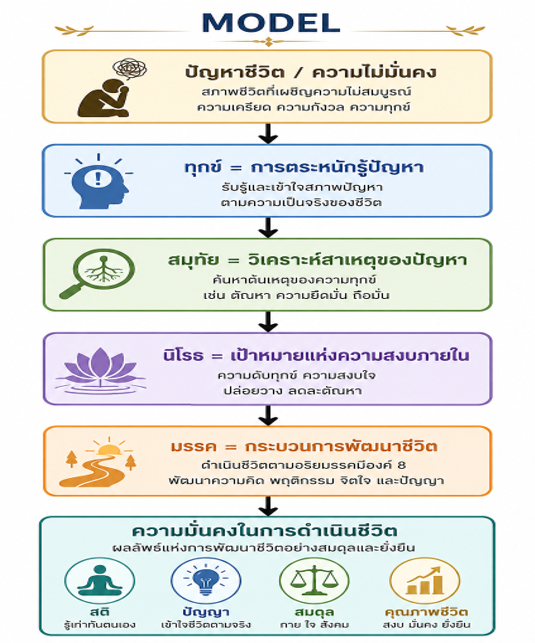
The research findings indicate that: The Four Noble Truths represent a complete life management system and a causal problem-solving cycle. Suffering (Dukkha) functions as a mechanism for recognizing the problems and imperfections of life; the origin of suffering (Samudaya) analyzes the root causes of problems arising from craving and attachment; the cessation of suffering (Nirodha) is a state of balance and inner peace through letting go; and the path to the cessation of suffering (Magga) is the guideline for practice through the Eightfold Noble Path to develop thoughts, behaviors, and mind. The relationship between the Four Noble Truths and life is found to play a role at the individual level, helping to accept reality, manage emotions, reduce stress, and create mental well-being. At the societal level, it promotes empathy, reduces conflict, and builds mutually beneficial relationships, which aligns with modern psychological concepts of mental resilience. An analysis of the Four Bases of Success (Iddhipada 4) in daily life reveals that strengthening life's stability according to the Four Noble Truths, which are interconnected, leads to lasting stability in four areas: mindfulness, understanding life's reality with wisdom, balance of body and mind, and a peaceful and stable quality of life. And we have a diagram illustrating a model for strengthening stability in life based on the Four Noble Truths.
Article Details

This work is licensed under a Creative Commons Attribution-NonCommercial-NoDerivatives 4.0 International License.
Copyright Notice
The content and information in the articles published in Journal of MCU Palisueksabuddhaghosa Review, are regarded as opinions and responsibilities of article author only. It definitely does not mean that the editor must agree or share any responsibility to the author.
Articles, information, content, figure etc. that have been published in the Journal of MCU Palisueksabuddhaghosa Review is considered as the copyright of the Journal. If any individual or organization will to bring any parts of article for promote or to do anything, must be licensed only in official form from the Journal of MCU Palisueksabuddhaghosa Review.
The content and information in the articles published in Journal of MCU Palisueksabuddhaghosa Review, are regarded as opinions and responsibilities of article author only. It definitely does not mean that the editor must agree or share any responsibility to the author.
Articles, information, content, figure etc. that have been published in the Journal of MCU Palisueksabuddhaghosa Review is considered as the copyright of the Journal. If any individual or organization will to bring any parts of article for promote or to do anything, must be licensed only in official form from the Journal of MCU Palisueksabuddhaghosa Review.
References
พระธรรมปิฎก (ป.อ. ปยุตฺโต), การพัฒนาที่ยั่งยืน, พิมพ์ครั้งที่ 6 (กรุงเทพมหานคร: มูลนิธิพุทธธรรม, 2546).
พระราชวรมุนี (ประยูร ธมฺมจิตฺโต), พุทธปรัชญา, พิมพ์ครั้งที่ 4 (กรุงเทพมหานคร: โรงพิมพ์มหาจุฬาลงกรณราชวิทยาลัย, 2557).
พระมหาสุทิตย์ อาภากโร, “พระพุทธศาสนากับการพัฒนาสังคมอย่างยั่งยืน,” วารสารสันติศึกษาปริทรรศน์ มจร ปีที่ 5 ฉบับที่ 2 (2560): 185-198.
พระมหาหรรษา ธมฺมหาโส, “การประยุกต์หลักอริยสัจ 4 เพื่อการพัฒนาชีวิตและสังคม,” วารสารพุทธศาสตร์ศึกษา ปีที่ 8 ฉบับที่ 1 (2560): 59-74.
กรมป้องกันและบรรเทาสาธารณภัย, รายงานสถานการณ์สาธารณภัยของประเทศไทย พ.ศ. 2567 (กรุงเทพมหานคร: กระทรวงมหาดไทย, 2567).
กรมอุตุนิยมวิทยา, รายงานสภาวะภูมิอากาศประเทศไทย พ.ศ. 2567 (กรุงเทพมหานคร: กระทรวงดิจิทัลเพื่อเศรษฐกิจและสังคม, 2567).
พระพรหมคุณาภรณ์ (ป.อ. ปยุตฺโต), พุทธธรรม ฉบับปรับขยาย (กรุงเทพมหานคร: ผลิธัมม์, 2559).
พระราชวรมุนี (ประยูร ธมฺมจิตฺโต), พุทธปรัชญา, พิมพ์ครั้งที่ 4 (กรุงเทพมหานคร: โรงพิมพ์มหาจุฬาลงกรณราชวิทยาลัย, 2557).
มหาจุฬาลงกรณราชวิทยาลัย. พระไตรปิฎกภาษาไทย ฉบับมหาจุฬาลงกรณราชวิทยาลัย. กรุงเทพมหานคร: โรงพิมพ์มหาจุฬาลงกรณราชวิทยาลัย. 2539.
องค์การอนามัยโลก, “ไข้หวัดใหญ่ตามฤดูกาล (Seasonal Influenza),” เข้าถึงเมื่อ 5 มิถุนายน 2569, จาก https://www.who.int/health-topics/influenza-seasonal.
