
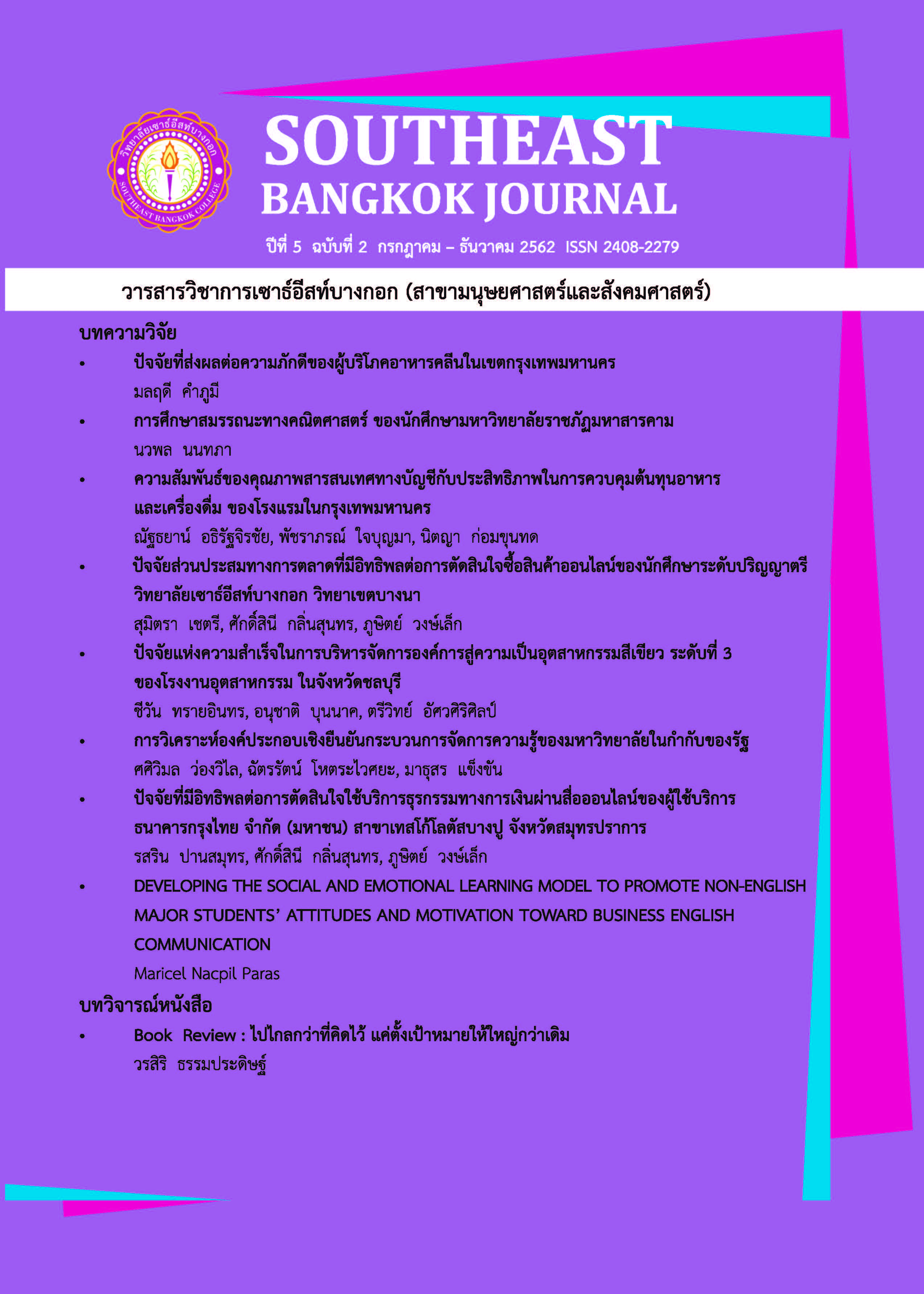
DEVELOPING THE SOCIAL AND EMOTIONAL LEARNING MODEL TO PROMOTE NON-ENGLISH MAJOR STUDENTS’ ATTITUDES AND MOTIVATION TOWARD BUSINESS ENGLISH COMMUNICATION
Article Sidebar
Main Article Content
บทคัดย่อ
งานวิจัยนี้นำเสนอการเรียนรู้ทางสังคมและอารมณ์ในบรรยากาศทางวิชาการเพื่อสร้างแรงบันดาลใจให้แก่นักศึกษาที่ไม่ได้เรียนภาษาอังกฤษเป็นวิชาเอกให้มุ่งเน้นว่าจะเรียนรู้ได้อย่างไรและจะเรียนรู้เพื่ออะไร ในการศึกษาครั้งนี้ ผู้วิจัยใช้กรณีศึกษาโดยมีกลุ่มตัวอย่างคือนักศึกษาชั้นปีที่ 1 จำนวน 20 คน ซึ่งมีภูมิหลัง ประสบการณ์ทำงาน และอายุที่แตกต่างกัน งานวิจัยนี้ต้องการศึกษาว่ากลยุทธ์สนับสนุนทางสังคมและอารมณ์สามารถเพิ่มพูนทัศนคติและแรงจูงใจของนักศึกษาทั้ง 20 คนในฐานะที่เป็นผู้เรียนที่พึ่งพากันและผู้เรียนที่อ่อนไหวได้หรือไม่ วัตถุประสงค์ของการวิจัยคือ (1) เพื่อนำเสนอการสนับสนุนการเรียนรู้ทางสังคมและอารมณ์ให้แก่นักศึกษาในบรรยากาศทางวิชาการ และ (2) เพื่อพัฒนาทัศนคติเชิงบวกของนักศึกษาที่ไม่ได้เรียนภาษาอังกฤษเป็นวิชาเอกผู้ซึ่งเรียนวิชาภาษาอังกฤษเพื่อการสื่อสารธุรกิจเพื่อให้อาจารย์ปรับรูปแบบการสอนให้เหมาะสมต่อการเรียนในชั้นเรียนขนาดเล็ก ผู้วิจัยได้สำรวจปัญหาของผู้เรียนทั้งปัญหาการสื่อสารแบบปากเปล่าและปัญหาการสื่อสารแบบเขียนโดยใช้กลยุทธ์ในการสื่อสารประกอบด้วย การควบคุมภาษา การตรวจสอบและการยืนยัน และการสะท้อนและการปฏิบัติซ้ำ จากการวิจัย ผู้วิจัยได้ค้นพบว่านักศึกษามีความพึงพอใจต่อการเรียนในชั้นเรียนขนาดเล็กและมีอารมณ์เชิงบวกซึ่งเพิ่มพูนกระบวนการเรียนรู้ทางภาษาของพวกเขา และการนำการเรียนรู้ทางสังคมและอารมณ์มาดำเนินการในชั้นเรียนเป็นทักษะการเรียนรู้และการใช้ชีวิตที่มีประสิทธิผลในศตวรรษที่ 21
Article Details
เอกสารอ้างอิง
Nunan, D. (1990). Collaborative language learning and teaching. New York, USA: University of Cambridge.
Richards, J. (1999). Teacher learning in second language teacher. Cambridge: Cambridge University Press.
Samovar, L., & Porter, R. (2001). Communication between cultures (4th ed.). Belmount, CA: Thomson Higher Education.
Sapir, R. (2012). Introduction to sociology (2nd ed.). California, USA: University of California.
Schaefer, R. (2013). Sociology: A brief introduction (10th ed.). New York, USA: The McGraw-Hill Companies, Inc.
Swoyer, C. (2003). The linguistic relativity hypothesis. In E. N. Zalta (Ed.), The Stanford encyclopedia of philosophy. Retrieved May 5, 2018, from http://plato.stanford.edu/archives/win2003/entries/relativism/supplement2.html
Weisberg, R. (2016). Why social and emotional learning is essential for students. Edutopia. George Lucas Educational Foundation.
