
Developing Teachers’ Capacity in Using Artificial Intelligence for Learning Design for Disadvantaged Students : A Case Study of Wat Pa Daet School, Chiang Mai
Article Sidebar
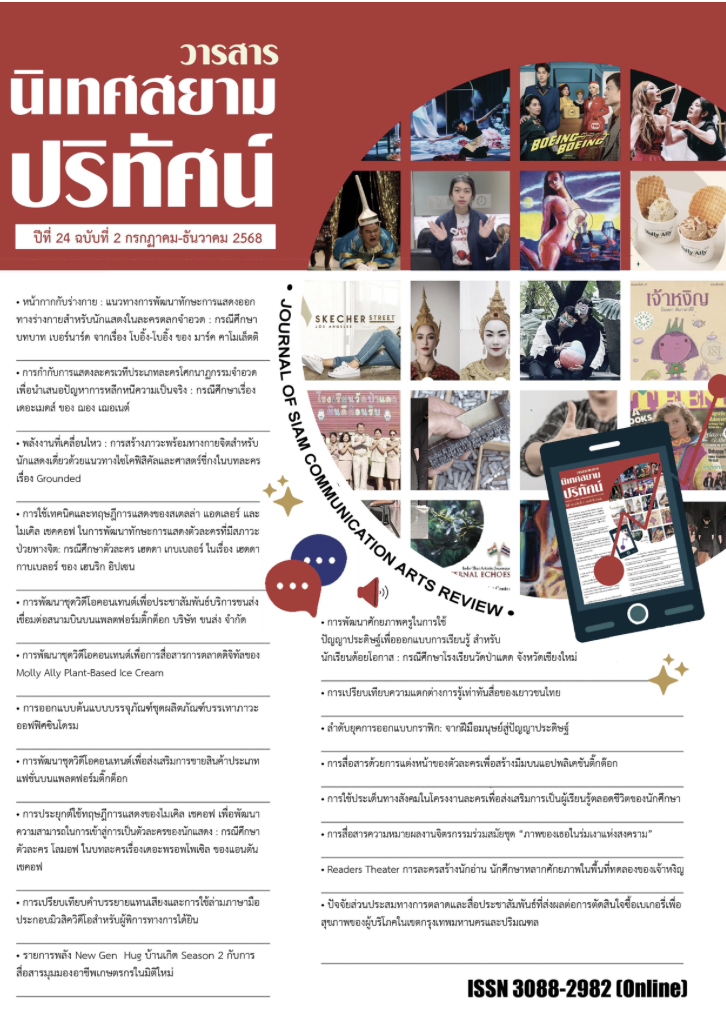
Main Article Content
Abstract
This research investigates the communication for the development process that enhances teachers' capacity to utilize artificial intelligence (AI) in designing learning for underprivileged students at Wat Pa Daet School, Chiang Mai. The objectives are: 1) to explore the participatory training process that emphasizes communication for development; 2) to analyze teachers’ capacity in applying AI with Project-Based Learning to foster 21st century skills and media literacy; and 3) to propose a systemic approach to strengthening teachers' roles as transformational leaders. This study employed a qualitative case study combined with developmental research. The target group consisted of 15 teachers. Data were collected through observation, AI-generated learning materials, and individual reflection forms. The findings reveal that the training process grounded in communication for development enabled teachers to use AI as a meaningful tool to design learning that fits the diverse needs of their students. Teachers were able to apply AI to enhance critical thinking, communication, collaboration, and media literacy. Moreover, there was a notable shift in teachers’ roles toward becoming learning designers and transformational leaders in their classrooms. This study proposes the CARED-AI Framework, a communication model for advancing digital educational equity in under-resourced urban schools.
Article Details

This work is licensed under a Creative Commons Attribution-NonCommercial-NoDerivatives 4.0 International License.
References
กนกวรรณ ว่องไว. (2565). การพัฒนาทักษะครูในศตวรรษที่ 21 ด้วยการจัดการเรียนรู้แบบใช้ปัญหาเป็นฐาน. กรุงเทพฯ: สถาบันพัฒนาครู.
กาญจนา แก้วเทพ. (2543). แนวคิดทฤษฎีว่าด้วยการสื่อสาร. กรุงเทพฯ: เอดิสัน เพรส โปรดักชั่น.
ชัยวัฒน์ สุทธิรัตน์. (2562). ผู้นำการเปลี่ยนแปลงทางการศึกษา. กรุงเทพฯ: สำนักพิมพ์แห่งจุฬาลงกรณ์มหาวิทยาลัย.
ชุติมา สัจจานันท์. (2556). การรู้เท่าทันสื่อ: เครื่องมือสร้างภูมิคุ้มกันทางปัญญาในสังคมประชาธิปไตย. กรุงเทพฯ: สำนักพิมพ์แห่งจุฬาลงกรณ์มหาวิทยาลัย.
พิภพ อุดร. (2564). ปัญญาประดิษฐ์กับความเป็นครูในศตวรรษที่ 21. กรุงเทพฯ: สถาบันเทคโนโลยีพระจอมเกล้าเจ้าคุณทหารลาดกระบัง.
ไพฑูรย์ สินลารัตน์. (2545). ปรัชญาการศึกษา: แนวคิดและทฤษฎีการเรียนรู้เพื่อพัฒนาคน. กรุงเทพฯ: สำนักพิมพ์แห่งจุฬาลงกรณ์มหาวิทยาลัย.
สำนักงานเลขาธิการสภาการศึกษา. (2561). แผนการศึกษาแห่งชาติ พ.ศ. 2560–2579. กรุงเทพฯ: กระทรวงศึกษาธิการ.
โรงเรียนวัดป่าแดด. (2566). รายงานข้อมูลพื้นฐานของสถานศึกษาเพื่อสนับสนุนการวิจัย. โรงเรียนวัดป่าแดด.
Melkote, S. R. (2001). Communication for development in the Third World: Theory
and practice for empowerment (2nd ed.). SAGE Publications.
Rowlands, J. (1997). Questioning empowerment: Working with women in Honduras.Oxfam.
Servaes, J. (2008). Communication for development and social change. SAGE Publications.
Trilling, B., & Fadel, C. (2009). 21st century skills: Learning for life in our times. Jossey-Bass.
Tufte, T., & Mefalopulos, P. (2009). Participatory communication: A practical guide. World Bank Publications.
UNESCO. (2021). Reimagining our futures together: A new social contract for education. UNESCO Publishing.
