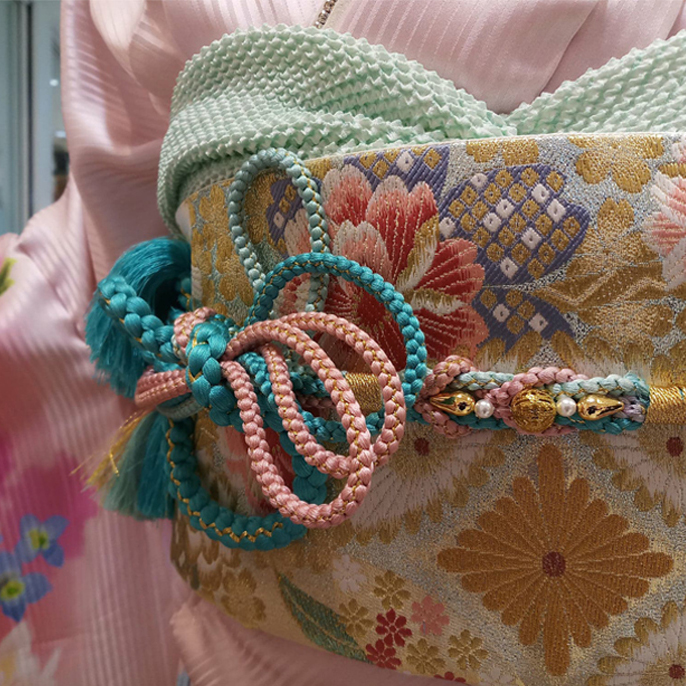
Kumihimo: The Communication through Cords and the Revitalization of Japanese Craftmanship in a Modern Society
Kumihimo: The Communication through Cords and the Revitalization of Japanese Craftmanship in a Modern Society
Keywords:
Kumihimo, New Meaning , Braid, Japanese HandcraftAbstract
This article aims to study the concept of using string in Japanese culture through Kumihimo, a traditional Japanese artform of making braids and cords that passes the beliefs in Shinto gods. The study also includes the process and evolution of Kumihimo arts during different generations. In a modern society where people highly rely on machine and technology, the meaning of Kumihimo arts was devalued to normal cords. However, Japanese society later has evoked nostalgia. People are sentimentally longing for the past, returning to nature and traditional beliefs. Kumihimo again is considered as a valuable arts and crafts in a modern social context. The image and meaning of the arts have changed as well as the application of the cords. It has become a new kind of beauty but still relates to nature, former respect and beliefs. Accordingly, it follows Musubi concept which refers to creation, connection, and relationship. This is an endless loop of disappearance and reconnection.
Keywords: Kumihimo/ new meaning/ braid/ Japanese handcraft
References
กำจร สุนพงษ์ศรี. (2551). ประวัติศาสตร์ศิลปะญี่ปุ่น. สำนักพิมพ์แห่งจุฬาลงกรณ์มหาวิทยาลัย.
จาร์เวส, เจ.เจ. (2545). ชำเลืองแลศิลปะญี่ปุ่น (กิติมา อมรทัต, ผู้แปล). กรมวิชาการ.
ปัญญา เทพสิงห์. (2548). ศิลปะเอเชีย. สำนักพิมพ์แห่งจุฬาลงกรณ์มหาวิทยาลัย.
คณะศิลปศาสตร์ มหาวิทยาลัยธรรมศาสตร์. (2522). โคจิกิตำนานเก่าแก่ที่สุดของญี่ปุ่น. เจริญผล.
อรรถยา สุวรรณระดา. (2553). เรียนรู้ตำนานเทพญี่ปุ่นจากวรรณกรรมโคะจิกิ. สำนักพิมพ์แห่งจุฬาลงกรณ์มหาวิทยาลัย.
Akibatan. (2016). มุซุบินั้นสำคัญไฉน มารู้จักศิลปะการทอเส้นไหมจากเรื่อง Your Name กันเถอะ. http://akibatan.com/2016/11/talk-about-kumihimo-japanese-braiding-from-kimi-no-na-wa/
Domyo. (2018). 組紐の歴史. http://domyo.co.jp/history/
Hidaka, K. (2003). 日本美術のことば案内. Tokyo: 株式会社小学館
Japan Traditional Crafts Aoyama Square. (2018). TRADITIONAL CRAFTS. http://kougeihin.jp.e.oo.hp.transer.com/item/0304/
Kinoko, H. (2022). Rope Artist Hajime Kinoko. http://shibari.jp/index.html
Konuma, O. and Futagawa, T. (2017).「君の名は。」で注文殺到 映画と同じ「組紐」欲しい. https://style.nikkei.com/article/DGXMZO12352000R30C17A1000000
Kumi, O. (2017). สนุกไปกับโชว์นินจาสุดมันส์ที่พิพิธภัณฑ์นินจาอิกะริว (โรส รสริน, ผู้แปล). https://matcha-jp.com/th/4177
Miharu. (2012). Shimenawa. https://www.marumura.com/shimenawa/
Nagaura, C. (2016). 手軽につくれる水引アレンジ Book2. Tokyo: Isuzuya.
Raskin-Schmitz, J. (1992). Japanese Kumihimo, the Art of Silk Braiding. http://www.englisch.kumihimo.de/html/history.html
Seiko, F. (1965). 図解捕縄術 /Zukai torinawajutsu. Tokyo: 井上図書株式会社
Uchino, T. (2016). しあわせを結ぶ 贈る、飾る、水引こもの. Tokyo: 文化出版局
Uozumi T., Yasuda S., Chottikampon K., Mathurosemontri S., Goto A., Hamada H. (2016). Study on Braiding Skills by Comparing Between Expert and Non-experts with Eye’s Movement Measurement. In Duffy V. (Ed), Digital Human Modeling: Applications in Health, Safety, Ergonomics and Risk Management. DHM 2016. Lecture Notes in Computer Science, vol 9745. (pp. 132-139). Canada: Springer.
Walkerplus. (2018).【京都らしい体験】伝統工芸を体験してみました。京都組紐. https://www.walkerplus.com/article/103055/
Yamada, H. (2017). 伝統工芸ってなに?. Tokyo: 美術書出版株式会社芸艸堂