The Use of Slip Nerikomi Technique to Create Landscape Art on Jingdezhen’s Blue-and-White Porcelain
Keywords:
Nerikomi, Jingdezhen, blue-and-white landscape, Nerikomi blue-and-white landscapeAbstract
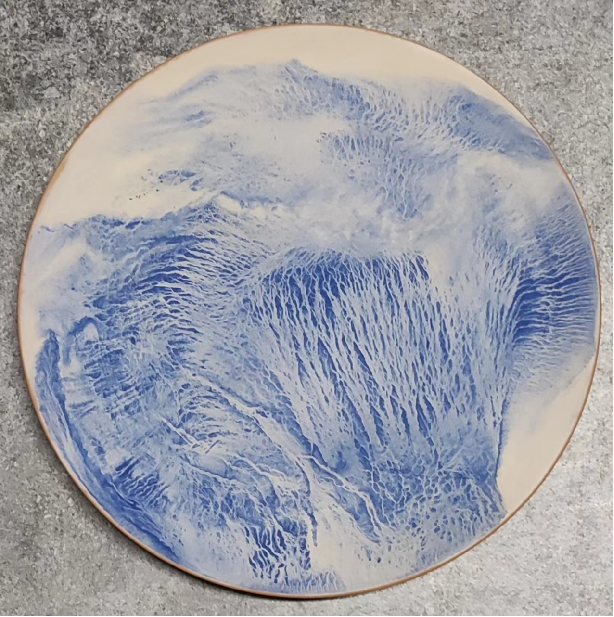
This comparative and experimental study investigated the innovative techniques and artistic results of Jingdezhen porcelain with mountain, river, and tree motifs. The researcher developed This new technique called Slip Nerikomi (Squeeze method with concentrated clay water: Slip). Then, incline the piece of equipment so that the concentrated soil water flows in the desired direction. To achieve a more natural appearance, spraying water on the piece of work is necessary. Patterns were created using Nerikomi (twisted clay) and traditional techniques by studying the works of porcelain masters who patterned the Jingdezhen landscape. Therefore, the researcher gathered data, classified the works, and compared them based on their landscape patterns. The researchers can develop a novel landscape painting technique using the collected data. Studies have demonstrated that the Slip Nerikomi technique can create landscape patterns comparable to traditional direct porcelain painting. Cobalt oxide blue pigments were combined with clay to create a porcelain painting medium. Then, this substance was utilized to create art on porcelain. Using the method of swirling with the flow, the Slip Nerikomi technique not only displays the scenery's character well but also allows for the display of other visual effects, such as thick or thin areas and light or dark areas. This new technique can be used to create porcelain landscape patterns. It also contributes to enhancing the workpiece with artistic qualities such as naturalness and flexibility, thereby creating aesthetic value. In addition, it can serve as a guide for future porcelain artists
References
Duan Suping (2020), “Humanistic Painting Concept and Artistic Aesthetics of Jingdezhen blue-and-white Landscape Painting’, Ceramics Research, p.113.
Dyrssen, C. (2011) Navigating in Heterogeneity. In M. Biggs & H. Karlsson. The
Routledge Companion of Research in the Arts. Routledge. Dyrssen, C. (2011) Navigating in Heterogeneity. In M. Biggs & H. Karlsson.
Feng Xianming (1994), ‘Chinese Ceramicst’, Shanghai Ancient Books Publishing Press, p. 452.
Guest, L. (2019). “Drifters” in Jingdezhen: Past meets present in the porcelain capital. p. 55.
Liang Caiyan (2021). The utility model relates to a method for preparing stranded embryo porcelain by stranded mud process, National Knowledge Bureau,www.xjishu.com/zhuanli/25/CN105272166.html. They were accessed on 26 July 2022.
Loussier, H. J. R. d. l. c. e. d. v. (2019). Le nerikomi hypnotique de Mandy Cheng.
(226), 42-43. Xiaomin, L. J. C. A. i. C. T. o. S. C. (2008). Jingdezhen–Porcelain Capital of the World. p. 67.
Solberg, A. J. F. (2021). Artistic Expression and Material Limitations: An Iterative Process of Porcelain Making. 14(2).
The Routledge Companion of Research in the Arts (pp. 223-239). Routledge. http://clab.iat.sfu.ca/804/uploads/Main/RoutledgeCompanion.pdf.
Yang Jingya (2020). The rhythm of points -- the application of point elements in ceramic decoration, Jingdezhen: the Jingdezhen University of Ceramics, pp. 17–21.
Yang Xia and Chai Zhanzhu (2012). Chinese Nerikomi porcelain, Henan Fine Arts Publishing Press.
Yang Zhiyue (2020). Study on Lu Weisun’s Freehand Brushwork of Celadon Landscape Theme Works, Hang zhou China Academy of Art, pp. 6–15.
Zhu, F., & Shao, J. (2012). Protection and symbolization innovation of manufacturing process of Blue-and-white porcelain. Paper presented at the Applied Mechanics and Materials. p. 430.
Zhang Pusheng (1999), ‘Identification of blue-and-white porcelain’, Beijing Library Press, p. 1.
Zhang Yongjun (2015),‘On the Inheritance and Innovation of blue-and-white Landscapes’, Ceramics Research, p.120.