The Influence of Leadership Styles and Work Motivation on Organizational Citizenship Behavior Among Personnel in the Private Health Care Business Sector
Article Sidebar
Main Article Content
Abstract
DOI : 10.14456/pnuhuso.2025.19
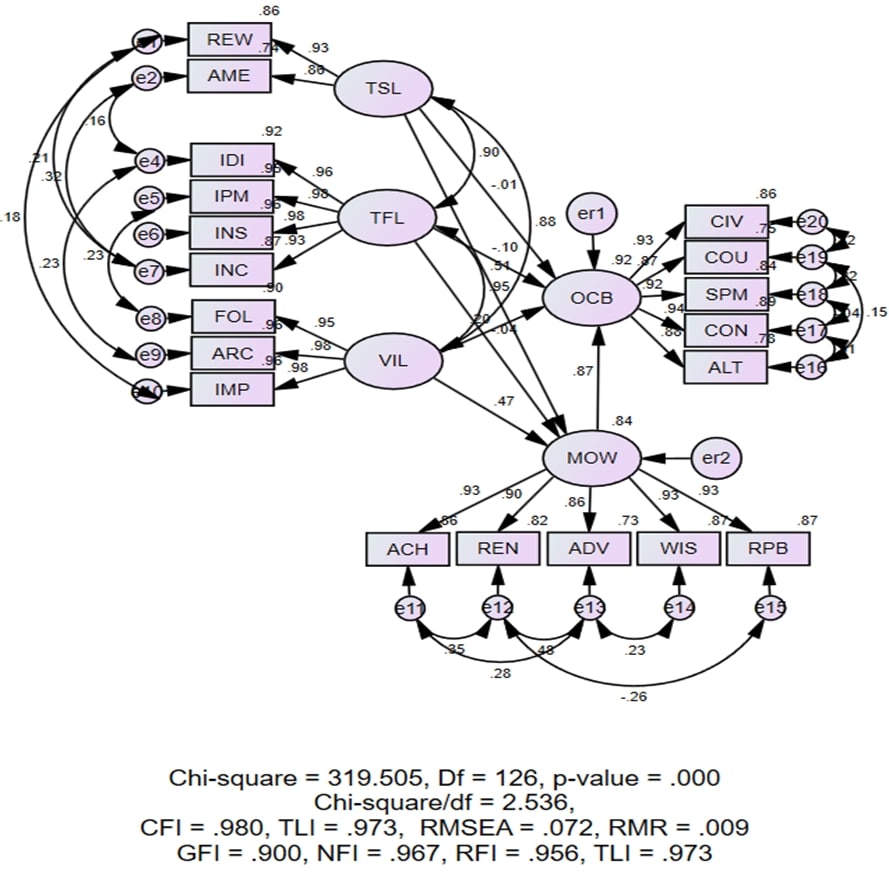
This research aims to: (1) study the level of opinions regarding transactional leadership (TSL), transformational leadership (TFL), visionary leadership (VL), motivation of work, and organizational citizenship behavior (OCB) among personnel in the private healthcare business sector; and (2) examine the influence of TSL, TFL, VL, and work motivation on OCB among such personnel. The sample group consisted of 300 staff members from a private hospital. The research instrument was a questionnaire with reliability coefficients ranging from .956-.992. Data analysis was conducted using frequency, percentage, mean, standard deviation. The study also utilised path analysis examine direct, indirect, and total effects using AMOS for Student software.
The findings revealed that: (1) the overall level of opinions among personnel in the private healthcare business sector was high, with the two highest-rated aspects being organisational citizenship behaviour and visionary leadership. The aspects of transformational leadership, work motivation, and transactional leadership also showed high average scores; and (2) work motivation , visionary leadership, and transactional leadership had a total influence on organisational citizenship behaviour, respectively. In contrast, transformational leadership showed no significant influence on organisational citizenship behaviour. Moreover, work motivation functioned as a mediating variable between both visionary leadership and transactional leadership in influencing organisational citizenship behaviour. The model fit indices were: Chi-square = 319.505, df = 126, p-value = 0.000, CFI = 0.980, GFI = 0.900, RMR = 0.009, RMSEA = 0.072, TLI = 0.973, NFI = 0.967, RFI = 0.956.
Article Details

This work is licensed under a Creative Commons Attribution-NonCommercial-NoDerivatives 4.0 International License.
References
กระทรวงสาธารณสุข, กรมสนับสนุนบริการสุขภาพ. (2566). ข้อมูล ความรู้ บทวิเคราะห์เกี่ยวกับอุตสาหกรรมการแพทย์ของประเทศไทย. กรมสนับสนุนบริการสุขภาพ กระทรวงสาธารณสุข.
เกรียงศักดิ์ แสงสว่าง และอภิรัตน์ โกสุมา. (2566). ภาวะผู้นำและวัฒนธรรมองค์การที่มีอิทธิพลต่อแรงจูงใจในการปฏิบัติงานของบุคลากรองค์การบริหารส่วนจังหวัดปทุมธานี. วารสารวิชาการวิทยาลัยสันตพล, 9(1), 9-17.
จอมพงศ์ มงคลวนิช. (2555). การบริหารองค์การและบุคลากรทางการศึกษา. ทวีพริ้นท์.
ธรรมรัตน์ จังศิริวัฒนา. (2563). ภาวะผู้นำเพื่อการเปลี่ยนแปลงและภาวะผู้นำแบบแลกเปลี่ยน: กรอบแนวความคิดของความสัมพันธ์กับผลการดำเนินงานขององค์การ. วารสารเกษมบัณฑิต, 21(2),181-191.
นิติพล ภูตะโชติ. (2566). พฤติกรรมองค์การ (ครั้งที่ 6). สำนักพิมพ์จุฬาลงกรณ์มหาวิทยาลัย.
บุญใจ ศรีสถิตย์นรากูร. (2550). ระเบียบวิธีการวิจัยทางพยาบาลศาสตร์ (พิมพ์ครั้งที่ 4). โรงพิมพ์แห่งจุฬาลงกรณ์มหาวิทยาลัย.
ปภัสณุ ปานพรม, วรกฤต เถื่อนช้าง และทนง ทศไกร. (2566). รูปแบบการพัฒนาภาวะผู้นำเชิงวิสัยทัศน์ของผู้บริหารศูนย์ฝึกอบรมตำรวจตามหลักทุติยปาปณิกสูตร. วารสารวิจัยวิชาการ, 6(6), 255-266.
มัทนิน พฤติธนาภัทร, ชมสุภัค ครุฑกะ และดวงเดือน จันทร์เจริญ. (2565). โปรแกรมฝึกอบรมออนไลน์เพื่อเสริมสร้างสมรรถนะทางการบริหารของผู้บริหารการพยาบาลระดับต้นธุรกิจดูแลสุขภาพภาคเอกชน. วารสารบัณฑิตวิทยาลัย มหาวิทยาลัยรามคำแหง ฉบับเทคโนโลยีการศึกษา, 6(1), 15-25.
รัตติกรณ์ จงวิศาล. (2567). ภาวะผู้นำ: ทฤษฎี การวิจัย และแนวทางสู่การพัฒนา (พิมพ์ครั้งที่ 6). เอเชียดิจิตอลการพิมพ์.
ราชกิจจานุเบกษา. (2561). ยุทธศาสตร์ชาติ (พ.ศ. 2561 - 2580). เล่ม 135 ตอนที่ 82 ก. ลงวันที่ 13 ตุลาคม 2561, หน้า 1-71.
ละเอียด จงกลนี, อินตอง ชัยประโคม, พระฮอนดา เข็มมา, เกรียงไกร ปัญญาประเสริฐกุล, และครรชิต ชัยกิจ. (2562). การบริหารการศึกษาสู่ความสำเร็จ: หลากหลายมิติของภาวะผู้นา 4.0. วารสารบัณฑิตศึกษามหาจุฬาขอนแก่น, 6(4), 61-70.
สกล อยู่วิทยา, สุภัททา ปิณฑะแพทย์, ทวีศักดิ์รูปสิงห์, และธนาธิป ศุภประดิษฐ์. (2564). การพัฒนารูปแบบบริการให้บริการสุขภาพของโรงพยาบาลเอกชน ในประเทศไทย. วารสารวิชาการครุศาสตร์ อุตสาหกรรม พระจอมเกล้าพระนครเหนือ, 12(3), 75-84
สิงห์คำ ยอดปานันท์. (2562). ภาวะผู้นำเชิงวิสัยทัศน์ของผู้บริหารสถานศึกษาที่ส่งผลต่อการบริหาร การเปลี่ยนแปลงในสถานศึกษาสังกัด สำนักงานเขตพื้นที่การศึกษามัธยมศึกษา เขต 38. [วิทยานิพนธ์ปริญญามหาบัณฑิต]. มหาวิทยาลัยสุโขทัยธรรมาธิราช.
สุดาวดี เตบุญมี. (2566). ความสัมพันธ์ระหว่างผู้นำการเปลี่ยนแปลงกับประสิทธิผลในการบริหารองค์กร. วารสารเครือข่ายส่งเสริมการวิจัยทางมนุษยศาสตร์และสังคมศาสตร์, 6(2), 98-113.
สุพจน์ ประไพเพชร, สราวุฒิ กุลแดง, ราตรี เลิศหว้าทอง, และสุดสวาสดิ์ ประไพเพช. (2566). ภาวะผู้นำ: แนวคิด ทฤษฎี และองค์ประกอบ. วารสารครุศาสตร์ปัญญา, 2(1), 59-73.
สุรศักดิ์ อมรรัตนศักดิ์, บุญมี พันธุ์ไทย และสมจิตรา เรืองศรี. (2559). ระเบียบวิธีวิจัยทางการศึกษา (พิมพ์ครั้งที่ 3). สำนักพิมพ์ศูนย์ส่งเสริมวิชาการ.
Aga, D.A. (2016). Tansactional leadership and project success: the moderating role of goal clarity. Procedia Computer Science, 100, 517 – 525.
Almaqableha, A., & Omarb, K. (2024). Nexus of leadership style organizational climate, motivation and organizational citizenship behavior in Jordanian telecommunications. Revista de Gesto Social e Ambiental, 18(5), 1-18.
Alshmemri, M., Shahwan-Akl, L., & Maude, P. (2017). Herzberg’s Two-Factor Theory. Life Science Journal, 14(5), 12-16.
Bass, B.M., & Riggio, R.E. (2006). Transformational Leadership (2nd ed.). Lawrence Erlbaum Associates, Inc.
Basalamah, M.S.A., & Ajmal, A. (2021). The role of work motivation and work environment in improving job satisfaction. Golden Ratio of Human Resource Management, 1(2), 94-103.
Cronbach, L. J. (1970). Essentials of psychological testing (3rd ed.). Harper & Row.
Engelbert, L. H., Elk, M. V., Kandrik, M., Theeuwes, J., & Vugt, M. V. (2023). The effect of charismatic leaders on followers’ memory, error detection, persuasion and prosocial behavior: A cognitive science approach. The Leadership Quarterly, 34(3), 101656.
Hair, J. F., Black, W. C., Babin, B. J., & Anderson, R. E. (2010). Multivariate data analysis (7th ed.). Pearson.
Herzberg, F., Mausner, B., & Syndeman, B. B. (1959). The motivation to work (2nd ed). John Wiley and Sons.
Kokt, D., & Seqhobane, M. (2024). The impact of remote and hybrid work and psychological wellbeing on organizational citizenship behavior: The moderating effect of psychological capital. Acta Commercii, 24(1), 11-11.
Lavelle, J. J., Rupp, D. E., & Brockner, J. (2007). Taking a multifoci approach to the study of justice, social exchange, and citizenship behavior: The target similarity model. Journal of Management, 33(6), 841-866.
Lee, H. W. (2020). Motivational effect of performance management: does leadership matter?. Transylvanian Review of Administrative Sciences, 16(59), 59-76.
Luo, Y. J., Li, Y. P., Choi, J. N., & Du, J. (2020). Visionary leadership effectiveness: Moderating roles of power distance and middle-way thinking. Social Behavior and Personality, 48(12), 1-12.
Mondy, R.W., & Mondy, J. B. (2014). Human resource management (13th ed.). Prentice Hall.
Nikookar, H., Ahi, P., & Akbari, M. (2021). The impact of vision leadership on organizational effectiveness: The mediating role of organizational citizenship behavior. The Journal of Productivity Management, 15(2), 57-70.
Nurtjahjani, F., Alotaibi, H. S., Batubulan, K. S., & Puspita, A. F. (2023). Does transformational and transactional leadership in Indonesia’s construction sector affect organizational citizenship behavior through job satisfaction?. Problems and Perspectives in Management, 21(4), 639-649.
Ojala, A. (2013). Leadership styles and traits in the public sector: Study in Vaasa Central Hospital. Business Economics and Tourism, Vaasa University of Applied Sciences.
Rosadi, I., Setyaningsih, S., & Suhardi, E. (2024). The influence of visionary leadership, organizational culture, self-efficacy, and work motivation on teacher creativity. Journal of Shenyang Jianzhu University (Naturel Science), 40(1), 30-55.
Sitohang, M. (2022). The influence of leadership styles, entrepreneurship trait, and work motivation of civil servants against organizational citizenship behavior. Quality Access to Success, 23(189), 74-88.
Tambe, S., & Shanker, M. (2014). A study of organizational citizenship behaviour (OCB) and its dimensions: A literature review. International Research Journal of Business and Management, 1(1), 67-73.
Ubaidillah, M., Christiana, R., & Sahrandi, A. (2019). The visionary leadership strategy in advancing educational institutions. Journal of Educational Innovation, 6(2), 206-215.
Udin, U., Dharma, R.D., Dananjoyo, R., & Shaikh, M. (2023). The role of transformational leadership on employee performance through organizational learning culture and intrinsic work motivation. International Journal of Sustainable Development and Planning, 18(1), 237-246.
Westley, F., & Mintzberg, H. (1989). Visionary leadership and strategic management. Strategic Management Journal, 10, 17-32.
Widarko, A., & Brotosuharto, M. K. A. (2022). Work motivation and organizational culture on work performance: Organizational citizenship behavior (OCB) as mediating variable. Human Resource Management, 2(2), 1-16.
Widodo, W., & Yusuf, F. A. (2021). The effect of organizational citizenship and visionary leadership on contextual performance: A case study in Indonesia. Journal of Asian Finance, Economics and Business, 8(6), 377-386.
