A Study of the Paradigm of Aisha (Radhiyallahu anha) in Juristic Rulings on Islamic Worship: The Case of Kissing One's Wife While in a State of Wudu
Article Sidebar
Main Article Content
Abstract
DOI : 10.14456/pnuhuso.2025.27
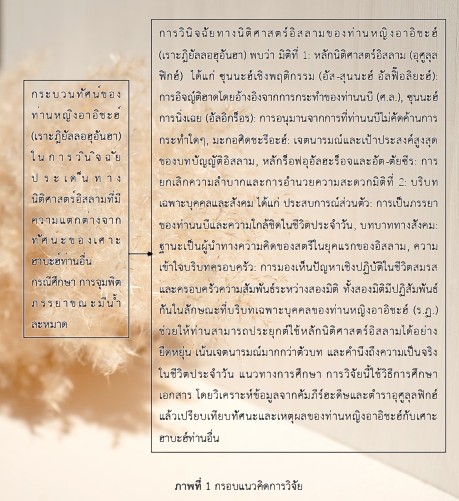
The objectives of this research were to study the ijtihad paradigm of Lady Aisha (Radiyallahu Anha) in adjudicating Islamic jurisprudence issues concerning ibadah that differ from the views of other Companions, using the case study of kissing one's wife while in a state of ritual purity (wudu). This is documentary research that collects data from primary sources including hadith and early usul al-fiqh texts, and secondary sources including contemporary academic works, and then analyzes them in-depth through selected case studies based on criteria including clear differences of opinion from other Companions, creative ijtihad, reflection of usul al-fiqh principles, and connection with maqasid al-shariah and social context. The research findings reveal that Lady Aisha's paradigm emphasizes the reference to behavioral sunnah (al-fi'liyyah) and tacit approval sunnah (al-iqrariyyah) of Prophet Muhammad as key evidence for legal inference. In the case of kissing one's wife without nullifying wudu, Lady Aisha’s view differs from the literal interpretation of some Companions. Furthermore, Lady Aisha's approach is characterized by flexibility according to maqasid al-shariah principles, adhering to the principles of raf' al-haraj (removal of hardship) and al-taysir (facilitation) that align with real-life contexts, particularly regarding the role of women and family.
Article Details

This work is licensed under a Creative Commons Attribution-NonCommercial-NoDerivatives 4.0 International License.
References
Abu Dawud, S. B. A. (1950). Sunan Abi Dawud. Al-Maktabah al-'Asriyyah.
Abu Zahrah, M. (1997). Usul al-Fiqh. Dar al-Fikr al-'Arabi.
Ahmad, H. (2001). Musnad Imam Ahmad bin Hanbal. Mu'assasah al-Risalah.
al-Dhahabi, S. M. (1985). Siyar A'lam al-Nubala'. Maktabah Al-Resala.
al-Hakim, N. (1990). Al-Mustadrak 'ala al-Sahihayn. Dar al-Kutub al-'Ilmiyyah.
al-Nasaiy, A. S. (1930). Sunan al-Nasaiy. Al-Maktabah al-Tijariyah al-Kubra.
al-Qaradawi, Y. (1999). Al-fiqh al-Islami bayna al-salan wa al-tajdid. Maktabah Wahbah.
al-Qasim, M. (1973). Musannaf 'Abd al-Razzaq. Al-Maktab al-Islami.
al-Sibai, A. M. (1999). Al-mar'ah bayna al-fiqh wa al-qanun. Dar al-Wraq.
al-Suyuti, J. A. (1983). Tabaqat al-huffaz. Dar al-Kutub al-'Ilmiyyah.
al-Tirmiziy, M. I. (1975). Sunan Tirmiziy. Dar al-Qar Islamiy.
Ibn Abi Shaibah, A. M. (1997). Musnad Ibn Abi Shaibah. Dar al-Watan.
Ibn al-Qayyim, S. M. (1991). I'lam al-Muwaqqi'in 'an Rabb al-'Alamin. Dar al-Kutub al-'Ilmiyyah.
Ibn Hajar al-Asqalaniy, A. M. (1969). Fath al-Bari sharh Sahih al-Bukhari. Maktabah al-Salafiyyah.
Ibn Hazm, A. A. (1900). Maratib al-Ijma'. Matba'at al-Ma'arif.
Masoud, S. (2018). Manhaj Umm al-Mu'minin 'A'isha fi 'Ulum al-Shari'ah. Dar al-Bashir.
